


Coffee Adulterants And Their Detection
Description
This section is from the book "Tea, Coffee, And Cocoa Preparations", by Guilford Lawson Spencer . Also available from Amazon: Tea, coffee, and cocoa preparations.
Coffee Adulterants And Their Detection
Facing or coloring. - It is not an uncommon practice to treat inferior or damaged coffees by some process for the improvement of their appearance and in imitation of superior grades. Java seems to have been especially subject to this treatment, or rather other coffees are colored in imitation of Java. E.Waller states ' that South American coffees are often exposed to a high, moist heat, which changes their color from green to brown, thus forming imitation Java. Waller also mentions the use of pigments in coloring coffees. This chemist found one twenty-fourth grain of Scheele's green per one-half ounce of coffee. He also reports the use in the Brooklyn mills of yellow ocher, silesian blue, chrome yellow, burnt umber, Venetian red, drop black, charcoal, and French black. Coffee is polished by rotation in cylinders with soap-stone.
The following2 is another method of preparing imitation Javas. Raw coffee, which has been damaged by sea water, is washed, decolorized with lime water, again washed, rapidly dried, and colored by a slight roasting or by means of azo-orange. By this method Santos coffees are converted into imitation Javas. The weight lost is regained by steaming, and then coating the beans with glycerine, palm oil, or vaseline to prevent evaporation.
Coffees are sometimes faced with Prussian blue or indigo, lead chro-mate, etc. The following list of facing mixtures is from the published investigations of K. Sykora.3
(1) Mixture of indigo, lead chromate, coal, and clay.
(2) (Approximately) 5 parts indigo, 10 parts coal, 4.5 parts lead chromate, 05.5 parts clay, and 15 parts ultramarine.
(3) (Approximately) 5 parts indigo with some yellow dye, 3 parts coal, 8 parts lead chromate, 82 parts clay, 2 parts ultramarine.
(4) (Approximately) 12 parts indigo and some yellow dye, 5.5 parts coal, 4.5 parts lead chromate, 6.6 parts clay, and 12 parts ultramarine.
A mixture examined by G. C. Wittstein4 was composed of 15 parts Prussian blue (or indigo), 35 parts lead chromate, 35 parts clay and gypsum, and 15 parts water. According to Nanning, coffee beans are colored blue by shaking with finely powered iron.
1 Analyst, 9, 128.
2 Bull, de la Soc. Chim. de Paris, 47, 7; Chem. News, 56, 24.
3 Chem. Centrbl., 1887, No. 47; Rep. f. anal. Chem., 1887, 765.
4 Chem. News, 33, 194.
Indigo and Prussian blue maybe detected by the microscope or chemically (see page 881 for methods). Lead chromate should be examined for in the ash by the usual qualitative methods for the de tection of lead and chromium. The ash should also be examined for copper, and in the case of moist preparations of coffee preserved in tin cans, both tin and copper should be searched for. Azo-colors are detected as follows:
Azo-colors are detected by treating the beans with strong alcohol, evaporating the solution to dryness, and treating the residue with water. This solution will give the characteristic reactions of these dyes.
It is preferable, when possible, to detach the facing by shaking the coffee with cold water. The sediment may be examined chemically or microscopically. Lead, tin, copper, and arsenic are the only objection able metals liable to be present in coffee or its preparations. The ash should be examined for these metals.
Chicory. - One of the common adulterants of coffee is the prepared root of the chicory plant, Cychorium intybus. There are several chemical methods for the detection of chicory, depending upon positive and negative tests. Ground chicory when thrown on cold water sinks quickly, coloring the water, and is soon softened, whereas ground roasted coffee floats, imparting no color. Chicory is easily bleached by chlorinated soda (labarraque solution); coffee is but slowly affected by this bleaching agent. The coloring 1 matter of chicory is not precipitated by iron salts, while that of coffee is colored green and is partially precipitated. G. C. Wittstein2 employs the following method:
Boil 30 drops of the coffee infusion in a test tube with 2 drops of concentrated hydrochloric acid; add 15 drops potassium ferrocyanide solution (1 part of the salt to 8 of water), and again boil until the liquid becomes a dark green; add 6 drops of potassium hydroxide solution and boil; if chicory is present the liquid will become brown and murky, otherwise a precipitate will separate and settle to the bottom of the tube, leaving the supernatant solution of a light-yellow color.
A.Franz3 states that copper acetate gives a greenish-brown precipi tate with coffee infusions and a dark-red brown precipitate with chicory. With coffee the supernatant liquid is greenish and with chicory red brown.
Hiepe4 tests for chicory as follows: Ignite 25 grams of the sample and determine the amount of chlorine present in the ash. Coffee contains 0.03 per cent chlorine, and chicory as high as 0.28 per cent. Kor-nauth5 gives the maximum and minimum chlorine content of coffee as respectively 0.00 per cent and 0.15 per cent.
Chicory can be most readily and certainly identified in mixtures by means of the microscope. The microscopic appearances of coffee and chicory are shown in Plates XLII, XLIII, and XLV.
Bull.NO.I3 Div.Of Chemistry. Plate XLIII
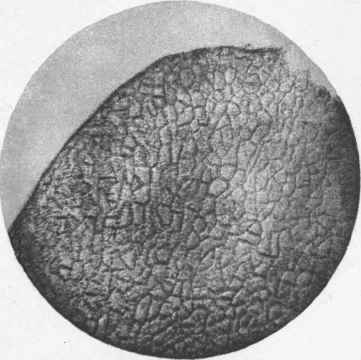
Raw Coffee X55
Cross section.
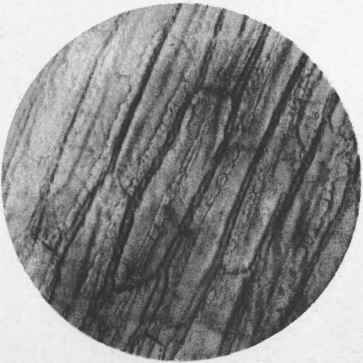
Wheat Bran Xll5
Outer or longitudinal layer.
A.Hoen & Co.Heliocaustic,Baltimore.
Bull.NO.I3 Div.Of Chemistry. Plate XLV
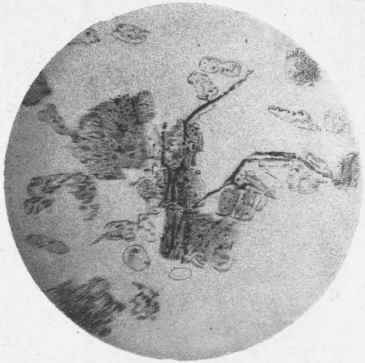
Chicory (Roasted) X95
Parenchyma cells and milk vessels.
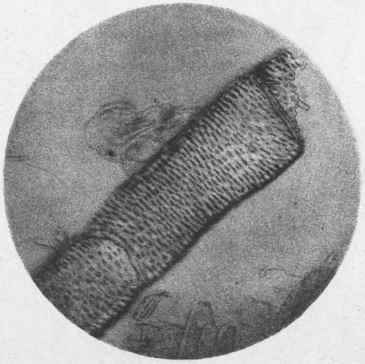
Chicory (Roasted) X95
Pitted cells.
A.Hoen & Co.Heliocaustic ,Baltimore.
Continue to:


My Books

