


Embroidery
Description
This section is from the book "Housekeeper's Handy Book", by Lucia Millet Baxter. Also available from Amazon: Housekeeper's Handy Book.
Embroidery
In old times, our great-grandmothers in their childhood worked samplers, which were done in cross-stitch, this stitch being the most familiar type of canvas stitch, which is considered the earliest used embroidery stitch.
Cross-stitch was worked upon the mesh in the form of a cross, and it is of the greatest importance that the stitches always cross in the same way. Square-meshed canvas has been made to guide the worker in making designs and patterns upon the different fabrics.
Outline Stitch
The first stitch in these days taught to a beginner is outline stitch, sometimes called stem stitch, Kensington stitch, or tent stitch. It may be described as a long stitch on the surface and a short stitch on the under side, the thread always kept above the needle; that is, to the left.
Bulgarian Stitch
Several rows of this stitch, side by side, and close together, are known as Bulgarian stitch.
Chain Stitch
Bring the needle and thread out, hold the thread down with the left thumb, put the needle in again at the hole through which you brought it out, take up one quarter of an inch of the goods; drawing the thread through this gives you the first link in the chain. The back of the work is like a back stitch. A decorative chain may be made by slanting the stitch from left to right.
Seed stitch is made of two or three tiny stitches one over the other, the thread carried on the back to the place for the next seed. It is used in fine needlework for filling in leaves or the petals of flowers.
Big Needle Stitch
This stitch is found in most of the muslin capes and collars of a hundred years or more ago. One comes across it in letters, leaves, petals of flowers, as a background, in single rows or in continuous rows close together to give a lacelike edge. It looks like drawn work, but no threads are drawn.
The material must be very sheer, the needle very large, - No. 0 or No. 1, - and the cotton fine, - either No. 100 or No. 150. The needleful must not be too long; it is a help, if not a necessity, to tie the thread into the needle. This stitch is not difficult and can be done rapidly after one sees the method.
Draw a line with a pencil on a piece of thin white cotton as a sampler, mark dots above and below this line as a guide; notice the dots are not opposite.
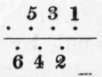
Tie the cotton from 3 to 1 on the under side, sew on this over and over twice to bind the little bunch of threads or goods taken up. Now pass the needle diagonally from 3 to 2 across the line, and sew over and over as before. Next, work from 2 to 4, then 4 to 3 across the line, from 3 to 5, then 5 to 4 across the line, from 4 to 6, then 6 to 5 across the line, and so on indefinitely.
Another method is to have the dots one above the other. Tie the thread as before from 3 to 1, and sew over and over till bound; three times ought to be enough. Now pass the needle diagonally from 1 to 4 on the under side, sew from 4 to 2, complete the group by sewing from 3 to 4. Next, work from 5 to 3, pass the needle diagonally on the under side and from 6 to 4, and then from 5 to 6. Continue till practice makes easy and perfect. If the stitches pucker the goods, the fault is in taking up too many threads or having the dots too far apart. One can, after seeing into the method, soon make the stitch as easily as one can sew anything, work without a guiding line, and never use a dot.
Continue to:


My Books

