


Domestic Pets. Birds. Part 6
Description
This section is from the book "Warne's Model Housekeeper", by Ross Murray. See also: Larousse Gastronomique.
Domestic Pets. Birds. Part 6
The Blackcap, which is sometimes called the Mock nightingale, redstart, whitethroat, and other warblers, require much the same treatment. The blackcap should never be without fruit of some kind, cherries, currants, raspberries, elderberries, or ripe apples. For all these birds, Mr. Sweet recommends hemp-seed soaked in boiling water and bruised, mixed with scalded bread (made without salt), and a little lean meat finely minced. This must of course be given fresh every morning, and the birds should have hard egg also. Other bird-fanciers recommend boiled carrot or beetroot mashed, and pastes made of white bread twice baked and pounded, with milk poured upon it, and mixed with barley meal or wheat meal, and the "German Paste " made as follows: - Heat two tablespoonfuls of melted lard, free from salt, in a saucepan till nearly boiling; stir into this while near, not on, the fire, four tablespoonfuls of treacle, and three pints and a half of pea-meal till the mixture becomes a stiff crumbly paste; a few more seeds may be mixed with this, or a little stale bread grated, or well boiled mealy potato can be added to it when given to the birds. It will keep a long time in a glass ja,r, and both seed-eating and soft-billed birds will thrive on it.
If birds of various kinds are kept together in a room or aviary, it is necessary to give some general food which those that live upon seeds, insects, berries, and fruit, may equally enjoy, and these pastes are suitable for all. The seed-eating birds have a mixture of seeds as well, and the insectivorous birds should be supplied with meal-worms, cockroaches, and crickets, easily procured from a baker's shop, and dried ants' eggs. These can be obtained in summer by uncovering a nest of the large wood ant, and placing the eggs on a cloth in the sun, with the corners turned up over small leafy branches. The ants, in order to protect them from the sun, will carry their eggs under shelter, and thus they are procured free from dirt and from the ants also.
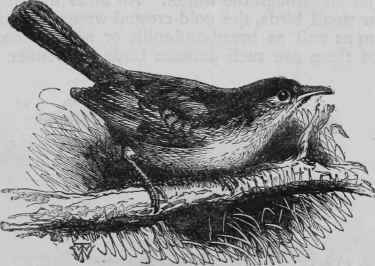
Blackcap.

Gold-Crested Wren.
They may be dried in a frying-pan on sand over a slow fire, and kept in the sand in a jar all through the winter. All birds like them. The most beautiful of our small birds, the gold-crested wrens, delight in them, and must have them as well as bread-and-milk or soaked biscuit beaten up with milk; but these are such delicate birds, and suffer so much from cold, that it is very difficult to keep them alive through the winter. They might do well in a plant case lined with a fine woollen net, with a myrtle or tiny fir tree to perch upon. They, like the robins, are quarrelsome birds, and do not live well with others in a confined space. Titmice are such murderous little creatures, that it is cruel to put them with other birds, for, besides fighting with them continually, they will hang on to them and hug them round the neck, to rob them of any dainty food they are eating, to which they may take a fancy, and torment them exceedingly. Robins and larks can only be kept happily in an outdoor aviary. This should be constructed of iron and glass upon a basement of brick or stone, with an earthen floor beaten hard, and be warmed by pipes, so as to keep up an even temperature in cold weather.
The glass should have wire within it, so as to be opened freely in summer, and be shaded by blinds at pleasure, unless it is well sheltered by creeping plants without, and should be provided with wooden shutters for the winter. Within the aviary there should be a small fountain playing in the centre, with a basin for the birds to drink and bathe in, and plenty of dwarf shrubs and creepers for them to build and hide in. It is best to keep these in pots when practicable, in order to change them for fresh shrubs when they become spoiled. The seed should be put in bird-hoppers against the wall, and there should be shelves and perches for the birds to roost on, and in the breeding season, wicker baskets and boxes for them to build in. The floor of the aviary must be kept covered with sand and small gravel, and old mortar well dried and braised is good for the birds also. Of course, anything belonging to the aviary must be as clean as possible, and the water always fresh and cool. In fitting up aviaries or cages, the natural habits and tastes of the birds which are to live in them must be carefully considered - their comfort is sometimes sacrificed to ornament - and they should always have shade as well as sunshine provided for them, and snug corners for those who love retirement.
Care must be taken to exclude fog and damp, and in sweeping out the aviary, to avoid raising much dust, from which the sensitive lungs of many of the birds would suffer exceedingly. The air from a close stove or any noxious gas too, would cause them much discomfort, if it did not stop their respiration altogether, so that means must be taken to secure good ventilation.
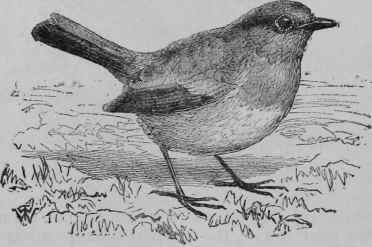
Robin.
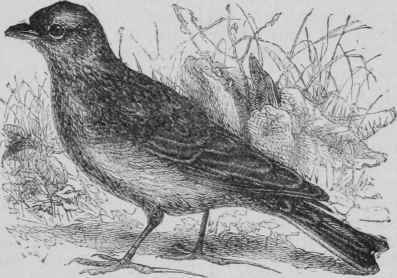
Skylark.
If we keep birds in captivity at all, it is our bounden duty to keep them as healthy and happy as possible; and unless we are well acquainted with their several wants and characteristic tastes, we cannot expect them to be our fond familiar friends, or to delight us with the exhibition of their natural beauties and talents. We must love our little prisoners and consult their happiness if we would entice them to treat us as friends, rather than gaolers.
Continue to:


My Books

