


Etiquette Of A Dinner Party. Part 2
Description
This section is from the book "Warne's Model Housekeeper", by Ross Murray. See also: Larousse Gastronomique.
Etiquette Of A Dinner Party. Part 2
Soup is put opposite to the lady of the house. If there are two soups, a tureen will be at each end and be succeeded by two kinds of fish.
It may be that the soup is before the lady, and the fish at the same time placed before the gentleman. The butler holds the plate close to the tureen, and one ladleful is sent to each person. The butler gives the plate, when filled, to the footman, who carries it round to the guests.
The gentleman on her right hand generally saves her the trouble of helping it.
The soup and fish are succeeded by the meat and chickens, or turkey. The inevitable saddle of mutton, or the fore-quarter of lamb, are put before the gentleman; the chicken or turkey before the lady, who is assisted in carving by the gentleman beside her.
But before either of these pieces de resistance are uncovered, the servants hand the side-dishes, which are not now put on the table.
The second course follows: the game is put before the gentleman; the lady has the pudding; jelly, blancmange, etc., are at the sides.
When the second course has been removed, and cheese handed round, grace is said again, and the dessert follows.
Ice is handed round first, then the separate dishes of fruit, etc. After which the servants leave the room. The wine is passed round the table, and the gentlemen help the ladies to it as well as to any more fruit which they may require. This is an especial time for conversation.
Sherry is offered once by the butler after soup, or oftener if there is no champagne or hock. Hock is offered with the fish, or chablis takes its place. Champagne is taken round three or four times immediately after the first entree has been served. Sherry and claret only are put for the dessert. Port and Madeira are rarely seen now.
As soon as the hostess thinks that her lady-guests have finished their dessert, she bows to the lady of the most distinction, and then all the ladies rise and leave the dining-room - the hostess remaining the last to go out. The ladies amuse themselves in the drawing-room till the gentlemen join them.
During the interval the hostess must endeavour to amuse her guests as she best can. Coffee is handed, and sometimes a young lady will play or sing, and the hostess must never relax her quiet and unobtrusive endeavours to make the evening pleasant. Observation, tact, and a little information on the events of the day, are required to make a perfect hostess.
Pleasant and lady-like habits at table are easily acquired, if carefully observed daily. But "manner " requires as much, or more, practice than music, and no one will attain a polished ease in society unless she practises its habits continually, and at all times, in her domestic circle. She cannot put on a habit, or a graceful manner, when she will; it must be a thing of daily life. And, allow me to say, that care bestowed upon it will add greatly to the comfort and happiness of home, as well as relieve the oppression of awkwardness and shyness in society.
Now we will describe a plain family dinner, which taxes more closely the attention and hospitality of the host and hostess.
In the dinner parties we have described the hospitality is dispensed by the servants; when a quiet family, with perhaps one or two guests, meet round the dinner table, a little more supervision of their guests' comforts will fall to the lot of the lady and gentleman of the house.
Soup and fish are placed on the table, and sent to each person. It is rude and inhospitable to ask a guest whether he will take soup or fish. He will probably take both; and it limits him to one by the question. It should be helped and sent round by the servant waiting.
The same mode is pursued with the side dishes - they are handed round; the end dishes are helped and handed round.
It has been the fashion for the last two years to hand cold and hot dishes alternately at dinner. Vegetables and sauces are handed as quickly as possible by the footman or parlour-maid. "Wine is offered by the servants after soup or fish and during dinner, as described above.
A lady ought to know how to carve, and it is well for the daughters of a family to learn it in their youth, that they may not be awkward at their own table when they marry.
We subjoin a few plain directions for carving and helping.
Of soup we have already spoken.
Fish is cut with a silver fish-slice, or the more modern large silver fish knife and fork.
Large flat fish, as turbot, brill, John Dorey, etc., must first be cut from head to tail down the middle, and then in portions across to the fin, which being considered a delicacy, is helped with the rest. (See cut).

Turbot.
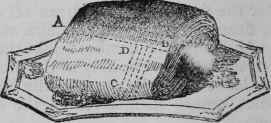
Middle Cut of Salmon.
Salmon is cut in slices down the middle of the upper side, as from A to B, and then in slices across D to C, and a little of the "thick," or upper side, and "thin," or under side, are put on each plate.
A mackerel divides between four people; the fish knife is passed between the upper and under side from head to tail, and each side is halved to help. Cod is cut cross-ways, like salmon, from C to B, and in down slices as from A to B, and a small piece of the sound is sent with each helping. Small fish, as smelts, are sent whole, one on each plate; as are whiting.
Fried soles are cut across right through the bone. The " shoulder," or head end, should be first helped.
A sirloin of beef is cut across for the under-cut, and lengthways for the upper. You should ask your guest if he or she prefers the under-cut, which is by some considered the most delicate part of the beef, and is disliked by others. Slices from the under-cut should be thick.

Continue to:


My Books

