


Etiquette Of A Dinner Party. Part 3
Description
This section is from the book "Warne's Model Housekeeper", by Ross Murray. See also: Larousse Gastronomique.
Etiquette Of A Dinner Party. Part 3
Cod Fish.

Sirloin of Beef.
Rolled ribs, and a round of beef, are easily carved in horizontal slices over the whole surface. The slices should be very thin.
Boiled beef should also be cut in thin horizontal slices the size of the joint itself in length and breadth. (See cut).
Mutton appears on the table in four forms - the saddle, the leg, the shoulder, the loin.
The saddle is the joint ordered for a large dinner-party. It is cut in very thin slices close to thebackbone; B to A and then downwards from A to D and C; but a lady is scarcely ever required in the present day to carve a saddle of mutton.

Aitch-Bone.
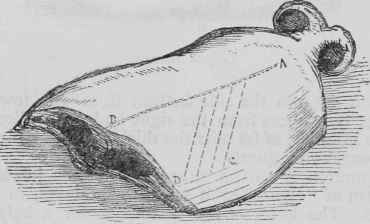
Saddle of Mutton.
A shoulder must lie with the knuckle towards your right, and the blade-bone towards your left hand.

Shoulder of Mutton.
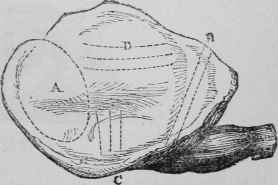
Shoulder of Mutton.
In the middle of the edge of the part farthest from you place the fork, and then give one sharp cut from the edge to the bone. The meat flies apart, and you cut rather thick slices on each side of the opening A to B till you can cut no more.
You will then find two or three slices from the centre bone to the end B to C. Afterwards the joint must be turned over, and slices cut from the under-side.
Some people, instead of cutting the joint in this manner, begin with slices cut lengthways near the middle of the joint from the end to the knuckle, and it is a better way.
A leg of mutton must be placed with the knuckle towards your left hand; you then cut into the side farthest from you towards the bone B to C, helping thin slices from the right and thick slices towards the knuckle. The little tuft of fat near the thick end is a delicacy, and must be divided amongst your guests.

Leg of Mutton.
A loin of mutton is carved either through the joints, which brings it into the form of "chops," or it is cut lengthways, in a parallel line with the joints. The latter is the best mode for a lady, but a loin is rather for family consumption than for guests.
A fore-quarter of lamb consists of a shoulder, the breast, and the ribs, and, alas! when the carver has to dissect it! If a lady is obliged to carve this joint, she must first place her knife upon the shoulder, draw it through horizontally, and then remove the joint whole, placing it on a separate dish, which is held for its reception. She must then cut off the breast and separate the ribs (see act); but the cook should always cut off the shoulder, and leave it on the joint.

Fore Quarter of Lamb.
The hind-quarter consists of a leg and loin.
A fillet of veal is cut in horizontal slices like a round of beef; they must not be too thin. The stuffing in the centre is taken out and helped with a spoon.
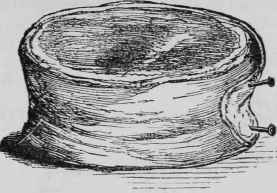
Fillet of Veal.

Breast of Veal.
In a breast of veal the ribs should be first separated from the brisket, after which either or both may be sent round.
A calf s head must be cut down the centre in rather thin slices on each side. The meat round the eye is scooped out; it is considered a delicacy. A small piece of the palate and accompanying sweetbread must be sent on each plate.
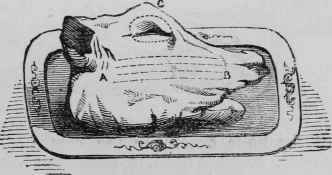
Half of Calf's Head.
Roast pork is never seen at dinner parties, but is occasionally served at a family dinner.
The leg is carved like a leg of mutton, but the slices should be thicker and not so large.
A ham may be cut in three ways - 1st. By beginning at the knuckle, which must be turned towards your left hand, and cut in a slanting direction; or at the thick end, which is then turned towards your left; or in the ordinary manner, like a leg of mutton, beginning in the centre.
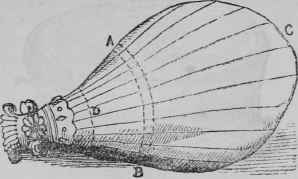
Ham.
The slices must be as thin and delicate as you can possibly cut them. One slice is given as accompaniment to fowl or veal.
A rabbit has the legs and shoulders removed with a sharppointed knife, then the back is broken into three or four pieces at the joints.

Boiled Rabbit.
Hare is thus carved: First take off the legs. Cut two long thin slices off each side of the back B to A; then take off the shoulders, and break the back into four pieces with the fork. Cut off the ears, insert the point of the knife exactly in the centre of the palate, and drawing it to the nose, split the head in two. But when only a small portion of the hare is eaten, and it is only served at second course, it is more elegant for a lady to help a portion of the side with a spoon, as we have often seen done.
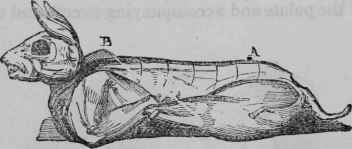
Hare.
The best parts of a hare are the slices from the back, the head, and cars. But ladies never eat the two latter. They should be sent to any gentleman guest who is known to be an epicure.
A chicken is carved thus: Take off the wings, cut slices from the breast, take off the merrythought and side bones. The liver wing is the best part of the chicken after the breast; but you should help the breast first, then both wings. If you have many to help, manage to reserve a slice of white meat to send with the legs and sides.
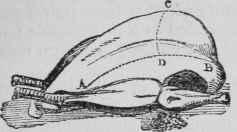
Roast Fowl.
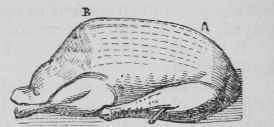
Boiled Turkey.
A partridge is carved like a fowl; so is a pheasant.
A pigeon is cut in halves right down the middle, and half is sent at once to the guest.
A snipe is treated in the same way.
Very small birds are sent whole.
A turkey and goose are helped by cutting slices off the breast, and then the wings and legs are taken off. Wild duck is helped in the same manner.
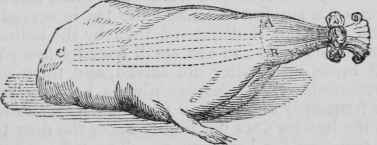
Haunch of Venison.
A haunch of venison should be cut from A to B close to the knuckle. (See cut first.) Then from C to A.*
Coffee is sent to the gentlemen in the dining-room. Tea only is handed after dinner when the gentlemen have left the dinner-table.
Continue to:


My Books

