


Ornamentation
Description
This section is from the book "Warne's Model Housekeeper", by Ross Murray. See also: Larousse Gastronomique.
Ornamentation
The taste of a lady is shown especially in the ornamentation of her apartments.
The best ornaments (available for poor as well as rich) are flowers. They will enliven the dullest room, and bring nature and beauty into the heart of a smoky city.
The power of arranging bouquets with taste and judgment is a gift not bestowed on everybody, but it may be in a great degree acquired by observation and care. The skilful grouping of colours is first to be considered. Scarlet and white - i.e. scarlet geraniums with white cloves and jessamine - will be found very effective. The long wavy stems of the jessamine greatly relieving the flatness of the other flowers.
Bouquets composed entirely of many-tinted roses are wonderfully lovely. A straw basket filled with roses and lilies {see plate) may be made a most charming ornament; but some people cannot bear the strong perfume of the tall lily - nor even that of lilies of the valley.
Bouquets of set flowers, as zinnias, carnations, asters, should always have the centre raised with thin tapering flowers - as sweet-peas, jessamine, clematis, etc.
A china bowl filled with roses is very pretty.
Large soup-plates, or dishes filled with wet sand, will hold dahlia blossoms, and show them to great advantage. There are also tables made for the purpose covered with a wire netting which, filled with dahlias, are very beautiful.
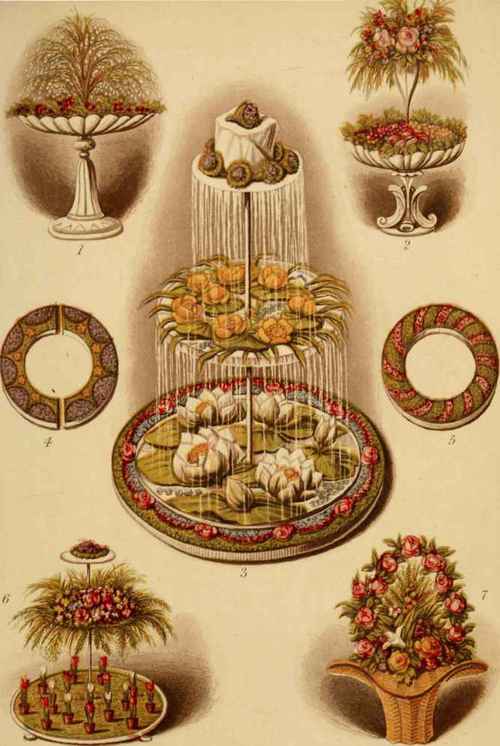
1. Crystallized Bouquet. (for Winter).
2. Fruit & Flowers. (for Summer).
3. Ice &. Flower Centre.
4. Ring of Flowers.
5. Ring of Flowers.
6. Spring Bouquet.
7. Rose Basket.
A majolica vase, large enough and round enough to be filled with earth, may be planted with snowdrop bulbs round the edge, and filled in the centre with tulip-roots. These will bloom in spring, and form a charming and lasting bouquet.
Tiny specimen glasses for rare flowers, containing a single magnolia, a choice rose, or new geranium, should stand about on the tables.
The new glass half-rings for flowers are also well adapted for displaying small flowers, such as yellow primroses, evening primroses, and violets in moss - all being put into wet sand. These may be formed into patterns in the rings {see plate) one half-circle of violets, the next of snowdrops, the next of yellow primroses, then heartsease, primulas, or nemophila. The interstices filled in with any rare bits of green and brown moss, with here and there a few scarlet blossoms.
In winter the rings may be filled with moss, red berries of holly, hips or haws, and the yellow and white immortelles, Russian violets, and Christmas roses. They may be also arranged to look like a twisted wreath by placing them in curved lines {see plate).
Tulips in tiny pots, placed in moss on one of the glass stands now sold for flowers, are pretty. Overhanging fern leaves give a grace to stiff bouquets, and are indeed always beautiful.
In the centre of the annexed plate will also be seen a pretty ornament for a stand in summer. It is a glass stand with a deep bowl-like bottom, surrounded by a rim for flowers. In the bowl, water-lilies are laid; on the second glass-round, which is nearly flat, other plants are placed; on the flat glass top is placed a small block of ice crowned with, and surrounded by, violets. As the heat of the day melts the ice, it flows down on the flowers on the stands below, and gradually floats the water-lilies. The ice, of course, must be in exact proportion in size to the water which the lower bowl will contain. Placed on a table in the hall, this bouquet will produce a delightful freshness of the air round it.
For a winter bouquet, nothing is prettier than crystallized twigs and evergreens, which sparkle in the light like diamonds.
We give the following receipt for one of these bouquets:
How To Ice Evergreens
Dissolve alum by boiling in hard-water, in proportion of a pound to a quart. Pour it into a deep vessel, and as it cools the alum will be precipitated. Choose light sprays, and hang them with the stems upwards on cords stretched across the top of the vessel so that they do not touch the bottom; they will attract the alum in the process of crystallization like the threads in sugar-candy. The warmer the solution when they are put in the smaller will be the crystals attached to them, but care must be taken that it be not hot enough to destroy the leaves or fronds; and, if there be berries, like holly, it must be hardly lukewarm. The same solution warmed again will do two or three bouquets.
How To Frost Leaves And Sprays
Purchase, at any glass manufactory-; a few pennyworths of powdered glass, or powder some pieces of broken glass, by breaking or rolling them yourself; but beware lest any chips of the glass get into your eyes (which should be covered with a gauze veil to protect them while you roll and pound the glass); dip the leaves and sprays in a thin gum-water; then shake the powdered glass over them and let them dry. The effect is wonderful.
How To Make Snowflakes
Dip pieces of cotton-wool, the size of snow-flakes, into weak gum-water. Dust them over with glass-powder. These flakes are pretty for Christmas ornamentation of all kinds.
Flowers should be gathered early in the morning, but not till the dew is nearly dried off them. They should be placed in a flat basket, or on a tray, so as not to press upon and crush each other, and they should be neatly cut, and not mangled or bruised. When thus gathered, they should be covered with a sheet of paper, and immediately conveyed to the apart' ment where they are to be used, if that apartment be near at hand. But if they are to be sent to any distance, they should be placed in tin cases, such as botanists use when collecting specimens.
Continue to:


My Books

