


Prescriptions For Swallowing Foreign Bodies
Description
This section is from the book "Warne's Model Housekeeper", by Ross Murray. See also: Larousse Gastronomique.
Prescriptions For Swallowing Foreign Bodies
It often happens that children swallow money, or other hard substances, such as pins, etc.
In these cases, if the substance be completely swallowed, it should be left to take its course through the stomach and intestines. The custom of giving purgatives in such cases is altogether contrary to physiological principles, as the intestinal movements will more safely carry them through than if violently urged by physic.
Vaccination is the only real protective we have from the ravages of small-pox. This is proved by the following facts, among many others: In proportion as vaccination is properly and efficiently performed, so the mortality of small-pox is reduced. Secondly, by the freedom from infection which is enjoyed by properly re-vaccinated persons in constant attendance upon, and actual contact with, small-pox patients. There has never been a case of small-pox among the nurses or the attendants at the Small-pox Hospital, High-gate, within a period of considerably over thirty years. This is simply because they are all properly re-vaccinated before they enter upon their duties.
We have used the expression, "properly vaccinated." It will be as well to explain what is intended thereby.
"Properly vaccinated " does not only mean to be vaccinated during infancy, as the law compels, but it also implies re-vaccination, performed at the period of puberty - that is, on or about fifteen to seventeen years of age.
During, a late severe epidemic of small-pox in England (1870-1871), it has been noticed that no persons who have been properly vaccinated and re-vaccinated have taken the disease.
There can be no doubt that diligent and careful vaccination and re-vaccination would in time extirpate small-pox.
Mode Of Vaccinating
The operation of vaccination is simple, but so highly important that no care bestowed upon its performance is thrown away.
The following instructions will be sufficient if carefully followed: -
Select an arm of a vaccinated infant that has good vesicles on the eighth day, i.e., the day week on which the lymph was inserted. Then with a perfectly clean lancet make several punctures in the clear part of the vesicles, avoiding the red border of inflamed skin, so as not to draw blood. A clear watery fluid will ooze out in beads.
Take off some of this clear fluid on the point of the lancet, and then taking the arm of the infant, or person to be vaccinated, draw the skin tense and insert the point of the lancet nearly horizontally into the skin to an extent of about one-tenth of an inch (-); then give the lancet a turn round, withdraw it, and press it down upon the puncture. Five such punctures, to the distance of about half an inch apart, should be made on one arm.
The following figures represent the characters of the vaccine vesicle: -
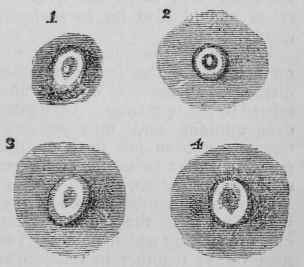
Supposing that an arm with mature vesicles should not be available, lymph may be procured from any vaccine station. It will be received in that case, preserved either in tubes, or on small points of ivory. If in tubes, the point at each end of one must be broken off, and the contained lymph be gently breathed on to the point of the lancet and inserted as above directed. If the lymph have been preserved dry on "points," one of these should be used for each puncture. Dip the point quickly into cold water, and shake off any excess of water. The object is just sufficiently to moisten the lymph, that it will be easily scraped off on to the point of the lancet, and inserted as before directed.
Some degree of inflammation occasionally occurs on the vaccinated arm. This will generally disappear quickly under the application of simple water-dressing.
A slight eruption of small colourless pimples on various parts of the body also occasionally follows vaccination, and disappears in the course of a few days.
To ensure the success of vaccination, the infant to be vaccinated should be in good health, and free from any eruption of the skin, and the child from whom the lymph is taken should also be in perfectly good health.
With these precautions, there is no ground for the fear that other diseases than cow-pox will be transmitted by the operation. Very great exaggerations and misrepresentations have been put forth on this point in order to excite prejudices against vaccination.
One very common source of prejudice exists in the ordinary fallacious reasoning which puts any two near things together in relation, as cause and effect. For instance, a child at about three months of age having been vaccinated has (we'll say for argument's sake) a skin disease break out a few weeks after - therefore, says the opponent of vaccination, "this irruption is the consequence of the vaccination".
We put another case. A child that has not been vaccinated arrives at the period of teething, and suffers from some skin disease. This is a very common thing; but clearly it could not have been caused by vaccination.
The explanation of the fallacy is this. Teething often excites a febrile disturbance. A febrile disturbance may excite into activity any latent constitutional tendency to skin, or other disease; vaccination usually closely precedes teething - and so the disturbance due to teething is charged upon the vaccination.
Re-Vaccination
The primary vaccination of infancy, if well and thoroughly performed, as shown by the existence of several well marked cicatrices, affords protection for life from severe small-pox - protection however, not so complete but that modified small-pox shall not occur. It is shown by a vast accumulation of statistics that there is a greater tendency in vaccinated persons to take small-pox between the ages of fifteen and twenty-five than at all other ages put together. It is therefore advisable, in order to obtain complete protection, the operation of vaccination should be performed at puberty, or when growth is completed.
The insertion of lymph by three punctures is sufficient for re-vaccination.
The lymph from a re-vaccinated vesicle should never be used for primary vaccination.
Continue to:


My Books

