


The Lady's Social Duties
Description
This section is from the book "Warne's Model Housekeeper", by Ross Murray. See also: Larousse Gastronomique.
The Lady's Social Duties
"Use hospitality one to another without grudging".
In addition to her household duties the lady of a house has social duties to perform, which she is equally concerned in fulfilling well and gracefully. Of these hospitality conies first. There has been much falling off in the frequency of domestic entertainments since the growth of luxury has made home parties so extremely expensive.
We think it would be well if the middle classes would return in some measure to the old-fashioned heartiness of their ancestors, and ask friends to spend a social evening without giving them a supper which it would cost an immense sum to return.
The late hours for dinner stand somewhat in the way of small evening parties; still if they were given oftener we believe that much social good would arise from them. The sons of the family would not seek evening amusement so much at music halls, plays, etc., but would find it at home, and their associates would be ladies and gentlemen; while the dulness of girl-life would be exceedingly brightened by them.
We have heard a lady relate how, in the old "war time," she and her young friends used to meet often at each others' houses once or twice a week and dance to their own playing; or play round games of cards - eat a light supper of sandwiches and wine, and, as they had walked to the friend's house, so walk back again at night, escorted by a servant and a group of merry friends. And these ladies were of high station; one of them became afterwards the wife of an earl, and the speaker herself was of still better family.
Amongst the upper middle class these simple gatherings no longer exist; they only entertain expensively; much in the style of far grander fortunes, and of course their parties must needs be few and far between. But it is time to say something about the present mode of entertainment. We begin of course with dinners.
Dinner parties have become so very expensive that people of small means cannot give them; they are compelled to ask their friends separately, or to entertain them at a "kettledrum," or an evening party. The latter is not less expensive than a dinner, but is more easily managed where the servants are not numerous and the rooms are small.
Nevertheless the wife of a professional man may often have to entertain a party of six or eight, and this may be done very pleasantly if too much is not attempted and the guests assimilate well.
And here we would observe, that if the servant who waits at table - whether footman or parlour-maid or housemaid - is used every day to wait wsll, and that the lady points out any little awkwardness or shortcoming which she may perceive in his or her service, not at the time, but the next day, there will be little difficulty in the waiting when two or three guests come to dine; but to wait on a dinner party of eight or ten, two persons are required. Waiters can, however, be hired, or a clever housemaid, occasionally trained, can help the footman.
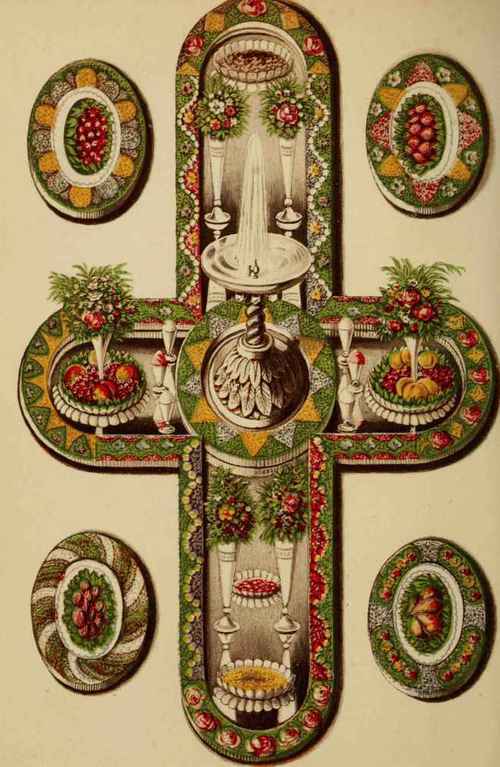
A Table spread for dinner a la Russe with plateau of looking glass and fountain.
Dinners a la Russe are now universal, and are very nice, if well managed. The table is spread with fruit and flowers only; a tiny basket of strawberries in summer, being placed at each seat near the wine glasses, etc. etc. In other respects plate and glass as usual.
There should be a tiny salt-cellar and a caraffe beside each person; this will be achieved (with a party of eight) by placing the former at the end of the table, one at each corner, and one in the middle on each side. Soup and fish are handed - then side-dishes - then the principal joints - next puddings - then cheese, etc.; ices and dessert.
The tin or glass half-moons are a very pretty and new device for ornamentation; the centre may vary according to taste or means. The basket of roses given in Frontispiece, or in winter the iced bouquet (directions for making which will be found in this book) will form a pretty centre. The tin half-moons will ornament the edges of dishes, etc. Nothing should be served which the cook is not sure of doing well; the meal, however simple, should be excellent of its kind, and some forethought should be exercised as to the cook's power of dishing up in time the things ordered, and the capabilities of the grate or stove for cooking them. Good soup is not difficult to make, and may be prepared the day before; so also must be the jellies and blancmange. Pigeon or any game pie, vols-au-vent and patties may also be ready, and only require warming - in short, preparations might commence, to save time and hurry, at least two days before.
The following are a few moderate dinners for middle-class people: -
Continue to:


My Books

