


Water. Part 2
Description
This section is from the book "Warne's Model Housekeeper", by Ross Murray. See also: Larousse Gastronomique.
Water. Part 2
River-water contains a less proportion of saline matters in solution: it is not, however, so good to drink as spring-water, because it frequently occurs that rivers receive the sewage of large towns, and hence the water contains organic matter in solution, and, should the water be taken whilst this organic matter is undergoing decomposition, very serious consequences may result to the person drinking it. It is now, however, a rule in sanitary matters to endeavour to divert the sewage from our noble rivers when possible, and with the help of proper filters the Thames water is now potable and wholesome.
All rivers flow into the sea, hence sea-water contains a larger quantity of sodium chloride, and many other salts, in solution, likewise organic matter; but, curious to say, it remains in a uniform condition so far as the quantity of saline matter is concerned, and the specific gravity varies little, the mean being 1.027, pure water being 1.000.
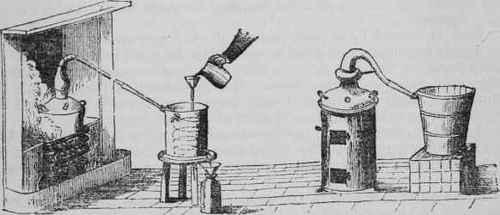
A Still placed on a common fire or fitted to a proper furnace. Both the Stills have worm tubs or condensers.
When sea-water or any other hard water is placed in a still and boiled, the earthy or saline matters are left behind, and, the steam only being condensed, pure water is obtained.
Some water is impregnated with lime, some with salt, some with iron. Mineral springs are caused by the water in its passage through the ground dissolving and absorbing metallic substances.
It is difficult to wash linen in hard water because the soda of the soap combines with the sulphuric acid of the salts of hard water, and the oil of the soap with the lime, and then it floats in white flakes on the water.
Wood ashes will, however, render hard water soft. The carbonate of potassa in the ashes, and the sulphate of lime in the water unite, and form into sulphate of potassa and carbonate of lime; the ashes also render some of the soluble salts of water insoluble; they fall to the bottom of the pan or tub as a sediment, and thus the water becomes fit to use for washing. It will then cleanse linen by dissolving the stains on it, while the soap has the power of uniting with grease, and rendering it soluble in water.
Water that has run through chalk is the worst of all for washing purposes. It is also bad for cooking vegetables and for making tea; a pinch of soda will soften it, by decomposing the earthy salts present in it.
Water flowing from granite rock is the purest: slate formations also are favourable to the purity of water flowing from them.
Rain-water is soft because it has not been impregnated with earths and minerals; it is consequently very pleasant to use for washing. It dissolves the soap, instead of decomposing it as hard water does.
Rain-water is produced chiefly by evaporation from the seas, but it is not salt, because saline matters will not evaporate. They remain in the bed of the ocean, the fresh vapour alone ascending from it into the cold regions of the sky; from whence when condensed by cold air it falls in rain.
Rain-water is more fertilizing for the soil than pump water. It contains more carbonic acid, and a small quantity of ammonia, which nourishes the young plants.
Rain is in fact a great benefit to us, not only for "watering the earth," but because it dissolves as it falls all noxious exhalations that may be lingering in the air, it mixes the upper air with the air of the lower regions, and washes out sewers and ditches, the stagnant water in which might bring diseases.
Rain is caused by a cold current of wind condensing the vapour of the clouds or the air, and precipitating it to the earth in drops. The vapoury particles in their descent attract each other, and those which are quite near unite and form drops. But in order that rain may fall, the atmosphere must be saturated with vapour; unless this be the case the vapour will be held in solution in spite of the cold currents.
A passing cloud coming in contact with cold air is condensed and falls in rain. More rain falls by night than by day. because the cold of the night condenses the air, and decreases its power of holding vapour in solution.
Snow is the vapour of the air condensed by a cold current below freezing point, and precipitated as a shower of crystals. It is of great service, for it nourishes the earth and keeps it warm. It is a very bad conductor, having a great deal of air in its crystals; it therefore prevents the heat of the earth passing off into the colder air, while it nourishes the soil with the carbonic acid it contains, which passes into every pore of the ground as the snow melts. Hail is frozen rain; that is, rain which passing through a cold current or layer of air is turned into ice. Two strata of clouds of opposite electricities, and two currents of air, are the causes of hail; the lower cloud containing resinous electricity is the one precipitated as hail.
The density of the air is lowered previous to a storm; this is shown by the rapid fall of the mercury in the barometer which is held up by the pressure of the atmosphere. This changed condition of the air causes sometimes a painful oppression; the air being lighter than usual does not balance the air in our bodies, and we have in consequence a disagreeable feeling of distension.*
Then again air laden with vapour has less oxygen, and in fact has a tendency to depress the nervous system. It is therefore not "mere fancy," as it is often called, which makes sensitive people susceptible of changes in the weather. All animals appear listless and drowsy when rain is at hand, because the air is supplying less oxygen. Sheep will lie under a hedge; horses neigh; cattle low from the same cause. Smoke falls, because the air is not dense enough to keep it up.
* This distension in the tissues of the feet, caused by the rarefied condition of the air before a storm, is the reason of corns aching. They cannot distend equally with the softer flesh, and thus irritation is produced in the fibrils of the nerves.
Continue to:


My Books

