


Water
Description
This section is from the book "Warne's Model Housekeeper", by Ross Murray. See also: Larousse Gastronomique.
Water
Water is another of the great agents of life. Without it the whole world must perish. On its uses we have no occasion to dilate. It is one individual thing. It never changes. It can be added to by careful adjustments for a little while; it can be taken apart and analysed, but it always remains water, cither in a solid, liquid, or gaseous state. It can be cooled into solid ice, or heated into vapour, but it may always be restored to its original state by thawing or condensation. In both cases of transformation it gains a wonderful increase of volume. As ice, it swells so violently that it will burst iron; and as steam, it expands and evaporates in a manner which reminds one of the genius the fisherman released from a bottle in the "Arabian Nights;" or if restrained, it becomes the mighty and dangerous power which science has chained and fettered to man's chariot wheels. A knowledge of the expansion of water by cold may save many domestic inundations in the time of severe frost. The water pipes should be kept (if possible) warm enough to prevent the water freezing; the taps should be half turned, to let it drip a little.
The jugs and bottles, in bedrooms which have no fires, should only be half filled with water.
Water becomes ice at a temperature of 32 degrees. It is a remarkable exception to the general rule that cold contracts the volume of liquids. " Water which becomes solid in all parts of the globe at the level of the sea at 320 Fahrenheit, or of 0° Centigrade," says Professor Pepper," expands instead of contracting when the water reaches a temperature of 400 Fahrenheit, and falls to 320: the amount of expansion is not very great, being one part in ten thousand at 320".
But the fact, which at first was thought illusory, is indisputable, as proved by the experiments of Dr. Hope. He placed two thermometers in a large vessel of water, the one being at the top, and the other at the bottom. Up to a temperature of 400, the cold water contracted, and, being the heavier, sank to the bottom, and the lower thermometer registered the greatest cold. After 400 was passed, the water evidently expanded; the coldest water was found to be at the top, and duly recorded by the thermometer sinking to 320, whilst the warmer water, which ought, according to the law of expansion, to have been uppermost, remains at the bottom, and therefore was heavier, bulk for bulk, than the water about to crystallize. It is this remarkable exception that preserves the fish in the lakes and rivers. During the severe winters of Siberia the water is frozen many feet thick; but it is related by one of the exiles in this roomy but severe prison, that part of their amusement in certain seasons consisted in fishing in great holes in the ice, and all they caught they partially but immediately ate raw and living, biting out a piece of the back, which was declared to be a most agreeable tit-bit.
* "Chemical History of a Candle," pp. 165, 166.
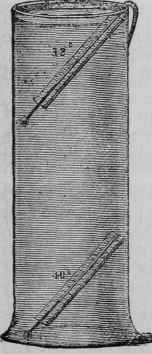
Dr. Hope's experiment.
"It is evident that the fish, if frozen, could have no power of locomotion - they must die; so that on the arrival of winter the Siberian waters would throw up their dead fish, as all would be killed if the water, which is a very bad conductor of heat, did not remain at 400 at the bottom of the lakes, rivers, and seas.
" Bismuth is said to possess the same curious property of expanding whilst it is being cooled, and thus iron bottles filled with melted bismuth, and plugged with a screw, burst at the moment the metal assumes a solid state".
This expansion of ice is supposed to be caused by the ice-crystals not fitting as closely to each other as the particles of water do.
Ice is considerably lighter than water; it floats on the surface of streams and ponds while the water flows beneath it, and is not chilled by the ice into freezing, when the surface is once covered; for as we have said before, water is a bad conductor of heat or cold, and the ice acts as a shield to prevent the cold air freezing the river by convection. We see divine wisdom in this law, for if the ice were a good conductor of cold, or if it were heavier than water and were to sink to the bottom, rivers would become blocks of solid ice which no heat could thaw, and all creatures inhabiting them would perish. As it is, the ice preserves the water fluid for us in the severest weather. Of course the ice thickens in protracted cold, because the heat of the water immediately beneath escapes through its pores into the cold air; but our English frosts never last long enough to allow this slow conduction to convert the whole of a large body of water into ice.
Water is composed of two gases, oxygen and hydrogen - eight parts oxygen to one part hydrogen. It is fluid because its particles are kept separate by latent heat. When a certain quantity of this heat has been driven out the water becomes solid - that is, ice. We speak of water as salt or brackish water, hard water, and soft water. Salt water is that of the sea, which holds in solution a quantity of saline matters. Hard water is that obtained from springs in the ground, from rivers, pumps, and wells. Soft water is that of rain.
"Water is presented to us in nature having different degrees of purity; hence we speak of hard or soft water. The former may contain calcium carbonate and sulphate, magnesium carbonate and sulphate, sodium sulphate and chloride, and many other substances, in considerable quantities, especially if the water flowing into the well be derived chiefly from surface drainage. When rain-water has been collected after several hours' tain, it is almost in a state of purity, containing then only certain gaseous matters in solution: such water is usually called soft, because it is free from the salts already mentioned. If the rain-water be collected after a long drought, it may then contain nitrates and salts of ammonium, and, if near the sea-side, would always contain sodium chloride or common salt".
Continue to:


My Books

