


Cinematograph Acting - A New Profession For Men And Women
Description
This section is from "Every Woman's Encyclopaedia". Also available from Amazon: Every Woman's Encyclopaedia.
Cinematograph Acting - A New Profession For Men And Women
Fortunes in Faces - Stage versus Screen - A Stupendous Salary - The Art of Acting in Dumb
Show - A Story as Acted for the Cinema
A really new profession is a remarkable thing. Acting for the cinematograph can now be regarded as a legitimate and lucrative profession, standing absolutely alone; for the rules of stagecraft and stage precepts have no bearing before the bioscope. America and France are the leading countries for cinema work, but within the last year every big American and French firm has opened a branch in London, and offers employment to English players of both sexes. Many English firms also have arisen.
Stage v. Screen
Many firms move their actors, and keep working all the year by following the sun round the world. They stay two or three months in the sunshine, and move on with the sun. Even if cinema work in England can only be obtained during nine months out of twelve, the rate of payment is so much better than for average stage work that it provides ultimately a larger income for players who would otherwise only draw small salaries on the stage, with the possibility of being out of work for months.
Many "legitimate" actors and actresses are now playing for the cinema, and doing very well; though, strangely enough, it is not always the best stage players who do well in film work.
Acting for the cinematograph is not at all the same thing as playing a part behind the footlights. In fact, cinema acting is an art that stands absolutely alone, and needs considerable skill and infinite practice.
By changes of facial expression and gesture, film actors convey an entire series of emotions and passions in one short play. Through the lack of words it follows that every movement has to be practically perfect, decisive, and deliberate in order to gain any effect. A mistake made by many stage players when first trying cinema work is to hurry all their actions. This is a fatal mistake. The machine is worked rapidly, recording an average of sixteen distinct pictures in a second. If the actors moved quickly the result would be blurred. Acceleration of speed comes when the film is shown, if necessary; but before that can be done the figures and faces of the actors have to be clear, not muddled.
The Film Dancer
Dancing is very seldom successful on a film, for this very reason; when it occurs the dancers endeavour to perform every movement at half its real pace, and this often ruins the dance.
A beginner at cinema work would do well
Woman's Work to take as a motto, "Don't hurry; be sure, and slow." Many successful actors and actresses have proved failures at cinema work through sheer lack of adaptability. A stage actor often scores by reason of a charming voice, or subtlety of expression. A voice is useless in cinema work; and delicate technique is valueless. But, on the other hand, actors are the most adaptable of all people, and a very little practice enables them to alter their methods, and achieve success.
Cinema work is not hard to obtain, for the right people are not always those who apply, and, consequently, there are more vacancies than possible applicants imagine.
Most big film firms have a London office, where managers interview likely players, usually in the morning.
The offices are mostly in the neighbourhood of Charing Cross Road and Piccadilly Circus; and the names of well-known firms can be learned from any cinema house, as every film has the maker's name attached. Once the names of firms are known, it is easy to obtain the addresses from a directory.
If it is impossible to interview managers (who prefer to see their possible players personally for this kind of work) a good plan is to write to them, stating any qualifications for the work, experience gained, and enclosing a picture, if possible. Most firms return a form, to be filled up, asking if the applicant can drive, ride, swim, row, fence, dance, etc. Any sort of sporting accomplishment is invaluable to film actors, as they are often expected to dive into the sea, row a boat in a gale, drive a motor at 60 miles an hour, or fight a duel "to the death."
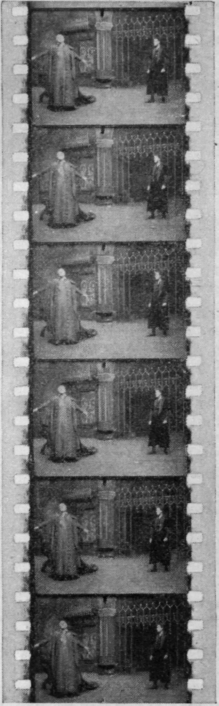
One of the marvellous films taken of Sir Herbert Tree's production of "Henry VIII.," for which the record price of £1000 was paid. The film is here shown in its actual size
It is rather remarkable that there are many film actors and actresses drawing salaries running into four figures, whose names are quite unknown to their audiences, but whose faces are famous the world over. There are, indeed, fortunes in faces to the lucky film players who "make good" at this work, and are engaged in stock companies at a big salary.
In Great Britain there are now over 3,000 picture theatres; and in each one dozens of players act several times daily - in dumb show - to audiences numbering millions. Three big American firms employ 1,200 players of both sexes as their permanent staff, this number being frequently added to for occasional films.
A "film face" is not of necessity beautiful, but clear-cut features and a mobile expression are leading characteristics of most cinema stars. Medium height is desirable for this work, as tall, thin people never "take" well, except for character work. A capacity for make-up, and the ability to convey character by means of facial expression and action with the hands are great assets in cinema work. Stage actors depend on subtlety of voice in character work, but the cinema player is dependent solely on his powers of pantomime.

Continue to:


My Books

