


Musical Culture For Concert Lovers
Description
This section is from "Every Woman's Encyclopaedia". Also available from Amazon: Every Woman's Encyclopaedia.
Musical Culture For Concert Lovers
Hearing Music Intelligently a Matter of Education - The Concerto and its History - The Symphony -What is Meant by a Suite - Chamber Music - The Rise of the Solo - The Cantata and How it
Differs from the Oratorio
There are many concert lovers who lament their lack of musical culture; who have to own, indeed, to hazy ideas concerning all the greater works that make up a classical programme.
A concerto, for instance, is not infrequently confused with a symphony, yet what different places these occupy in the world of tonal art. The first is a work which gives its leading theme to one instrument throughout. This may be the piano, violin, or violoncello. The other instruments are subordinate, and accompany the soloist. The symphony, on the other hand, gives no prior place to any instrument, though in parts strings, brass, and wood divide important subjects between them.
This concerto went through many forms before taking on its more recent garb. Quite an early one was the single voice idea, with thorough bass organ accompaniment. Haydn, Mozart, and Beethoven all loved the concerto, and used it for some of their highest inspirations. Mendelssohn's immortal violin concerto will be in the minds of all concert lovers. Latter-day composers use it for the mere display of technical difficulties, rather than because they have any true message for one special instrument.
The History Of The Symphony
The symphony had its beginnings in very simple fashion, the name being used in mediaeval times for a work confined to a bagpipe, organ, and flute. Scarlatti developed it notably, and a hundred years later Haydn, followed by Mozart, Beethoven, Schubert, and Brahms brought to it the richest stores of their genius.
Its characteristic movements are an impressive adagio, a lengthy woven allegro, a soothing andante, and the graceful minuet, followed by the trio, so called not because the subject is written for three instruments, but because it is in triple time.
It was Beethoven who introduced the whimsical, sportive scherzo in place of the minuet. It is found, for the first time, in the "Eroica."
Minuets as separate compositions are familiar items of a concert programme. Composers of every period love to set this seventeenth century French dance to dainty melodies.
Yet another work about which we should have a clear conception is the concert overture. This must stand distinct from the kind that makes the opening to Grand Opera. Mendelssohn wrote several of this type, the "Hebrides" being the most noted.
A suite is merely incidental music inspired by romantic narratives. The " Peer Gynt" suite, for instance, is Grieg's tonal illustration of a weird Scandinavian epic. To read this epic is to find the full meaning of the music. Schumann's setting to Byron's ' Manfred " is a similar composition, and as one's musical education proceeds, there is distinct pleasure in noting the ways in which composers approach the narrative poem.
Chamber Music
None of these works can come under the title of chamber music, the form of concert beloved of Louis XV., Frederick the Great, and Queen Elizabeth. The lines of its programme are the sonata, trio, quartette, quintette, sextette, septette, and octette. In Queen Elizabeth's time the madrigal was always included, and its revival would be a great artistic gain.
It is an advance in musical culture to be able to trace the similarity of form in the instrumental works to the symphony, which, one may say with truth is a glorified sonata. Somewhat differently disposed, there come into it all the movements already mentioned as characteristic of symphonic construction.
Into a chamber music concert Bach's " Chaconne " often finds its way. It will make this work more enjoyable to be acquainted with its nature. A chaconne is an air founded on an old Moorish dance in triple time, given out on a ground bass of eight majestic bars. From this beginning it develops a series of variations of great artistic value.
The Recital Programme
The recital programme draws largely on what musicians call the romantic school. Under such a term can come the noveletten, faschingswank, papillons, fantasies, rhapsodies, ballades, polonaises, impromptus, and all dances of the Chopin mode of treatment. Such works are not formally divided into movements on the old classical model, but are swift, continuous outpourings of great emotional appeal. In them plaintive melodies, and tumultuous outbreaks change places rapidly, without real break in the theme, or any sense of actual close.
The term polonaise arose from the name of a curious Polish national dance, in which the dancers make a sort of dancing promenade in three-four or six-eight time. Chopin did not set this nor his mazurkas and waltzes to serve as actual dance music, but to present dancers and dances as a living picture to the mind. In the same category should be placed the entrancing waltzes and Hungarian dances of Brahms.
The Development Of The Solo
Turning to the vocal side of the concert-room, the actual solo song of our programme had its beginnings, apart from choral singing, about 1601. The first book of poems set to music for the single voice was published that year in Italy. As the solo crept into the simple cantatas of that period it was received with the greatest enthusiasm.
Cantata and oratorio differ thus : the former has its events given out by the singers as impersonal narrative; the latter has the parts actually assumed, each character voicing its own happenings in the first person, as on the stage. To use the language of poetry, the cantata is the epic, the oratorio, the dramatic poem.
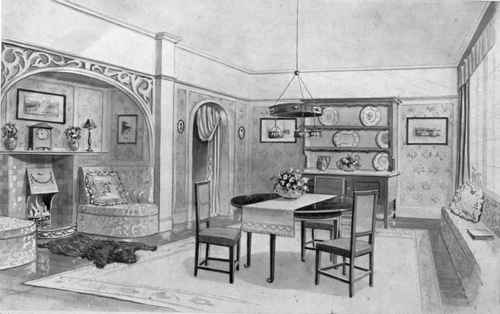
A charming dining-room- furnished with a sense of proportion and simplicity which creates an impression of restfulness and comfort as well as of good taste and beauty. The door has been taken down and replaced by a wooden arch and draped curtian. See page 4307 beauty. The door has open taken
Continue to:


My Books

