


Jam
Description
This section is from the book "Choice Dishes At Small Cost", by A. G. Payne. See also: Larousse Gastronomique.
Jam
In making jams or preserves, care must be taken, first of all, that the fruit is gathered on a dry day, and when the morning sun is on the garden. If gathered in damp or foggy weather the jam will certainly become mouldy, and will not be worth the trouble and expense of boiling. The fruit should be free from dust, and any that is unsound should be cast aside; It should be boiled as soon as possible after it is gathered. • The best quality of sugar, either white or brown, will be found the cheapest in the end. White sugar should be shining and close in appearance; brown sugar, bright and gravelly. The inferior sugars throw up so much scum in boiling that they waste as much as they save. The quantity of sugar required depends upon the nature of the fruit. As there is no economy in using inferior sugar, there is also no economy in using too little sugar. The only result of endeavouring to save in this way is that the jam has to be boiled so much the longer, and thus the quantity is reduced; to say nothing of the expenditure of fuel. If, on the contrary, too much sugar is used, the flavour of the fruit will be lost. In making common jams, the fruit should be well boiled before the sugar is added, and care should be taken that it is not so much thickened that the sugar will not easily dissolve. Sugar should never be reduced to powder before it is added to the fruit, or it will give the jam a turbid appearance. The scum should be carefully removed as it rises.
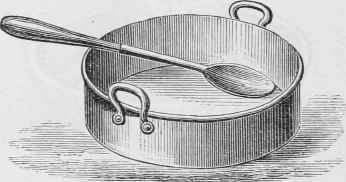
PRESERVING - PAN.
Wooden spoons should be used for stirring jam. Iron, tin, or pewter ones will spoil the colour.
An enamelled saucepan is the best for making jam. If a brass preserving-pan is used, it should be scrupulously clean, bright, and dry. The pan should be raised a few inches above the fire. If placed flat on it, the fruit will be in danger of burning. The flavour and colour will be best preserved if the fruit is boiled rapidly. It should be watched constantly and stirred frequently during the process of boiling.
Home-made jam, when properly prepared and well preserved, is incomparably superior to that which is offered for sale.
In making jam from stone fruits, the stones can be removed previous to boiling, or afterwards. Only sufficient water should be added to simply prevent burning. Care should be taken to get rid of the moisture, as all jams made from stone fruits are apt to ferment. When lemon-rind is added it must be grated very fine. In stone fruit jams some of the stones should be cracked, and the kernels halved and added.
In all jams a little brandy may be added with advantage. Jam when finished should be placed in jars, covered over with a thin piece of paper soaked in brandy, and another piece of stout paper tied over the jar as tightly as possible.
The following is a list of the quantity of sugar and other ingredients required for making the jams named. One pound of fruit is supposed in each case: -
Apricot Jam
Three quarters of a pound of sugar.
Blackberry Jam
Half a pound of sugar. If apple is mixed, a little more.
Carrot Jam
Boil till tender; rub through wire sieve. (See No. 21). The rind and juice of one lemon, a small glass of brandy, one pound of sugar. To make the jam look very nice, only use the red part of the carrot.
Black Currant Jam
One pound of sugar.
Red Currant Jam
One pound of sugar.
Damson Jam
One pound of sugar.
Gooseberry Jam
Three quarters of a pound of sugar.
Greengage Jam
Three quarters of a pound of sugar.
Plum Jam
One pound of sugar.
Raspberry Jam
One pound of sugar.
Rhubarb Jam
Three quarters of a pound of sugar, half the rind of one lemon, half an ounce of bitter almonds, or, if no almonds, juice of one lemon.
Strawberry Jam
Three quarters of a pound of sugar.
Vegetable Marrow Jam
Three quarters of a pound of sugar, rind and juice of one lemon, one teaspoonful of powdered ginger. Peel the vegetable marrow, take out the pips, cut it up into pieces, and simmer till tender. The ginger can be omitted and more lemon-juice added.
Continue to:


My Books

