


Lemon Jelly
Description
This section is from the book "Choice Dishes At Small Cost", by A. G. Payne. See also: Larousse Gastronomique.
Lemon Jelly
Take six lemons, rub half a pound of sugar on the peel of three of them, and squeeze the juice of all six into a basin. Soak two ounces of gelatine in a pint of water, after first washing the gelatine. Add it to the sugar and lemon-juice, and dissolve it in a small enamelled saucepan over the fire, and strain through a jelly-bag. If it is not bright, clear it with the whipped white of an egg, exactly as stock is cleared (see No. 18) and strain it through a jelly-bag (see Jelly-bag). Add, when nearly cool, half a pint of sherry. Pour it into a mould that has been held over some steam so as to get moist inside. "When it is set, dip the mould into rather warm water for a second, place a glass dish over the mould, turn it quickly upside-down, and turn it out.
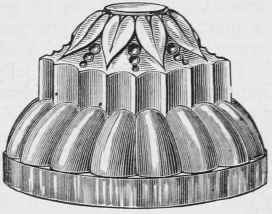
JELLY MOULD.
In turning out the jelly, the dish and mould should be held together in two hands, then make a quick but not too violent movement downwards, as if you were going to throw the dish on the ground, and suddenly stop: this will generally bring the jelly out. If it cannot be got out otherwise, dip the mould for a second or two into warm water. But this must be done very carefully, or the sharpness of the mould will be spoiled.
This is very good simple lemon jelly; you can make cheaper jelly by putting much less wine and only two lemons. Two ounces of gelatine will always set a quart. A great improvement, but by no means essential, is to boil a stick of cinnamon and a pinch of coriander seeds in the jelly.
A very important point for consideration is the consistency of the jelly. Two ounces of gelatine is generally too much, especially in winter, but gelatine so varies in quality that it is scarcely safe to recommend less. Remember that jelly is best when it will only just hold together, and fit for nothing when you almost have to cut it with a knife and bite it. If it is winter, or if you have any ice, you can test the jelly by putting, say, a saucer in the snow or ice. Wipe it dry, and put a teaspoonful of the jelly into the cold saucer; it will set almost immediately, and you will be able to judge whether it is too stiff or not.
Another point is colour. Rubbing the sugar on the peel will give a pale yellow colour, and many persons think it best so. I think, however, four or five drops of cochineal gives it tone; you do not want to make it pink.
The above receipt gives the basis of all jellies. You can add various kinds of liqueurs in less quantity instead of the wine, and vary the name of the jelly accordingly.
Orange Jelly
Act exactly as above, only using six oranges and two lemons, rubbing the sugar on three oranges.
Continue to:


My Books

