


Roast Pheasant
Description
This section is from the book "Choice Dishes At Small Cost", by A. G. Payne. See also: Larousse Gastronomique.
Roast Pheasant
A pheasant should be kept and hung for some time before roasting; a fresh pheasant is flavourless. On the other hand, it should not be high, but just getting so. Pluck, draw, and truss the bird, and roast (see No. 3) before a clear fire, basting with a little butter. Time to roast, about forty-five minutes; to roast in an oven, rather less, for an ordinary-sized bird. Keep some of the long feathers to stick in the tail after placing it on a dish. Serve bread sauce (see Bread Sauce) and good brown gravy with it.
How To Carve Roast Pheasant
Fix the fork in the centre of the breast, and cut slices off evenly on either side. Should there be more persons to partake of the roast pheasant than these slices will satisfy, disengage the legs and wings in the same manner as is done when carving boiled fowl. In taking off the wings, be careful not to cut too near the neck; if you do, you will hit upon the neckbone, from which the wing must be separated. Cut off the merrythought by passing the knife under it towards the neck. Cut the other parts as in a fowl. The breast, wings, and merrythought of a pheasant are the most highly prized; but the leg has a superior flavour.
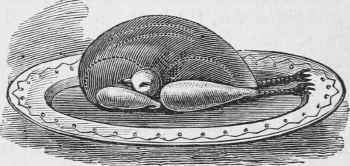
ROAST PHEASANT.
Salmi Of Pheasant
Proceed in every respect as making a salmi of partridge. (See Partridge, Salmi of).
Trussed Pheasant
The pheasant may be trussed either with or without the head. If without, care must be taken to leave sufficient skin on the neck to skewer back; if the head, however, is left on, it must be brought round under the wing, and fixed on the point of a skewer, with the bill laid straight along the breast. In this case, the crop must be removed through a slit made for the purpose in the back of the neck. Draw the bird, bring the thigh close under the wing, pass a skewer through the pinion, the body, and the leg, and skewer and tie the legs firmly down.
Continue to:


My Books

