


Beating Eggs
Description
This section is from the book "Practical Cooking And Serving", by Janet McKenzie Hill. Also available from Amazon: Practical Cooking and Serving: A Complete Manual of How to Select, Prepare, and Serve Food [1919].
Beating Eggs
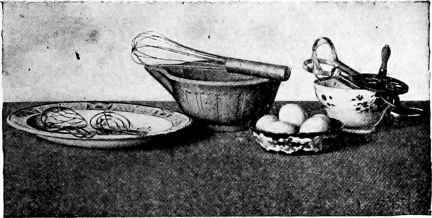
Utensils for beating eggs. Flat beaters, Confectioner's whisk, Dover egg beater.
Without taking into consideration the fact that eggs enrich mixtures, they are added either to thicken a mixture, or to thicken and render a mixture light. Lightness is not always desirable. When eggs are added simply to thicken a mixture they should be beaten only until the whites and yolks are well mixed, i.e., without separating the whites from the yolks and until a spoonful of the mixture can be taken up and held in the spoon. A spoon, fork, whisk, or Dover egg-beater may be used. When the eggs are added to insure lightness the yolks and whites should be beaten separately - the yolks until thick and lemon-colored, and the whites until dry.
Various textures may be given to the whites of eggs in beating, by a judicious selection of the utensil used. If a close texture be desired, choose the Dover egg-beater; a looser texture is insured by the confectioner's whisk, and a still looser texture by the flat-beater. The reason for this lies in the fact that the whisk and flat-beater carry into the mixture more air, half the utensil at each motion being first in the air and then in the egg, while the Dover beater is immersed in the egg until the egg is beaten.
In using the Dover egg-beater, let it rest lightly in the bowl, beating slowly at first, then increasing in rapidity. To beat well eggs should be cold and fresh; a few grains of salt may be added to the whites to hasten the process.
Continue to:


My Books

