


Part 3. Chapter 6. Hospitality and the Etiquette of Entertaining
Description
This section is from the book "Practical Cooking And Serving", by Janet McKenzie Hill. Also available from Amazon: Practical Cooking and Serving: A Complete Manual of How to Select, Prepare, and Serve Food [1919].
Part 3. Chapter 6. Hospitality and the Etiquette of Entertaining
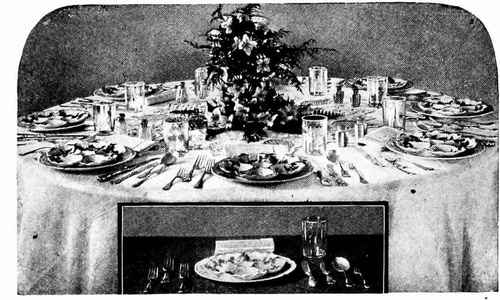
Dinner Table, First Course
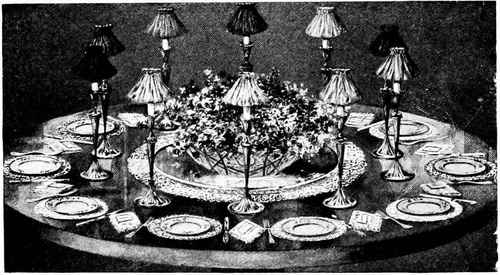
Luncheon Table, Centrepiece Of Sweet Peas
"He must leave the omniscience of business at the door when he comes into the palace of beauty."
At the beginning of the Christian Era, hospitality was enjoined as a sacred duty. Timothy enumerates among the attributes of a bishop that he "must be a lover of hospitality." The laity also are exhorted by him to "use hospitality one to another without grudging." In those days, when inns did not abound, and the traveler could not readily procure food and shelter, an indiscriminate entertaining of guests must have been oftentimes a tax on courtesy.
But, as times changed, invitations began to precede and become warrant for the acceptance of hospitality; and the old-time duty was gradually transformed into a flattering expression of personal favor. For trust and confidence in one who has been invited into the presence of your lares are implied.
Eating is a chief and natural concern of life. It is, moreover, a pleasure; and she who charges herself with the entertainment of a guest becomes responsible, in a measure at least, for his temporary comfort and happiness. Like all other pleasures, that of the table is increased as it is shared; yet those who are bidden to break bread together should be congenial spirits. There needs be some common ground upon which all can meet. It is Montaigne who says that a man is not so much to regard what he eats as with whom he eats; and he commends Chilo "that he would not engage himself to be at Periander's feast till he first was informed who were to be the other guests." The sequence is natural; for, when one entertains another, and eats and drinks, with more deliberation than is customary - hygienic consideration to the contrary - the hour needs be filled with "good discourse and pleasant talk." This it is that best gives relish to a feast.
Having bidden, then, congenial company to meet at her table, the hostess must needs give attention to the food that is to supply the mental and physical wants of her guests. As no one course must be drawn out to unseemly length, so no one subject of conversation should engross too much attention. Then, too, the discourse, like the dishes in the menu, must be such as will be appreciated by the company. Sameness, which engenders weariness, needs be avoided; and controversy must never be admitted. Upon the hostess devolves largely the duty of keeping the conversational ball rolling briskly back and forth, to the end that each guest may take his turn without apparent effort or seeming premeditation. Truly, the hostess plays no inconsiderable part in a successful evening's drama; and, certainly, to cultivate and refine one's taste, to learn how to lose one's self in the study of what is pleasing to others, has its influence in the formation of character itself. The menu provided for the "refection" of the physical body, while it should be in harmony with the environments and enlivened by the judicious introduction of little surprises, need not be ornate or extravagant. "Flamingoes from Sweden, game from Africa and South America, and pears from Assyria" are not called for.
Within the past twenty-five years times have changed. The "decline of the kitchen" has become an assured fact; and the dweller in a flat, be it in Paris, New York, or the suburb of a more unpretentious city, should not seek to essay the impossible. The vast and seemingly boundless resources of the country that once were, and made lavish providing possible, exist no longer. An elegant simplicity, enough and no more, neither ostentation nor profusion, mark the choicest entertainments of the present day. Perfect cookery, immaculate surroundings, and dainty service, each stamped with the hall-mark of the individual hostess, exemplify the ideal to be sought for by the hostess of the new century.
In the greater number of homes in this country, the menage is limited to a single servant, perhaps, with special work done out of the house or a women to help on some extra occasion. Under these circumstances, do not attempt to entertain guests in a ceremonious style and manner that can be successfully carried out only in those homes where a corps of trained servants is kept. Be natural and simple; retain your friends by manifesting sincere interest in their prosperity, and genuine concern in their adversity. You yourself may not have the time to mingle with the outside world as you would desire; but these friends, if wisely chosen, will be as so many lines stretching out into the world and bringing to your fireside the lights and shadows of human affairs, the events of distant lands and climes, the living questions of the day, for thought and discussion. What more liberal education could one desire for her children?
And should you wish to emphasize your hospitality by some outward sign, attempt only what you can do well and without undue expenditure of time, money or strength. Set before your friends something simple, choice and well-prepared, that which will leave you free from anxiety concerning it. Cyrus, the younger, was conversant with the art of hospitality. We read how he used often to send his friends viands partly eaten, and the halves of loaves, and other such things, desiring the bearer to say, in presenting them, "Cyrus has been pleased with these, and therefore wishes you also to taste of them." And no one, says Xenophon, was ever beloved by a greater number of persons, either Greeks or barbarians. Always select those things that are appropriate to the occasion. If a friend drops in for five o'clock tea, do not make of it an opportunity to serve refreshments elaborate enough for a reception. There is an "eternal fitness" in the small affairs of life, as well as in those of the gravest importance. Give each the thought it deserves. Entertain simply, but often, and so learn to excel.
Continue to:


My Books

