


Recipe For Making Puff-Paste
Description
This section is from the book "Practical Cooking And Serving", by Janet McKenzie Hill. Also available from Amazon: Practical Cooking and Serving: A Complete Manual of How to Select, Prepare, and Serve Food [1919].
Recipe For Making Puff-Paste
Wash thoroughly a mixing bowl, and the hands, or a wooden spatula, first in hot, then in cold water. Fill the bowl with cold water or let stand under the faucet and work in the water half a pound, or one cup, of butter, until it becomes smooth and pliable; then pat, until it is absolutely free from water, and shape into a flat, square cake. If the room be cool, do not chill the butter on ice, since the use of ice is to be avoided if possible. Sift together half a pound, or two cups, of flour and one fourth teaspoonful of salt; reserve two spoonfuls of flour in the dredger for dusting the board, mix the flour to a dough, toss on the board and knead until smooth and elastic; cover and let stand from three to five minutes, then pat and roll out into a rectangular shape.
Put the piece of butter in the centre of the lower half of the paste End fold the other half over it, letting the edge "a" fall on "b." Press the edges together closely on the open side and ends to keep
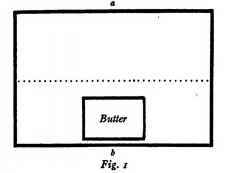
in the air. Figure 2 now represents the paste; "a" represents the butter beneath a layer of paste.
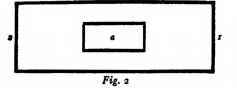
Fold the end marked "1" under, and the end marked "2" over the paste, enclosing the butter, and press the edges together closely. Cover and let stand from three to five minutes. Turn the paste halfway round, pat gently with the pin, thus pressing the paste together in ridges and breaking up into smaller bubbles the enclosed air; roll out into a long strip, keeping the butter enclosed in the paste and the ends and sides even, as herein, in large measure, lies the success of the undertaking.
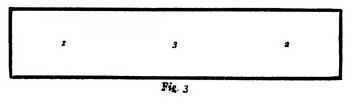
Fold the end marked "1" over "3," and "2" over "1," making three even layers with straight edges; press the edges together and turn the paste halfway round, so as to roll in the opposite direction. Since the butter was enclosed, the paste has been rolled into a long strip and folded "in three." This rolling and folding is called "giving it one turn." Repeat until the paste has been given six turns. Each time, before rolling the paste, turn it halfway round, having an open end toward you, so as to roll the paste from a different side each time. Cut out as desired, and let chill thoroughly on ice; it will take about half an hour. Bake on the lower floor of the oven.
This gives a pastry in which the layers are very distinct. If two tablespoonfuls of butter be worked into the flour before the water is added, a tender crust will result; but the layers will not be distinct as by the first method. In rolling out the paste, take care lest the butter penetrate the dough. As long as the paste slips upon the board or slab, it is in good condition. Never roll back and forth, as the motion will break the bubbles of air, which are to give the paste its lightness. The folding of the paste gives the layers; the cold air enclosed, on expanding in the heat of the oven, gives the lightness.
If the room be cool, this condition may be easily secured; in winter the paste may be quickly made, and without the use of ice. But if the paste does not slip on the slab and shows signs of softening, it should be folded in a napkin and chilled in a pan set between two pans of ice. Having been chilled once, it will require chilling between each two "turns," or, in the case of a novice, after each turn.
Baking Puff-Paste Recipe
Ice-cold pastry and a very hot oven, especially on the bottom, are prime requisites when light puff-paste is the article under consideration. When properly made and set upon the hot floor of the oven, the sudden expansion of the cold air enclosed between the layers sends up the paste. The top of the paste needs be protected from the heat above by a paper or sheet of tin, until the paste has attained its full height. Paste, cut one fourth an inch thick, should rise about two inches in height. Turn, if necessary, that it may rise evenly. To avoid burning on the bottom, when the paste is well risen, very gently push a second sheet under that on which the paste is baking.
Continue to:


My Books

