


Recipes For Making Puff Paste
Description
This section is from the book "Practical Cooking And Serving", by Janet McKenzie Hill. Also available from Amazon: Practical Cooking and Serving: A Complete Manual of How to Select, Prepare, and Serve Food [1919].
Recipes For Making Puff Paste
Shaping And Baking Vol-Au-Vents Recipe
Vol-au-vents are generally shaped in one of three ways, each of which has its advocates.
Vol-Au-Vent With Rim Recipe
Have the paste rolled out into a sheet half an inch thick; with a charlotte mould as a pattern mark out upon it an oval of the size desired; then with a sharp knife, dipped in hot water, cut out the pastry, lay on a piece of double paper on a baking-sheet. Cut out a second piece of paste of same thickness and size; then, with a small charlotte mould as guide, cut out the centre, leaving a rim an inch and a quarter wide; brush the edge of the first paste with cold water and press the rim upon it. Set aside to chill. Bake about an hour. (See Baking of Puff-Paste.) Roll out the pieces, cut out in making the rim, to the size of the other pieces of paste, giving it the same shape; ornament this with figures cut from the trimmings and brush over the under side of each bit of paste with water before pressing it in place; chill and bake about twenty-five minutes. This will serve for a cover.
Vol-Au-Vent Baked In One Piece Recipe
Roll the paste to the thickness of one inch nearly, and cut out in the shape desired; then with the point of a sharp knife, wet in hot water, cut halfway through, an inch and a qaurter from the edge, all around the paste; brush the top with beaten yolk of egg, or beaten egg, chill and bake. Remove the centre carefully and set aside. Serve with or without this piece as the cover. Carefully remove any uncooked paste before filling the vol-au-vent.
Vol-Au-Vent Baked Over A Form Recipe
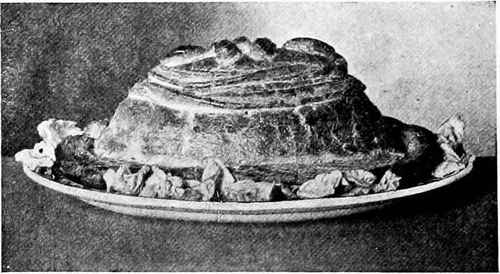
For a large vol-au-vent make two pounds of puff-paste, using three fourths pound of butter to a pound of flour. Roll one third of this into a sheet (oval or round as suits the fancy) one third an inch thick, and trim to the desired shape and size. Scallop the edge or leave it plain. Put the paste upon the baking-sheet and spread over it a large piece of cheesecloth. Roll excelsior into small balls and place these closely together on the cloth, about three inches from the edge, one layer above another, and each layer smaller than the one below, to give shape to the vol-au-vent. Pin the cloth smoothly about these, then roll out the rest of the paste into a sheet one fourth an inch thick. Cut off two or three-fourth inch ribbons of paste, also crescent and diamond shaped pieces for decoration, and roll the rest of the paste a little thinner, then spread it over the cloth filled with excelsior - first lightly scoring the paste all round about six inches from the centre to indicate a cover - trim the paste to meet loosely the under crust, brush with water and press the upper crust firmly upon it. Brush the crust on both sides of scoring with cold water, and press upon it the ribbons of paste. Brush the under sides of the crescent and diamond shaped pieces of cold water, and put them in place inside of the ribbons.
Let chill half an hour on ice, then put into a hot oven, protecting the top of the pie. When well risen, reduce the temperature of the oven and bake, in all, about forty minutes. When cooled slightly, with a sharp knife cut around the crust, in the scorings between the ribbons, and take off the cover. Draw the pin from the cloth, and remove the excelsior, the cloth and any uncooked paste. When ready to serve, reheat and fill with chicken or game heated in a hot sauce. Chicken may be in large pieces, from which the bones have been taken, or in cubes of the size used in filling patty cases. Three chickens will be needed to fill a pie of this size, if the pie is to be served cold, it may be filled with bits of chicken and aspic jelly. The jelly should be cold, but not quite set, when it is turned into the pie alternately with the meat. Cubes of tongue and cooked mushrooms may also be added.
Continue to:


My Books

