


Preliminaries To Making Cakes
Description
This section is from the book "Practical Cooking And Serving", by Janet McKenzie Hill. Also available from Amazon: Practical Cooking and Serving: A Complete Manual of How to Select, Prepare, and Serve Food [1919].
Preliminaries To Making Cakes
Before beginning to mix cake have everything needed at hand, and in such condition that the ingredients can be put together quickly, i.e.
1. Measure or weigh out the exact quantities of the different ingredients to be used. Weight is preferable to measure, especially in the case of butter.
2. Sift the flour before measuring, and sift again with the baking-powder, or soda and cream-of-tartar.
3. Pulverize and sift soda before measuring, and add always to the flour; baking-powder is better sifted, but it may be made light by working with a spoon.
4. To cream butter successfully, it should be at about the temperature of the living room (70° Fahr.). If too cold, it may stand a short time in the mixing bowl after that has been heated slightly with warm water and wiped dry.
5. Have the pans (if the ordinary pan be used) buttered and floured, or lined with paper, and the paper buttered.
6. Break the eggs, one by one, over a cup, separating the whites from yolks when desired. Beat the yolks, but let the whites stand unbeaten in a cool place until the cake is nearly mixed.
7. When fruit is used, cut citron in slices, and then in narrow strips; seed raisins, and cut them in pieces; remove stems from sultanas; wash currants on a coarse sieve, then dry. Fruit to be mixed through a cake may be added to the butter and sugar creamed together, without dredging with flour; in layers, dredge lightly with flour, then, when the cake is mixed, sprinkle in between layers of cake mixture.
The Fire
Electricity, gas, or oil, the heat from all of which may be regulated to a nicety, are ideal fuels for cake baking, and in no branch of cooking is such nice adjustment of heat demanded as in the baking of pastry and cake. Even at the present prices, where one is to bake several cakes in the morning (as do consignors to industrial unions, etc.), electricity or gas will be found more economical than coal. If the fuel be wood or coal, the fire should be in such condition that it may be regulated easily and last through the baking without being replenished - i.e., do not attempt to bake a delicate cake mixture with a freshly built coal fire, or with a fire from which the life has largely died out.
Temperature Of The Oven
Layer cakes and small cakes require a hotter oven than loaf cake. So cakes made with baking-powder call for a higher temperature (the carbon dioxide is evolved more quickly) than do cakes made of cream-of-tartar and soda, lemon juice and soda, or molasses and soda.
Biscuit, or sponge cake, and pound cake, will bake at a lower temperature than cake lightened with carbon dioxide.
Also, cakes made rich with yolks of eggs require less heat than cakes made with whites of eggs - i.e., an oven should be hotter for an angel cake than for yellow form of sponge cake (yolks of eggs are rich in fat, hence they burn quickly).
Cake containing fruit should be baked in a slow oven,
Utensils For Cake Making
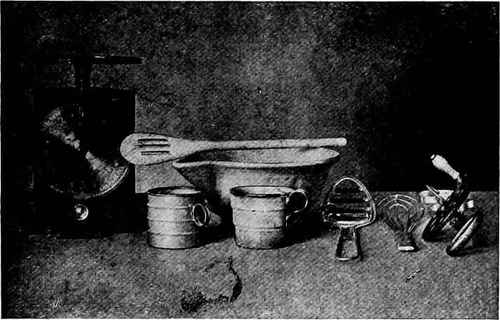
Utensils For Cake Making
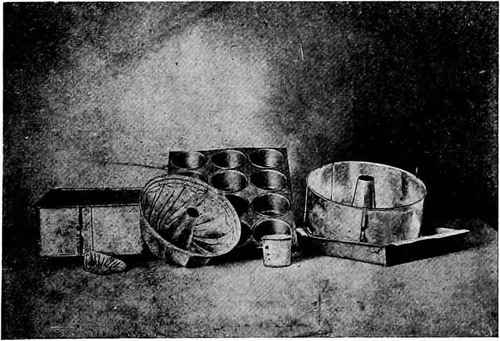
Cake Tins-Sponge, Lemon Queen, Layer. Etc
Earthen bowls for mixing the ingredients and beating eggs, a slitted wooden spoon, an ordinary sized sieve for flour, a small sieve for soda, etc., a Dover egg-beater, an egg whisk, pastry bag, and tubes for lady-fingers, eclairs, and frosting, a small saucepan for boiling sugar, scales, measuring cups, and a variety of baking tins are the most important utensils needed for work in this branch of the culinary art.
Continue to:


My Books

