


The Hardy Border. Part 2
Description
This section is from the book "Amateur Gardencraft", by Eben E. Rexford. Also available from Amazon: Amateur gardencraft.
The Hardy Border. Part 2
By planting low-growing kinds in front, and backing them up with kinds of a taller growth, with the very tallest growers in the rear, the effect of a bank of flowers and foliage can be secured. This the illustration clearly shows.
Shrubbery can be used in connection with perennials with most satisfactory results. This, as the reader will see, was done on the grounds from which the picture was taken. Here we have a combination which cannot fail to afford pleasure. I would not advise any home-maker to confine his border to plants of one class. Use shrubs and perennials together, and scatter annuals here and there, and have bulbs all along the border's edge.
I want to call particular attention to one thing which the picture under consideration emphasizes very forcibly, and that is - the unstudied informality of it. It seems to have planned itself. It is like one of Nature's fence-corner bits of gardening.
For use in the background we have several most excellent plants. The Delphinium - Larkspur - grows to a height of seven or eight feet, in rich soil, sending up a score or more of stout stalks from each strong clump of roots. Two or three feet of the upper part of these stalks will be solid with a mass of flowers of the richest, most intense blue imaginable. I know of no other flower of so deep and striking a shade of this rather rare color in the garden. In order to guard against injury from strong winds, stout stakes should be set about each clump, and wound with wire or substantial cord to prevent the flowering stalks from being broken down. There is a white variety, Chinensis, that is most effective when used in combination with the blue, which you will find catalogued as Delphinium formosum. If several strong clumps are grouped together, the effect will be magnificent when the plants are in full bloom. By cutting away the old stalks as soon as they have developed all their flowers, new ones can be coaxed to grow, and under this treatment the plants can be kept in bloom for many weeks.
"Golden Glow" Rudbeckia is quite as strong a grower as the Delphinium, and a more prolific bloomer does not exist. It will literally cover itself with flowers of the richest golden yellow, resembling in shape and size those of the "decorative" type of Dahlia. This plant is a very strong grower, and so aggressive that it will dispute possession with any plant near it, and on this account it should never be given a place where it can interfere with choice varieties. Let it have its own way and it will crowd out even the grass of the lawn. Its proper place is in the extreme background, well to the rear, where distance will lend enchantment to the view. It must not be inferred from this that it is too coarse a flower to give a front place to. It belongs to the rear simply because of its aggressive qualities, and the intense effect of its strong, all-pervading color. You do not want a flower in the front row that, being given an inch, will straightway insist upon taking an ell. This the Rudbeckia will do, every time, if not promptly checked. It is an exceedingly valuable plant to cut from, as its flowers last for days, and light up a room like a great burst of strong sunshine.
Hollyhocks must have a place in every border. Their stately habit, profusion of bloom, wonderful range and richness of color, and long-continued flowering period make them indispensable and favorites everywhere. They are most effective when grown in large masses or groups. If they are prevented from ripening seed, they will bloom throughout the greater part of the season. The single varieties are of the tallest, stateliest growth, therefore admirably adapted to back rows in the border. The double kinds work in well in front of them. These are the showiest members of the family because their flowers are so thickly set along the stalk that a stronger color-effect is given, but they are really no finer than the single sorts, so far as general effect is concerned. Indeed, I think I prefer the single kinds because the rich and peculiar markings of the individual flower show to much better advantage in them than in the doubles, whose multiplicity of petals hides this very pleasing variegation. But I would not care to go without either kind.
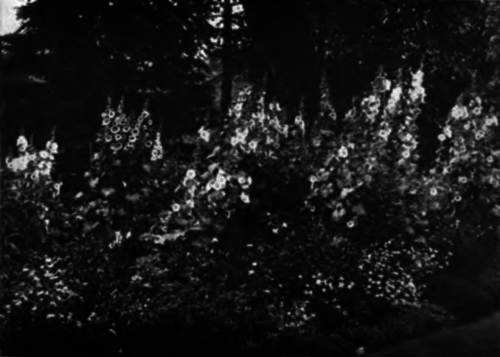 OLD-FASHIONED HOLLYHOCKS
Coreopsis lanceolata is a very charming plant for front rows, especially if it can have a place where it is given the benefit of contrast with a white flower, like the Daisy. In such a location its rich golden yellow comes out brilliantly, and makes a most effective point of color in the border.
Perennial Phlox, all things considered, deserves a place very near to the head of the list of our very best hardy plants. Perhaps if a vote were taken, it would be elected as leader of its class in point of merit. It is so entirely hardy, so sturdy and self-reliant, so wonderfully floriferous, and so rich and varied in color that it is almost an ideal plant for border-use. It varies greatly in habit. Some varieties attain a height of five feet or more. Others are low growers, - almost dwarfs, in fact, - therefore well adapted to places in the very front row, and close to the path. The majority are of medium habit, fitting into the middle rows most effectively. With a little care in the selection of varieties - depending on the florists' catalogues to give us the height of each - it is an easy matter to arrange the various sorts in such a way as to form a bank which will be an almost solid mass of flowers for weeks. Some varieties have flowers of the purest white, and the colors of others range through many shades of pink, carmine, scarlet, and crimson, to lilac, mauve, and magenta. The three colors last named must never be planted alongside or near to the other colors, with the exception of white, as there can be no harmony between them. They make a color-discord so intense as to be positively painful to the eye that has keen color-sense. But combine them with the white kinds and they are among the loveliest of the lot. This Phlox ought always to be grouped, to be most effective, and white varieties should be used liberally to serve as a foil to the more brilliant colors and bring out their beauty most strikingly.
Continue to:


My Books

