


Peach Buds And Their Untimely "Taking-Off."
Description
This section is from the book "The American Garden Vol. XI", by L. H. Bailey. Also available from Amazon: American Horticultural Society A to Z Encyclopedia of Garden Plants.
Peach Buds And Their Untimely "Taking-Off."
BEFORE the winter just closed was more than half through, it became evident that the season was to be a most exceptional one, and the peach as a sensitive fruit tree was selected as a subject for microscopic examination of the flower buds. On the third of January, twigs of the peach were obtained from a number of New Jersey growers. At that time, while there was some swelling manifest, no injury could be observed. From that date until the time of writing (March 19) fresh buds were inspected almost every week, especially following any cool spell, there being nothing that could be called real cold weather until near the middle of March. During the past week a large number of buds have been examined, some lots of which had no living buds, while others showed the rate of mortality not lower than seventy-four per cent.
The facts, well known to every peach-grower, are quickly stated. The winter was a warm, moist one, and the peach, being one of those trees easily stimulated into activity, began to push its flowers, and by the middle of January many blossoms had appeared. All such flowers it was natural to expect would prove fruitless, and the peach-growers hopes were centered in those flower buds that did not more than swell, some of them only slightly. Up to the 10th of March the peach crop for New Jersey, for example, was not specially impaired. At that time, while some of the more forward trees in the warmly exposed situations, as hillsides sloping to the south, were not in the best condition, the owners of the orchards counted upon a fair crop, provided the weather would not change to that of an ordinary winter. At a, in Fig. 1, is seen a portion of a twig showing the condition of the buds at the coming of the "March freeze," which, in passing it may be said, was far above zero for all parts of New Jersey. The figure was drawn from an average twig, and it represents three of the flower buds with their scales loosened one from the other.
To the feeling such buds are soft, and in some cases, by looking down upon them, the rose color of the infolded petals is apparent, and occasionally a stamen shows its yellow anther. In order to bring out the swollen condition more strikingly, a portion of another twig, b, is placed by the side of a, on which the buds are of their normal size for the time of year at which I am writing.
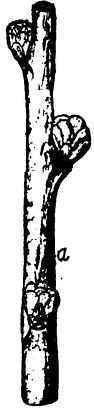
FIG. 1. Peach Buds.
The real condition of things within the bud scales is show to some advantage in Fig. 2.
At a, the bud is represented as in a normal midwinter condition, while at b we have a thin longitudinal section through the half-opened bud. In the center of all sits the pistil or miniature peach, which is of the shape of an Indian club, the large basal portion finally maturing into the luscious fruit. There is no great change in the pistil between the two buds, the one in b being larger and better filled out. In a, the stamens are small and the anthers often suspended, the cup bearing them coming quite close up to the pistil. In b, the anthers are larger and upright, while the cup is expanded at the top into an inverted bell. The scales, also, instead of folding over the pistil are extended laterally, and have grown to double their former size.
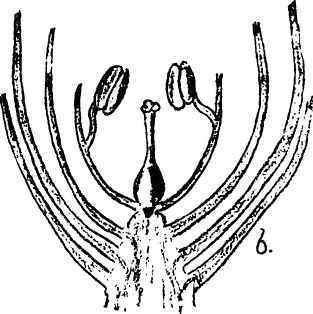
Fig. 2. Peach Buds in a Normal (a) Winter Condition and Half-opened (b).
Such are some of the more prominent structural differences between the closed and the open peach bud in winter. The fact that one bud is open and the other closed is not enough to account for the differences of behavior of the two towards a low temperature. It is natural to infer that the cold can get into one and not the other, and therefore the freedom of access is sufficient reason for frost killing. We need to look back of this visible difference to the condition of the vital portions of the bud. It is a well known fact that any living vegetable tissue that is in an inactive condition will bear extremes of heat or cold much better than one that is undergoing growth. A dry seed, for example, will not suffer under circumstances in which it would perish if filled with water, and a growing seedling may be still more susceptible. The whole design of a scaly winter-bud is to be quiet, and, as far as possible, avoid sudden changes of temperature. A well-prepared bud is in many respects like a mature seed, and becomes most subject to the influences of heat and cold only when it begins to unfold. The most delicate tissue is one that is growing or upon the eve of growth.
The opening out of the peach bud scales helps to expose the tender parts within, but the cause of the opening of the scales is the one that has rendered the vital central parts vastly more tender than they were when in a hibernating condition. When a peach bud has been killed, the pistil is among the first parts to show the fatal effects. Instead of being green - the only green portion in the center of the flower - upright and plump, as illustrated at a, in Fig. 3, it turns brown, shrivels, and the slender part twists, as shown at b. Next outside of the pistil the stamens change in the same way, and later the crown or calyx to which the stamens are attached loses its healthy appearance and becomes of a dark brown. In short, all that part of a flower bud lying within the inner scales usually turns dark. In b, Fig. 3, for example, it is all of the flower that is attached to the tip of the short branch bearing the miniature peach, or all above a small obscure triangle that may be seen below the base of the pistil. The petals also turn to a dark color, but these are borne by the crown, and therefore come within the area described. On account of the scales retaining their color, it is not always easy to distinguish the dead bud from the outside for a long time after death.
As the tender parts within when killed dry up to a powdery mass, especially the stamens, a pinch of the bud is often sufficient. However, the best test for the orchardist is to make a longitudinal cut through the center of the suspected bud, and if the central portion is dark nothing more need be hoped of such buds.
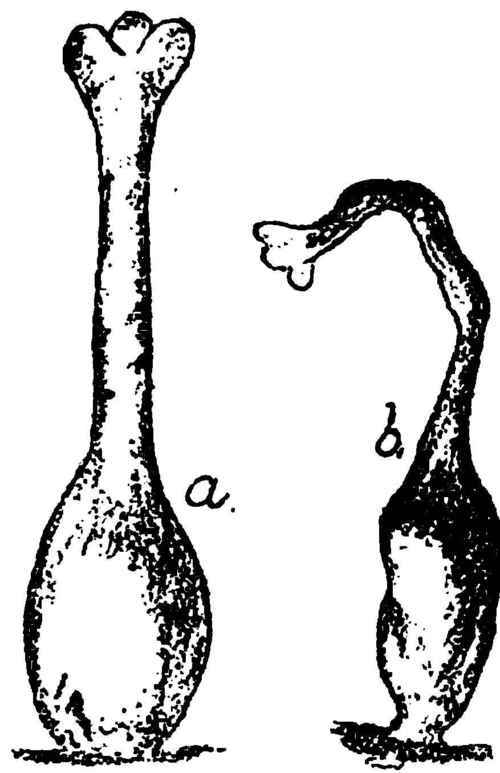
Fig. 3. Peach and Pistils.
This has been a test winter in some respects, and it is hoped that every one will learn some valuable lesson from any loss sustained. If some varieties of peaches have come through better than others, make a note of the fact and be governed accordingly; it is by continuous selection that we shall attain hardiness.
Byron D. Halsted.
Rutgers College, New Jersey.
Continue to:


My Books

