


Apple. Part 3
Description
This section is from the book "A Dictionary Of Modern Gardening", by George William Johnson, David Landreth. Also available from Amazon: The Winter Harvest Handbook: Year Round Vegetable Production Using Deep Organic Techniques and Unheated Greenhouses.
Apple. Part 3
Hagloe
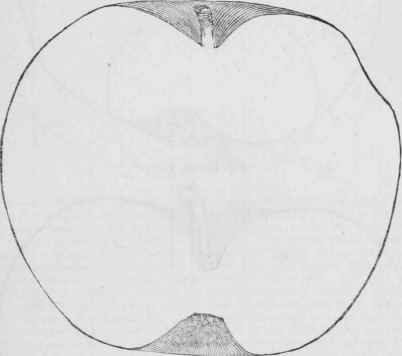
(Hagloe Crab of Coze: Downing.) (Fig. 6.) There is evidently some blunder as regards this apple, which was imported by Coxe, and described by him. It is unquestionably not the Hagloe Crab of the English, a cider apple of high repute, to which, it is believed, this has no pretension. It is said that Coxe himself discovered the error, and designed correcting it in a future edition of his work. It occurred from the label having been lost in the original package, and a loose Hagloe Crab label being found, was supposed to attach to the tree in question.
It is now well known in Pennsylvania and New Jersey, as the Hagloe, the Crab having been dropped, and is much esteemed in the Philadelphia market as a cooking apple; its fair size, above of very different appearance. The size is in good specimens, above medium; outline rather flattened, and narrowing towards the blossom end. Calyx quite small, nearly closed and set in a shallow basin. Stem short, seldom rising to the crown of the fruit. Flesh white, with occasional pink streaks and clouds; crisp, and when over ripe, mealy.
Fig. 6. - (P. 45).
Early Queen
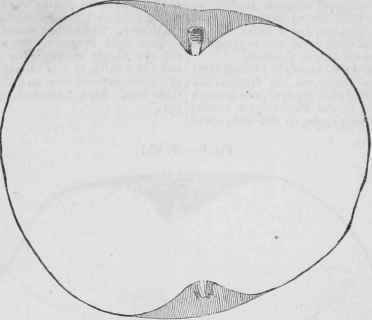
(Fig. 7.) The apple here represented, has been known for many years around Philadelphia by the above name; it is one of the earliest seen in our market, making its appearance early in July and continuing throughout August. When ripened in the sun it is nearly of a uniform aspect - striped and clouded with red of darker or lighter shades on a greenish-yellow ground, the red frequently the prevailing colour: others ripened in the shade have but little red, the stripes more distinctly marked on a greenish ground, thus presenting fruit from the same tree medium, and great beauty, recommend it for the table. The prevailing colour is yellow, streaked with red of darker or lighter shades, and with a delicate bloom on well-ripened specimens. The outline round, sometimes a little irregular. Stem short; the eye deeply seated. The flesh is soft and woolly, as it is termed, which of course detracts from its quality as a table fruit. Ripe, August and September.
Fig. 7. - (P. 47).
Baldwin
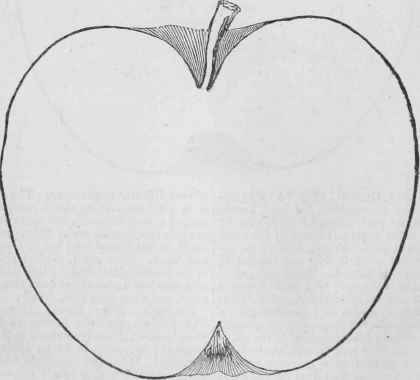
Ken: Down. (Fig. 8.) The Baldwin, partially known as the Woodpecker, is nearly confined to New England; but ought to be an apple of the world. It has few superiors, and is above average quality in all respects.
Fig. 8 - (P. 47).
48 - ♦
Its flavour is rich and sprightly. Flesh yellowish and crisp; few taste it without admiration.
The outline is round, flattened at the stem end and narrowing towards the eye; ground colour yellow obscured by red and crimson shading and slightly marked by russet near the stem, which is rather deeply planted. In season from November to March.
Continue to:


My Books

