


Green-House
Description
This section is from the book "A Dictionary Of Modern Gardening", by George William Johnson, David Landreth. Also available from Amazon: The Winter Harvest Handbook: Year Round Vegetable Production Using Deep Organic Techniques and Unheated Greenhouses.
Green-House
This is a winter-residence for plants that cannot endure the cold of our winter, yet do not require either the high temperature or moist atmosphere of a stove [i. e. hothouse] .
"The first thing to be attended to in its construction," says Mr. H. Fortune, of the Chiswick Gardens, "is the choice of a proper situation. South is the best aspect, or as nearly that as possible: south-west or south-east will do, or even east or west; but on no account should it ever face the north. Green-houses should be fixed in situations where they will not be shaded from the sun by any part of the dwelling-house, or other buildings, and should also be quite free from large trees. They should not be placed near trees for another reason than being shaded by them, namely, the glass in the roof being apt to be broken by the rotten branches which are sent down during high winds.
"Another most desirable consideration is, to make arrangements for a constant supply of rain-water. This is very easily done when the house is building. Gutters are wanted to carry the wet off the roof; and, in so doing, letit be brought into a tank in the house, and used for watering the plants. Slate-tanks may be used for this purpose, or they may be built of brick and cemented over on the inside. This will be economy in the end; and the water collected in this way is much to be preferred to many kinds obtained from springs.
"A drain should be made to enable the tank to be emptied at pleasure, and into which the water used in washing out the house can be swept, without running into the tank." - Gard. Chron.
The following is the plan of a greenhouse erected at Yester, the seat of the Marquis of Tweedale, and which answers perfectly.
"In ordinary severe weather, while the thermometer, in the open air during night, ranges between 20° and 30°, no difficulty is found in keeping the temperature to any point required between 50° and 80°, which is quite sufficient. The stove is heated with coke; and during a period while the thermometer ranged between 60° and 76°, the cost did not exceed 2s. 6d. per month. The fuel consumed during the time was ten bushels. We do not know what is the principle of the stove, but it resembles an Arnott, and stands within the house, which is twenty-five feet long, twelve feet broad, and thirteen feet high.
"a a, back wall; b b, mouths of cold air stove, d; ee,a. few descending steps by which it is supplied from the outside with fuel, through an opening in the wall, as shown in the plan. On the same level there is a place, f, for containing coke, as represented by the dotted lines; g g is a brick casing, formed in lengths of two feet each, and neatly joined together; they are open at top, and have movable covers. Into this casing the heated air from the stove is first received, and afterwards distributed at pleasure. In addition to the heat given off in this way, the brick casing, from retaining the hot air, together with the flue-pipe passing through it, becomes so hot as to give oft' a large quantity in a radiating form.
Fig. 75.
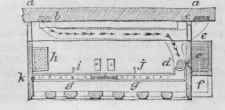
"In the figure, two of the flue covers are removed to show the surface of the iron water-troughs, fitted on the flue-pipe, and resting on the bottom of the brick-casing, better seen in the sectional view. The troughs are only filled with the heated air when it is wanted in a humid condition; in other cases the humidity from the cistern h, which supplies water for the ordinary purposes of the house, will be sufficient; i and j are wood wedges inserted on one side of the covers to raise them, more or less, in proportion to the quantity of heat required: k is the termination of the flue-pipe, where it ascends, crossing the house above the door, and entering the back wall into the chimney. When the house is to be heated, it is only necessary to light the fire in the stove d, and open one of the cold air-drains b c, as in the present instance the internal one, b, is open. The arrows represent the cold air flowing towards the stove, where it enters below, and after traversing a numerous formation of winding channels in a heated state, discharges itself into the brick-casing, g g, above the flue-pipe, from which it escapes as heretofore mentioned.
"When the cold air is taken from the external drain, c, the internal one, b, is closed; a regulation, however, which is entirely at the discretion of the superintendent of the house: r, the regulator in the ash-pit of the stove, the handle of which is turned so as to admit a greater or less quantity of air, by which the combustion of fuel in the stove is regulated: s s and m m, ventilating grates; n n, rods of iron suspended to the frames of the top windows to open and shut them; g, a system of small rods for conveying the drip from the inside of the roof to the cistern, h; p, cover of stove-pit: it is hinged, and readily thrown back when admission to the stove is wanted.
"For ordinary-sized plant or fruithouses, the above method of heating will be found quite sufficient. Where very large structures are required to be heated, any additional quantity may be procured by means of hot water-pipes supplied from a boiler placed within the patent stove. The pipes may be conveyed in a different direction from the hot-air flue. The boiler, although heated with the stove-furnace, requires no additional fuel." - Gard. Chron.
Fig. 76.
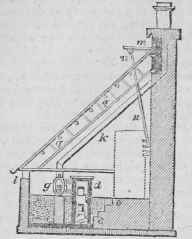
On a larger scale is the green-house at Kew; but as the same principles and arrangements may be adopted on a smaller scale, I give the following extracts from the details- published by Dr. Lindley: -
"The general arrangement is excel-ent. None of the door-ways are placed in direct continuation of the walls; but they are either formed immediately opposite the principal masses of plants, or obliquely with respect to the walks; so that the eye necessarily rests upon the foliage as soon as the house is entered.
"Then, again, at the point where the houses join each other, a semicircular stage is thrown forward, by which the disagreeable effect of a long narrow walk, in a small house, is completely removed.
"The house is span-roofed, and illustrates the great advantage of this kind of construction over the wretched lean-tos, which were formerly in fashion. We need not say that one of the advantages of a span-roofed house is, that plants are exposed to light in all directions: but, all-important as is that property, it by no means forms the only valuable feature in them. Plants can be easily reached and easily removed; the appearance of the interior is very much improved, and no space is wasted. In a common glass shed, at least one half is useless - that is to say, the whole of that part which is next the back wall. Here, on the contrary, every portion of the interior, except the walks, is rendered available.
"The construction of the roof is excellent. It rises at an angle of 30o, which is exactly that best suited for houses of such a description; the rafters are very light, and of a better form than any we have previously seen. We will not pretend to say why they produce so good an effect; for words will never convey an adequate idea of the cause of the beauty of such objects. Perhaps it is their lightness; probably it is the two combined. Lightness of appearance has been combined with strength by the addition of an iron rod to the lower edge of the rafter, in the place of a head.
"In order to strengthen the roof and to provide for the cultivation of climbers, all the rafters are connected by means of curved iron rods, which themselves add much to the beautiful appearance of the interior. This mode of combining strength and decoration may of course be varied, but it will not be improved.
"Another important thing in the arrangements is the ample provision for receiving in tanks the rain-water that falls on the roof of the building: this is raised for use by means of small hand-pumps.
"It must be apparent that such a house as this is precisely what is most generally wanted by those who build green-houses. If a large space is required, it is easy to lengthen any of the arms; if more variety is desired, another cross house could be readily added to the smaller one. Should it be too large, as will more frequently be the case, the smaller arm may be copied or the larger, as the case may be. If a stove is wanted instead of a greenhouse, it would only be necessary to inclose the stages, to put hot water troughs into the chamber so obtained, and to add evaporating-pans to the pipes which are carried round the walls.
"In short, it appears to us that in this one house are contained illustrations of all the more important objects which are in the majority of cases to be attained in green-house building.
"It should be added, that the upright sides of the house are glazed with panes of sheet-glass, in one length; and that each of the roof sashes has but two panes in its length; this no doubt adds very much to its beautiful appearance." - Gard. Chron.
The plan given of the green-house at Yester is a lean-to, but the same system of heating is adaptable to a span-roofed house. This form is to be preferred on many accounts. Thus, as the practice is most injurious to have the temperature of the hot-house too elevated during the night, so no less injurious, in winter, is it to permit tender plants in the green-house or elsewhere, which may have been subjected to a freezing temperature, to be suddenly exposed to a higher degree of heat. Experience has placed it beyond dispute that such plants should be shaded from the sun, and thus returned very slowly to a more genial temperature. So convinced by experiment of the importance of securing plants in greenhouses from sudden transitions is Mr. Macnab, the curator of the Caledonian Horticultural Society's garden, that he has those structures ranging north and south, and consequently with a western and eastern aspect. They have two aspects, because he has them with span roofs, instead of the old lean-to form. For green-houses, but not for forcing, there is no doubt that this form is to be preferred; and Mr. M'Nab thus enumerates its advantages: "In a span-roofed house the circulation of air may be constantly kept up so as effectually to prevent damp.
For such a green-house fire heat is scarcely at all required; for, if there be a free circulation of air during the autumn and winter months, and if the tables and shelves be carefully kept dry and clean, water being sparingly given to such plants only as require it, cold, even descending to freezing occasionally the surface of the soil, will do less injury than the application of fire heat to most plants. In the case of plants frozen in a lean-to house, and others in a span-roofed house extending north and south, the consequences were much the least injurious in the latter, for in it the influence of the sun was much less felt; 18 as he proceeded towards the meridian, the astragals and rafters formed a shade, and air being given, the plants survived and soon recovered; in the lean-to house they blackened and perished".
Green-House #1
Air, give with all possible freedom; bring ail but the tenderest out of the house. - Camellias, done flowering, remove into higher temperature. - Cuttings of various plants may now be inserted. - Dress the plants as they are brought out of the house. - Earth, give fresh, and liquid manure, as necessary. - Flowering shrubs, shade. - Geraniums, plant cuttings. - Head down and prune irregular growing shrubs. - Heaths, plant slips; water frequently. - Inarching of jasmines, oranges, etc, may be performed. - Leaves (decayed), remove, and wash the foliage generally. - Layers of shrubs generally make. - Mowings of grass spread over surface of earth in large pots or tubs - an excellent mode of arresting evaporation. - Myrtles, propagate by cuttings, e.; - Oranges and Lemons in bloom, give liquid manure: thin blossom when in clusters. - Rain, if excessive, move tenderest plants back into the house; and tilt the pots of others. - Seedlings, transplant. - Shift into larger pots, as necessary, b. - Succulent plants propagate by cuttings; remove to outside, e. - Water frequently, but moderately; some plants require it every morning or evening.
Continue to:


My Books

