


Leaves
Description
This section is from the book "A Dictionary Of Modern Gardening", by George William Johnson, David Landreth. Also available from Amazon: The Winter Harvest Handbook: Year Round Vegetable Production Using Deep Organic Techniques and Unheated Greenhouses.
Leaves
Leaves are highly vascular organs, in which are performed some of the most important functions of a plant. They are very general, but not absolutely necessary organs, since the branches sometimes perform their offices. Such plants, however, as naturally possess them, are destroyed or greatly injured by being deprived of them.
The duration of a leaf is in general but for a year, though in some plants they survive for twice or thrice that period. These organs are generally of a green colour. Light seems to have a powerful influence in causing this, since if kept in the dark they become of a pale yellow or even white hue, unless uncombined hydrogen is present, in which case they retain their verdure though light be absent. Hence their etiolation would seem to arise from their being unable to obtain this gas under ordinary circumstances, except when light is present. Now the only source from which they can obtain hydrogen, is by decomposing water; and how light assists in the decomposition, may perhaps be explained by the dis-oxygenizing power with which it is gifted. The violet rays of the spectrum have this power in the greatest degree; and Sennebier has ascertained by experiment, that those rays have the greatest influence in producing the green colour of plants.
Fig. 97.
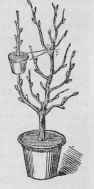
When leaves are of any other hue than green, they are said to be coloured. This variegation is often considered to be a symptom either of tenderness or debility, and it is certain, when the leaves of a plant become generally white that that individual is seldom long-lived. Mr. Knight, however, has demonstrated that variegation is not a certain indication of a deficiency of hardihood.
The function of the leaves appear to be a combination of those of the lungs and stomach of animals; they not only modify the food brought to them from the roots, so as to fit it for increasing the size of the parent plant, but they also absorb nourishment from the atmosphere. The sap, after elaboration in these organs, differs in every plant, though as far as experiments have been tried, it appears to be nearly the same in all vegetables when it first arrives to them. The power of a leaf to generate sap is in proportion to its area of surface, exposure to the light, and congenial situation.
Evergreens transpire less moisture than deciduous plants, which would lead to the expectation that they are more capable of living in dry situations, which in general is really the case. The matter transpired by a healthy plant is nearly pure water, 5.000 grains of it never containing more than one grain of solid matter, and this is constituted of resinous and gummy matter, with carbonate and sulphate of lime. It appears to be nearly the same in all plants. The quantity varies, however, in every species, probably in every individual, and is greatly influenced by the quantity of water applied to the roots.
The transpiration of plants decreases with that of the temperature to which they are exposed, as well as with the period of their growth. This explains why the gardener finds that his plants do not require so much water in cold weather, nor during the time that elapses between the fall of their blossoms and the ripening of their seed. During this period they do not transpire more than one-half so much as during the period preceding and attending upon their blooming.
The transpiration takes place from the upper surface of the leaves; and if these gradually decay and fall, the growth of the plant ceases until fresh leaves are produced. Hence arises the benefit which plants derive in rooms, greenhouses, and other confined in-closures, from keeping those surfaces cleansed with the sponge and syringe. Some plants are particularly sensitive to injury from any check to their transpiration, among which are the tea-scented roses; and it thence arises that they cannot now be cultivated in nursery-gardens near London, where they once flourished when that metropolis was less extensive.
It must be remembered, however, in using the sponge and syringe, that the under side of leaves is an absorbing surface, benefited by being kept clean, and by the application of moisture. The kidney bean, sunflower, cabbage and spinach, absorb moisture equally by their under and upper surfaces; the cockscomb, purple-leaved amaranth, heliotrope, lilac, and balm, absorb most freely by their upper surfaces; and the vine, pear, cherry, apricot, walnut, mulberry, and rose, absorb most by their under surfaces.
The transpiration from the leaves of plants is effected through pores or stro-mates, varying in number and size in every species, but being usually either largest or most numerous in plants inhabiting moist or shady localities. This is a wise provision, for such plants, consequently, have an abundant supply of moist food to their roots, requiring a competent provision for its elaboration and reduction from superfluous water. Those plants which are natives of sandy exposed soils, have, on the other hand, either fewer or smaller stromates.
The drier the air the greater is the amount of moisture transpired; and this becomes so excessive, if it be also promoted by a high temperature, that plants in hot-houses, where it has occurred, often dry up as if burned. The justly lamented Mr. Daniell has well illustrated this, by showing that if the temperature of a hot-house be raised only five degrees, viz., from 75° to 80°, whilst the air within it retains the same degree of moisture, a plant that in the lower temperature exhaled 57 grains of moisture, would in the higher temperature exhale 120 grains in the same space of time. Plants, however, like animals, can bear a higher temperature in dry air than they can in air charged with vapour; animals are scalded in the latter, if the temperature is very elevated, and plants die under similar circumstances as if boiled. MM. Edwards and Collin found kidney beans sustained no injury when the air was dry at a temperature of 167°, but they died in a few minutes if the air was moist.
Other plants under similar circumstances would perish, probably, at a much lower temperature; and the fact affords a warning to the gardener to have the atmosphere in his stoves very dry, whenever he wishes to elevate their temperature for the destruction of insects, or other purposes. Leaves have the power of absorbing moisture as well as of emitting it, which power of absorption they principally enjoy during the night.
During the day leaves also absorb carbonic acid gas, which they decompose, retaining its carbon and emitting the greatest part of the oxygen that enters into its composition. In the night this operation is in a certain measure reversed, a small quantity of oxygen being absorbed from the atmosphere, and a yet smaller proportion of carbonic acid emitted.
Carbonic acid gas in small proportions is essential to the existence of leaves, yet it only benefits them when present in quantities not exceeding one twelfth of the bulk of the atmosphere in which they are vegetating, though one twenty-fifth is a still more favourable proportion; and as hot-beds, heated by fermenting matters, rapidly have the air within their frames contaminated to a much greater extent than the proportions above named, thence arises the injury to the plants they contain from a too long neglected ventilation. The leaves turn yellow from the excess of acid, which they are unable to digest, and which consequently effects that change of colour which also occurs in autumn, and which will be more fully considered when the decay of plants is detailed.
Whatever promotes an over-luxuriant production of leaf-buds, proportionately diminishes the production of flower-buds, and the reason is obvious. A luxuriant foliage is ever attendant upon an over-abundant supply of moist nourishment to the roots, the consequent amount of sap generated is large, requiring a proportionately increased surface of leaf for its elaboration, and for the transpiration of the superfluous moisture; and as the bud becomes a branch or a root accordingly as circumstances require, so does it produce, as may be necessary for the plant's health, either leaves or flowers. - Principles of Gardening.
Continue to:


My Books

