


Peach. Part 2
Description
This section is from the book "A Dictionary Of Modern Gardening", by George William Johnson, David Landreth. Also available from Amazon: The Winter Harvest Handbook: Year Round Vegetable Production Using Deep Organic Techniques and Unheated Greenhouses.
Peach. Part 2
Wall-Culture. English Method
Borders should never be deeper than eighteen or twenty inches for the peach, and six feet wide. Soil chopped turfy loam from a rich pasture, rather more clayey than light - beneath a good drainage, at least one foot deep, made of broken bricks and stones, with an outfall into a neighbouring ditch.
Planting
Two year old plants are to be preferred, and planted as soon as the leaves begin to fall at the end of October. The best aspects are south and south-east. Plant, at the least, sixteen feet apart; the stem three inches from the wall, inclining towards it. Nail the branches to the wall, but do not prune them.
Summer Pruning is of far more importance than that of the winter.
"In May and June, and occasionally in the succeeding months, it is necessary to regulate the shoots of the same year, and to prevent improper growths by disbudding. Pinch off fore right buds or shoots; and pinch off or cut out ill-placed, very weakly, spongy, and deformed shoots, retaining a plentiful supply of good lateral shoots in all parts of the tree, and leaving a leader to each branch.
"Let them mostly be trained in at full length, all summer, about three inches asunder, for next year's bearers; and divest them of any lateral twigs to prevent a thicket-like intricacy, and to promote a healthy fruitful growth in the shoots themselves. In the course of the summer regulation, if any partial vacancy occurs, or should a young tree under training want an additional supply of wood, shorten some conveniently placed strong shoot, in June, to a few eyes to furnish a supply of laterals the same season." - Abercrombie.
This disbudding and regulation should be done by degrees. If many shoots and leaves are removed suddenly, it occasions gumming, and over-luxuriance in the shoots that remain. If shoots are very strong, train them as nearly perpendicular as is admissible, that there may be no check to the sap's return. Shoots less robust train horizontally.
Protect from frosts whilst in blossom; and, when the fruit is well set, syringe three times a week with water to which half a pint of ammoniacal liquor, from gas-works, has been added to each gallon. This will destroy all insects, and especially the aphis, and prevent the occurrence of mildew.
"Winter Pruning may be performed at the fall of the leaf, and thence, according to some professional writers, at any time in mild weather until spring. It should be completed in February or early in March, before the blossom-buds are considerably advanced, which are distinguishable by being round, plump, and prominent, while the leaf and shoot-buds are oblong and narrow. Retain, in all parts of the tree, a competent supply of such regular grown shoots of last year as are apparently fruitful in blossom-buds. Most part of these should be shortened, not indiscriminately, but according to their strength and situation; the very strong shoots should be left longer, being topped about one-fourth or one-third. Shoots of middling vigour reduce one-third or one-half; and prune the very weak to two or three buds. Always cut at a shoot-bud to advance for a leader. Sometimes a shoot-bud lies between a twin blossom-bud; cut hall an inch above the bud. As many new shoots as will lie from three to six inches asunder may be deemed a competent supply: remove or reduce some part of the former bearers.
Cut out quite close the redundant, irregular, and other improper shoots: remove or reduce some parts of the former bearers of the two preceding years, cutting the most naked quite away, and others down to the most eligible young branch or well-placed shoot. Also take out all diseased and dead wood, retaining young where necessary to fill a vacuity." - Abercrombie.
The most systematic mode of preserving a constant supply of young wood is that proposed by Mr. Seymour, and described as follows in the Gardener's Magazine:
"A maiden plant must be cut down to three eyes, a, and three shoots being produced, the two lower ones are left at full length, and the succeeding spring the centre shoot is again cut down to three eyes. At the time of disbudding the trees all the buds on the lower side of the two horizontal branches are rubbed off, and buds are left on the upper side of the branches at a distance of from nine to twelve inches from each other. These are suffered to grow five or six inches, and are then stopped; but still suffering the leading shoot to extend itself. At the second spring pruning, the centre shoot is again cut to three eyes; or, if the tree be very vigorous, five eyes may be left, two for each side, and a centre one for again furnishing leading shoots. The leading shoots are laid in the fan form, nine or ten inches from each other. The shoots on the leading branch are nailed to the wall in summer; but after the winter's pruning they are tied to the leading shoots to be nailed in, where they get well ripened, and mature their buds for another crop. At the winter's pruning they are cut to three or four inches, according to their strength.
The maiden plant, being headed down the first winter, will present two laterals, 6. The second year, at the end of summer, there will be four side-shoots, and six or more laterals, c. In the following spring pruning, the laterals, d, which had been nailed to the wall, are loosened and tied to their main shoot, e, and the upright shoot shortened to three buds, as before.
Fig. 106.
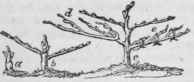
"At the end of the third summer the laterals will be doubled on the old wood by one having sprung from the base of the shoot tied in, g, and another from its extremity, h. In the pruning of the following spring the laterals of two years' growth, which had borne fruit, are cut off close, and the young laterals which had sprung from their base, i, are loosened from the wall, and tied down to succeed them; the other laterals, k, are tied in, and the uprightshoot shortened, /, as before.
Fig. 107.
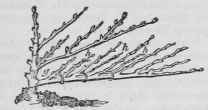
Fig. 108.
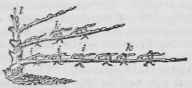
"Now, or before, the side shoots will have to be headed down once or even twice, so as to increase their number, and regularly cover the wall. The extent to which this practice is carried will depend on the height of the wall, and the distance of the trees from each other; the ultimate object being to produce a fan form, as regular as possible, of permanent wood, with no young wood thereon, besides what is produced along the spokes of the fan, on their upper side, at about twelve inches apart, and the prolongation of the shoots.
"In the course of the winter or spring of the third year, I shorten the side shoots to about ten or twelve inches, as may be most convenient for wood-buds, to get two principal leading shoots from each side shoot; the first about three inches from the stem, as the bud may suit, and the other at the end of the shortened shoots, so as to double the leading shoots. The upright shoot is always cut at three of the lowest and most suitable buds, so that the stem may be kept as short as possible; for, unless the side shoots are multiplied, the stem gets too high. If the side shoots are strong the year after cutting down, they may be laid in their whole length; but if weak, they must be cut short to give them strength. Continue in this way to double the side shoots for two or three years, by which the tree will get strength, and then it will admit of the side shoot being shortened to about fourteen inches. Cut for two or three years, so as to produce three shoots upon each side shoot, and so continue until there is a sufficient number of leading shoots to furnish the wall.
"After the tree has got into a bearing state, cut the lateral shoots to about eight or nine inches, taking care to cut at a wood-bud; and at the time of disbudding leave the best situated buds, and those nearest the base, for the future year's bearing." - Gard. Mag.
Continue to:


My Books

