


Peach. Part 3
Description
This section is from the book "A Dictionary Of Modern Gardening", by George William Johnson, David Landreth. Also available from Amazon: The Winter Harvest Handbook: Year Round Vegetable Production Using Deep Organic Techniques and Unheated Greenhouses.
Peach. Part 3
Thinning
Let there be a space of nine inches between every brace of fruit upon the weaker shoots, and six inches on the stronger. See Thinning.
Blistering Of The Leaf
This disease, which is called by some gardeners the Bladder Blight, and by the French la cloque, is occasioned by more moisture being forced into the leaves from the roots than they can evacuate by expiration. Rome gardeners, annotating upon this opinion, expressed by the present writer in the Gardener's Chronicle in June, 1S45, have concluded, because the blistering appears more abundantly when cold nights succeed to hot days, that they occasion the disorder; but they are only the proximate cause; those cold nights reduce the expiratory power of the leaves, whilst the roots in a soil of unreduced temperature continue to imbibe moisture, and to propel it to the leaves with undiminished force. The blistering is, consequently, more extensive. That the force with which the sap is propelled, is quite sufficient to rupture the vessels in the parenchyma of the leaf, is evident from Dr. Hale's experiment. He found the vine propelled its sap with a force equal to a column of mercury fifteen inches high. There is no doubt upon my mind, that if the soil be well drained, and not too fertile, blistering will never occur.
The remedy, therefore, is obvious in either case.
Diseases
See Aphis, Chermes, Honey Dew, Mildew, Extravasated Sap.
Forcing. Any of the early varieties are suitable for this purpose; success does not depend so much on the kind, as on the management.
Form Of Ilouse
The best form for a Peach-house, is that thus described by the late T. E. Knight, Esq.
Fig. 109.
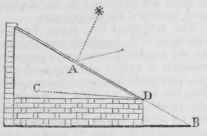
As the lights to be moved to the required extent with facility must necessarily be short, the back wall of the house must scarcely extend nine feet in height, and this height raises the rafters sufficiently high to permit the tallest person to walk with perfect convenience under them. The lights are divided in the middle at the point a, and the lower are made to slide down to the d, and the upper to the point a. The flue, or hot-water pipe enters on the east or west end, as most convenient, and passes within six inches of the east and west wall, but not within less than two feet of the low front wall, and it returns in a horizontal direction through the middle. The trees must) be planted between the flue and the front wall, and the other row near the back wall, against which they are to be trained.
If early varieties be planted in the front, and the earliest where the flue first enters, these being trained immediately over the flue, and at a small distance above it, will ripen first; and if the lower lights be drawn down in fine weather to the point b, every part of the fruit on the trees which are trained nearly horizontally along the dotted line c, will receive the full influence of the sun. The upper lights must be moved as usual by cords and pulleys, and if these be let down to the point A, after the fruit in the front tree is gathered, every part of the trees on the back wall will be fully exposed to the sun, at any period of the spring and summer after the middle of April, without the intervention of the glass. A single fireplace will be sufficient for a house fifty feet long, and I believe the foregoing plan and dimensions will be found to combine more advantage than can ever be obtained in a higher or wider house. Both the walls and flue must stand on arches, to permit the roots of the trees to extend themselves in every direction beyond the limits of the walls, for whatever be the more remote causes of mildew, the immediate cause generally appears to be want of moisture or dampness above it.
A bar of wood must extend from d to b, opposite the middle of each lower light, to support it when drawn down. - Knight's Select Papers.
The soil, culture, and pruning are the same as required for those trees grown on walls.
Forcing in Pots is a very excellent mode, and enables the Peach to be thus grown in establishments where there is no regular Peach-house. Pot a three year old tree in a twelve inch pot, cutting it back to four buds; and shift every year until it has attained an eighteen inch pot, a size which need never be exceeded. Let the soil be turfy, and mixed with decaying wood from the bottom of an old wood stock.
Commencing forcing and temperature. The best and most successful directions on these points are the following, given by Mr. W. Hutchinson, gardener at Eatington Park. He says: - "Bring the trees into the house in mild weather during November, a little earlier or later according to the state of the weather; do not start them all, however, at once; the last lot are not put in until the first of January. Any later than this would not answer, as the weather, if clear, is then hot through the day. Commence forcing them at 55° at night, allowing the thermometer to fall to 50° in the morning, if cold, but if the weather is mild, never to fall below 55°; and from that to 60° is the usual temperature kept up throughout the period of forcing during the night; during the day, I make up for low night temperature, when I have the chance, by sun heat. Do not be fastidious about a few degrees: to get it high enough is the main point, say from 70° to 85° and 90°, until the fruit is stoned, then keep them very hot during the day, viz. from 95° to 105°, and sometimes even as high as 110°. Of course a great deal of moisture is required with this high temperature: syringe over head twice a day, and sometimes oftener when the air is dry, and you will scarcely ever be troubled with either green fly or red spider.
Watering at the root must be carefully attended to-; very little is wanted until the trees get covered with leaves; but after the fruit is stoned they should be watered plentifully. Ofcourse the watering must be gradually withdrawn as the fruit approaches maturity, in order to increase their flavour." - Gard. Chron.
When the blossoms are well open, impregnation should be assisted by the aid of a camel's hair pencil.
One essential for securing vigorous production in the Peach-house is to have the roots of the trees well nourished. If these are not duly supplied with moisture and food during the time the fruit is setting and swelling, a failure of the crop is inevitable. To secure such a supply, it is a most effectual treatment to give the border a top-dressing, at the close of February, of charred turf. Liquid manure and water, of course, must be given also, as the dryness of the soil and appearance of the trees indicate are necessary.
Standards
In Essex, I have grown the peach successfully, both as a standard and as an espalier, in a garden sloping to the south, and well protected from the east and strong westerly winds.
Continue to:


My Books

