


Raspberry. Rubus Idaeus
Description
This section is from the book "A Dictionary Of Modern Gardening", by George William Johnson, David Landreth. Also available from Amazon: The Winter Harvest Handbook: Year Round Vegetable Production Using Deep Organic Techniques and Unheated Greenhouses.
Raspberry. Rubus Idaeus
Best Varieties. Red
Fastolff, or Bee-hive, Franconia, Antwerp, red; Barnet; Cornish; Double-bearing, and Gennessee.
Yellow
Antwerp, yellow; Cox's Honey; Old white.
The Fastolff (Fig. 142) has been "recently received from England, where it was raised or discovered near the castle of that name. It has produced fruit at Philadelphia the two past seasons, and quite equals its transatlantic character, which is higher than that of any of its tribe. The fruit is large, deep red, inclining to purple, well flavoured, and yielded longer than usual. Such was the description written before the fruit of the present year (184b') had matured; another season's observation has confirmed it. The annexed drawing, accurately copied from nature, has been supplied by Doctor William D. Brincklé. The plants are yet scarce, and consequently higher priced than the old varieties; but from its adaptation to our climate, it will, it is hoped, be speedily increased, and widely distributed - so valuable an acquisition one could desire to see domesticated in every garden in the land." - Rural Reg.
Fig. 142 (P. 4960)
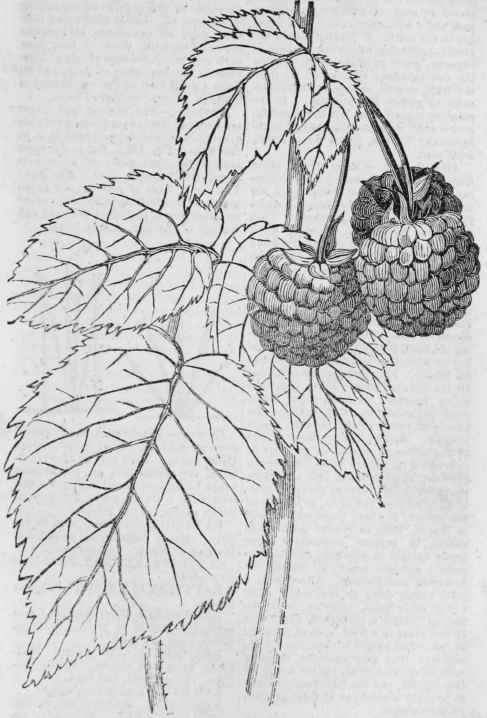
The Franconia was "imported from France some years since; it is hardy, fruitful, and may be safely recommended as in all respects desirable. This is, perhaps, taking all its merits into account, next in value to the Fastolff." - Rural Reg.
Propagation By Seed
New varieties are easily raised from seed. Wash away the pulp from some of the finest thoroughly ripe fruit, dry the seed, and sow it the same autumn in a dry border, giving it the shelter of a frame through the winter. Trim and plant out the seedlings to remain in the autumn following, and they will bear in the succeeding summer.
By Suckers
These spring from the root annually, and grow from three to five feet in height the same year, forming plants by autumn or winter for transplanting, to bear fiuit the following summer.
Planting may be done any time from October till March, the earlier the better, in open weather. Raise the plants carefully with plenty of fibres; shorten any long straggling root; and cut off any naked woody part of the root of the old stool, observing at the same time, if one or more buds appear near the root, they, being the embryo of future shoots, must be very carefully preserved; and shorten each sucker at top to about three or more feet long, according to their strength - they are then ready for planting: having previously to this chosen an open spot of good ground and trenched it, put in the plants as soon as possible, in rows a yard and a half apart, and a yard asunder in the rows. If planted closer the plants, producing numerous suckers in summer, grow so close as to exclude the due influence of sun and air from the fruit, as well as render it troublesome to gather the produce. If the planting is performed late in the spring, give a good watering, and repeat it occasionally till the plants have struck fresh root.
Continue to:


My Books

