


Rhubarb
Description
This section is from the book "A Dictionary Of Modern Gardening", by George William Johnson, David Landreth. Also available from Amazon: The Winter Harvest Handbook: Year Round Vegetable Production Using Deep Organic Techniques and Unheated Greenhouses.
Rhubarb
Rheum rhaponticum, R. hybridum, R. undulatum, and R. palma-tu;n. This last is the medicinal, or Turkey Rhubarb of the shops - the esculent one or pie-plant, as it is familiarly termed, has become quite a common inmate of our American gardens; its early growth, affording facility for pies and tarts, long before green fruit can be obtained, and its close resemblance in flavour to the gooseberry, render it almost indispensable.
Varieties
There are several varieties, of which the most preferable are the Tobolsk; Gigantic; Victoria, (best;) and Bucks or Elford.
Soil And Situation
The soil best suited to these plants is light, rich, deep, unshaded, and moderately moist. A poor heavy or shallow soil never produces them in perfection.
Sowing
It may be propagated by cuttings, but the mode almost universally practised is by seed. Sow soon after it is ripe, in September or October, for if kept out of the ground until the spring, it often continues dormant for twelve months: if the danger of this, however, is risked, sow early in February or March, in drills three feet apart, and an inch deep, the plants to remain where raised; for although they will bear removing, yet it always checks and somewhat lessens their growth. When they make their appearance in the spring, and have been thoroughly cleared of weeds, thin to six or eight inches asunder, and let the surface of the ground about them be loosened with the hoe. At the close of summer, when it can be determined which are the strongest plants, finally thin to three or four feet, or the Gigantic and Victoria to six. In autumn remove the decayed leaves, and point in a little well putrefied stable-dung, and earth up the stools. In the spring hoe the bed, and as the stalks when blanched, are much less harsh in taste, require less sugar to be rendered palatable, and are greatly improved in appearance, dig a trench between the rows, and the earth from it place about a foot thick over the stool.
This covering must be removed when the cutting ceases, and the plants allowed to grow at liberty. As the earth in wet seasons is apt to induce decay, the covering may be advantageously formed of coal ashes or drift sand.
To Obtain Seed
Those plants produce the seed in greatest perfection that are not gathered from, but on no account must they be subjected to the process of blanching. Two year old plants often produce seed, but in their third year always. It must be gathered as soon as ripe, and great care taken that none is scattered over the beds, for the plants thence produced often spring up, and greatly injure the old plants by growing unobserved amongst them.
Forcing
Plant a single row three feet apart in ground that has been trenched two spades deep, and dressed with well putrefied dung at the time. The forcing may commence in December; first cover either with sea-kale or common garden pots (twelves), but chimney pots are still better, the leafstalks becoming much longer and finer, and envelope them with fermenting dung. When well up, the pots are removed, except when chimney pots are used, and large hand-glasses substituted; covering is required every night, and in dull weather with thick mats. By this mode the plants are very liable to be broken, as their leaves soon touch the sides. A frame is much less objectionable, formed by driving stakes into the ground on each side of the bed, alternating with the plants. These are to be three feet high above ground, and the space between the two rows of stakes two feet at the bottom, but approaching each other, and fastened by cross pieces, so as to be only fifteen inches apart at top. To the sides and top stout laths are fixed to prevent the dung falling upon the plants, as represented in the accompanying sketch.
Fig. 147.
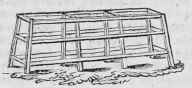
The dung may either be fresh, or that which has previously undergone fermentation, and placed all round the frame eight or ten inches thick, and the top covered with long litter. The temperature in the interior should have a range from 55° to 60°. If it rises higher, two or three large holes made through the top soon corrects it.
A frame renders hand-glasses or any other cover unnecessary, requires much less attention, and produces plants of. excellent quality. Rhubarb may be forced without either pots or frame, by merely covering the plants six inches deep with light litter, care being taken that the plants are not injured.
Mr. Knight's mode of forcing is to place "in the winter as many plants as . necessary in large deep pots, each pot receiving as many as it can contain, and the interstices entirely filled up by fine sandy loam, washed in. The tops of the roots are placed on a level with each other, and about an inch below the surface. These being covered with inverted pots of the same size, may be placed in a vinery or hot-bed, and on the approach of spring, probably any time after January, any room or cellar will be sufficiently warm. If copiously supplied with water, the plants vegetate rapidly and vigorously, and each pot will produce three successional cuttings, the first two being the most plentiful. As soon as the third is gathered, the roots may be changed, and those removed replanted in the ground, when they will attain sufficient strength to be forced again in a year's time. If not, it is of little consequence, foryear-old roots raised from cuttings, or even seed sown in autumn, are sufficiently strong for use".
Propagation By Division
Mr. Rogers, a successful cultivator, says, that "when the rhubarb is propagated by the root, care must be taken to retain a bud on the crown of each offset, together with a small portion of the root itself, with, if possible, some fibres attached to it. These offsets may be taken from roots of three or four years old, without injury to the plant. They may be planted where, they are intended to remain, at the same distance and in the same manner as advised for the seedlings".
Taking For Use
"Scrape away a little of the earth, then bend down the stalk you wish to remove, and slip it off from the crown without breaking it, and without using a knife. The stalks are fit to gather when the leaves are but half expanded, but alarger produce is obtained by letting them remain till full grown."- Gard.and Pract. Flor.
Continue to:


My Books

