


Sea-Kale
Description
This section is from the book "A Dictionary Of Modern Gardening", by George William Johnson, David Landreth. Also available from Amazon: The Winter Harvest Handbook: Year Round Vegetable Production Using Deep Organic Techniques and Unheated Greenhouses.
Sea-Kale
Soil And Situation
A light moderately rich soil, on a dry substratum, suits it best, though in any dry soil it will succeed. A bed may be composed for it of one-half drift sand, one-third rich loam, and one-third small gravel, road stuff or coal-ashes; if the loam is poor, a little well-rotted dung or decayed leaves being added. The soil must be deep, so that the roots can penetrate without being immersed in water, which invariably causes their decay. The depth should not be less than two feet and a half; and if not so naturally, worked to it by trenching. If at all tenacious, this opportunity may be taken to mix with it drift or sea-sand, so as to reduce it to a friable texture. If wet it must be drained, so that water never shall stand within three feet of the surface. If poor, well putrefied dung must be added; but decayed leaves are preferable, and sea-weed still more so. Common salt is a very beneficial application, either applied dry, in the spring, in the proportion of twenty or thirty bushels per acre, or by oceeasional waterings, with a solution, containing four ounces in the gallon, round every stool during the spring.
The situation cannot be too open and free from trees.
Propagation is both from seed and slips of the root. The first is the best mode; for, although from slips it may be obtained with greater certainty, yet the plants arising from seed are the strongest and longest lived. Sow from October to the commencement of April; but the best time for inserting it is during January or February. Leave the plants where raised; and, to guard against failure, insert the seed in patches of six or twelve seeds, each six inches apart, and the patches two feet asunder. If intended for transplanting, the seed may be sown in drills twelve inches asunder; in either case it must not be buried more than two inches below the surface; and it is a good practice, previous to inserting it, to bruise the outer coat of the seed, without injuring its vegetating power, as by this treatment the germination is accelerated. The plants will in general make their appearance in four or five months, never sooner than six weeks; but, on the other hand, the seed will sometimes remain twelve mouths before it vegetates.
The best time for increasing it by slips is in March. Rooted suckers may be detached from established plants; or their roots, which have attained the thickness of the third finger, be cut into lengths, each having at least two eyes. The cuttings must be inserted in an upright position, two or three inches beneath the surface. It is best to plant two together, to obviate the danger of failure, at two feet apart, to remain. Some persons, from a desire to save a year, recommend yearling plants to be obtained and inserted in February or March; but as the shoots ought not to be cut for use the first season after planting, the object is not attained, for seedlings may be cut from the second year.
The beds should be laid out three feet wide, and a two feet alley between every two, in preference to the plan sometimes recommended of planting three rows in beds seven feet wide. If the months of June and July prove dry, the beds should be plentifully watered. The seedlings require no other attention, during the first summer, than to be kept free from weeds, and to be thinned to five or six in each patch. When their leaves have decayed and are cleared away, about November, they must be earthed over an inch or two with dry mould from the alleys, and over this about six inches depth of long litter spread. In the following spring the Jitter is to be raked oft", and a little of the most rotten dug into the alleys. When the plants have perfectly made their appearance they must be thinned, leaving the strongest plant, or, as Mr. Maher recommends, the three strongest, at each patch, those removed being transplanted at similar distances if required; but it must be remarked, that those transplanted never attain so fine a growth, or are so long lived. In the second winter the earthing must be increased to five or six inches deep over the crowns, and the covering of litter performed as before.
In the third spring, the litter being removed, and some dug into the alleys, as before, about an inch depth of drift sand or coal-ashes must be spread regularly over the surface. The sprouts may now be bleached and cut for use; for, if this is commenced earlier, the stools are rendered much less productive and much shorter lived. In November, or as soon as the leaves are decayed, the beds being cleared of them, the coating of sand or ashes removed, and gently stirred with the asparagus-fork, they must be covered with a mixture of three parts earth from the alleys, and one part of thoroughly decayed leaves, to the depth of three or four inches. The major part of this is to be removed in the following spring, the beds forked, and the covering of sand renewed, this routine of cultivation continuing during the existence of the beds.
The above course is the one also pursued if the plants are raised from offsets or cuttings, as it is by much the best practice not to commence cutting until they are two years old.
Blanching may commence the second spring after sowing. The most simple mode is that originally adopted, namely, to cover over each stool sand or ashes to the depth of about a foot; the shoots, in their passage through it, being excluded from the light, arc effectually bleached. Dry clean straw may be scattered loosely over the plants to effect the same purpose. But pots are by much to be preferred to any of these coverings. Common flower-pots, of large dimensions, may be employed, care being taken to stop the hole at the bottom with a piece of tile and clay, so as to exclude every ray of light; but those suggested by Mr. Maher are generally adopted. They are of earthenware, twelve or eighteen inches in diameter, and twelve high. Mr. Sabine improved upon them by making the top moveable, which prevents the trouble arising from the escape of the spreading shoots, or the entire removal of the dung at the time of forcing. Frames of wicker are sometimes employed, being covered with mats more perfectly to exclude the light.
See Rhubarb.
Fig. 152.
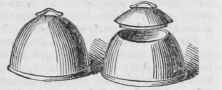
Previously to covering the stools with the pots, etc, the manure laid on in the winter must be removed; and the operation should commence at the close of February, or at least a month before the shoots usually appear, as the shelter of the pots assists materially in bringing them forward. In four or six weeks after covering the plants should be examined, and as soon as they appear three or four inches high, they may be cut; for if none are taken until they attain a fuller growth, the crop comes in too much at once. In order to prolong the season of production, Mr. Barton recommends plants to be raised annually, so that every year a cutting may be had from a yearling crop, which come in much later, and consequently succeed in production the old established roots. The shoots should be cut whilst young and crisp, not exceeding five or six inches in height; the section to be made just within the ground, but not so as to injure the crown of the root. Slipping off the stalks is much preferable to cutting. The plants may be gathered from until the flower begins to form, when all covering must be removed. If, when arrived at the state in which brocoli is usually cut, the flower is employed as that vegetable, it will be found an excellent substitute.
When the cutting ceases, all covering must be removed, and the plants be allowed to grow at liberty.
Continue to:


My Books

