


Tetratheca - Thuja
Description
This section is from the book "A Dictionary Of Modern Gardening", by George William Johnson, David Landreth. Also available from Amazon: The Winter Harvest Handbook: Year Round Vegetable Production Using Deep Organic Techniques and Unheated Greenhouses.
Tetratheca - Thuja
Tetratheca
Seven species. Green-house evergreen shrubs. Young cuttings. Loam, peat, and sand.
Tettigonia
Tettigonia spumaria. Froth Fly, or Cuckoo Spit. The frothy patches seen in April and May upon the young shoots of hawthorn, lilac, peach, etc, are formed by this insect. As the froth is formed from the sap of the plant, the insect is by so much injurious to it. The froth protects the insect from the sun, from night colds, and from parasitic insects; but it betrays the insect to the gardener, whose hand is the best remedy.
Teucrium
Forty-seven species. Hardy, half-hardy, and green-house evergreen shrubs and herbaceous perennials; some hardy annuals, and T. cubense a stove biennial. The herbaceous perennials increase by division and seeds; the shrubby kinds by young cuttings; the annuals and biennials by seeds. Common soil suits them all.
Thalia
Thalia dealbata, a half-hardy aquatic perennial, and T. geniculata, a stove herbaceous perennial. Division. Light rich soil.
Thalictrum
Fifty-six species. Hardy herbaceous perennials: a few are twiners. Division. Light soil.
Thapsia
Seven species. Hardy herbaceous perennials. Seeds. Common soil.
Thapsium
Two species. Hardy herbaceous perennials. Division or seeds. Common soil.
Thea
Tea. Three species. Greenhouse evergreen shrubs. Cuttings. Sandy loam and peat.
Theophrasta
Theophrasta Jussieui. Stove evergreen tree. Cuttings, with the leaves left entire.
Thermopsis
Three species. Hardy or half-hardy herbaceous perennials. Seeds. Light rich soil.
Thesium
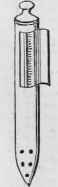
Six species. Hardy herbaceous perennials, except T. amplexicaule, a green - house evergreen shrub; increased by cuttings, and growing best in loam and peat; the herbaceous kinds increase by division or seeds, and require a chalky soil.
Fig. 166.
Thespesia
Two species. Stove evergreen trees. Half-ripe cuttings. Sandy loam.
Thibaudia
Four species. Stove evergreen shrubs. Cuttings. Turfy loam, peat, and sand.
Thomasia
Seven species. Greenhouse evergreen shrubs. Ripe cuttings. Loam, peal, and sand.
Thouinia
Thouinia pinnata. Stove evergreen shrubs. Ripe cuttings. Sandy loam and peat.
Thrift
Throatwort
Campanula cervi-caria.
Throatwort
Campanula tra-chelium.
Throatwort
Thryallis
Thryallis brachystachys. Stove evergreen climber. Ripe cuttings. Loam and peat.
Thuja
Thuja arbor vita. Eight species. Evergreen trees, all hardy except T. articulata, which is half-hardy, and T. cupressoides, which belongs to the greenhouse. Seeds, and T. pendula, one of the rarer kinds, by cuttings. A moist soil suits them best. T. occidentalis and T. orientalis form admirable evergreen hedges, and when properly sheared, inclining inward from the base so that no part is overshadowed, retain their beauty for many years. As a standard, the occidentalis or American arbor vitae, has few superiors among the minor evergreens.
Continue to:


My Books

