


274. Architectural Ornaments
Description
This section is from the book "The Villa Gardener", by J. C. Loudon. Also available from Amazon: The Villa Gardener.
274. Architectural Ornaments
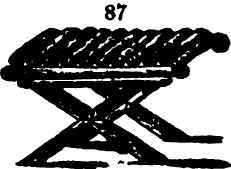
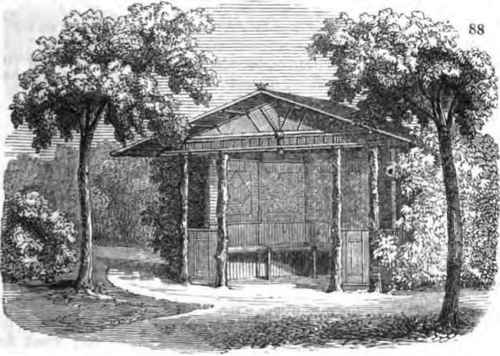
The number of these about a place depends on various circumstances, but chiefly on whether the pleasure-ground is plain, or much decorated in the immediate vicinity of the mansion. If there be a terrace-walk bordering the house, and leading to the flower-garden, the former may be enriched with statues, and the latter with vases, agreeably to principles already laid down in the preceding pages of this work. The walks in the pleasure-ground should, at all events, have seats placed in situations displaying the best views; which may be of the most simple description, and formed of the most common materials, as shown in fig. 82.; or there may be covered seats, in the form of different descriptions of rustic buildings, constructed chiefly of wood, introduced where they would be useful as places for resting, and desirable as objects in the landscape. (See fig, 88.) In general, garden buildings of a purely ornamental description, should either be very few (in which case they may be built of substantial materials, such as brick or stone); or, if of frequent occurrence, the materials of which they are constructed should be temporary, interest and value being given to each by its design.
Expensive garden buildings, such as classical temples, porticoes, colonnades, etc, containing statues, busts, and sculptures of marble, can seldom be indulged in in small places, and, indeed, are better adapted for the grounds of hereditary residences. In residences liable to be sold on the death of the proprietor, ornamental buildings, whether of the permanent or temporary kind, add little or nothing to the price of the estate; and had Stowe, where the garden buildings are magnificent, been sold at the death of the Earl Temple, during whose occupation of that estate they were built, they would have brought little more than the root-houses at the Leasowes, a contemporary ornamental residence, did on the death of their architect and proprietor, Shenstone. Ornamental buildings, therefore, are chiefly to be valued for the enjoyment they afford the proprietor during his lifetime; and, unless a part of this enjoyment consists in knowing that these buildings will descend to his posterity, prudence dictates that they should be built so as not to occasion great expense.
In all that respects the introduction of ornamental buildings, however, much must be left to the particular taste of the proprietor; and, as most proprietors take pleasure in having at all times some structure, alteration, or addition, going forward, this is an additional argument in favour of structures of temporary materials, erected for picturesque effect, and as occasional resting-places; or for affording shelter, and not intended to last longer than the verdant scenery by which they are surrounded; or, in other words, to be equally subject to change as the rest of the garden. 275. Rustic vases (as shown in fig. 89.), baskets of rustic work, boxes or beds of flowers cased with fantastic roots, hollow stumps of trees, rustic arcades, dead trees, and other places for forming receptacles for low plants, or supports for climbing ones, may all be introduced occasionally; care being taken that they are never displayed in such numbers, or of such magnitude, as to attract more attention than the flowers to which they are meant to be subservient To keep within the happy medium, however, in this kind of garden ornament, is extremely difficult; since the proprietor, who has had them constructed under his direction one after another, is apt to lose sight of the general effect, in the interest which each separate object has crested in his mind, and which he looks upon with the fond indulgence of a parent; forgetting that a stranger judges of them solely by their effects as connected with the scenery around them.
276. Wirework, in the form of the rims and handles of baskets, edgings, and various kinds of props for climbers, may also be occasionally introduced; always, however, remembering that they are to be subordinate objects to the plants which they enclose, protect, or sustain. It is customary to paint wirework of this description green; but, in our opinion, this colour is the very worst that can be adopted for any kind of structure or utensil to be placed among the green of nature. A stone-colour, or dull white, or greyish black, we think greatly preferable. Fig. 90. shows a mode of forming edgings to beds in gardens. Fig. 91. shows a wirework edging of a handsome kind, and on a larger scale.
277. The use of vases, and other garden ornaments of artificial stone, or of earthenware, is now very fashionable in pleasure-grounds, and more especially in flower-gardens; but this kind of ornament is very frequently overdone or misplaced. When they are used, they should, if possible, be placed on a pedestal corresponding to the vase, as shown in fig. 92.
Continue to:


My Books

