


Sculpture In Gardens. Continued
Description
This section is from the book "The Villa Gardener", by J. C. Loudon. Also available from Amazon: The Villa Gardener.
Sculpture In Gardens. Continued
281. On a level surface, a preparation may be made, beginning at a short distance from where the main body of rockwork is to be placed, by sinking, some fragments of stone into the earth, so deep as to show only their edges, or angles, rising above the turf. As the main body is approached, these stones may become more numerous; larger portions of them may be shown; and they may be connected in lines, or ridges, in such a manner as to indicate, partly by protruding stones, and partly by raised places in the turf, something like the "cropping out," or rising to the surface of natural strata. A few half-sunk stones, of different sizes, may then appear in groups, as if they had been accidentally separated from these strata; and immediately before the mass of rockwork, there may be some loose stones, with flat sides, piled irregularly on one another, so as to form subordinate masses to the large mass. This large or principal mass must be in imitation of some natural character of rock; and, whatever that character may be, the manner of the preparation for it which we have been just describing must be of the same kind.
The rock to be imitated may be stratified in various ways, as we see sandstone, limestone, slatestone, etc, in nature; or it may be in masses, with no appearance of regular strata, but with cracks and fissures, sometimes horizontal or oblique, and at other times perpendicular; and differing both in the magni-tude of the clefts or fissures, and also in their numbers, as we often see in masses of granite, trapstone, etc In short, having thrown out the idea of imitating nature, both in the main mass of rockwork, and in the preparations for it, that alone will be sufficient to guide the artistical gardener, who has lived in a hilly or rocky country. It will be seen, from these remarks, that the kind of rockwork which displays a heap or heaps of stones, however large some of these may be, all showing themselves above the surface, and to the same extent over the whole heap, as if it had been merely a mound of earth dotted over with stones, has no claim whatever to be considered as rockwork in our sense of the word. It may represent a commonplace or a curious heap of stones, which may be more or less convenient for the culture of plants; bat it is altogether unfit to be introduced into garden scenery, as an artistical object.
In general, rockwork, to be truly natural, can only show the rock on one side, or, at most, on two sides; as scars, cliffs, precipices, etc, are seen in rocky districts. The upper part of the rock should be covered with turf, and trees, and bushes, and the inclination of the turf should follow the supposed continuation of the rocky strata. This mode is not only natural, but has the advantage of being convenient; because, by making the angle of elevation of the strata more or less, according to the extent of the ground, the covering of turf can, at a greater or less distance, be made to unite with the level turf of the lawn. Where ferns, or plants requiring shade, are chiefly to be cultivated as rock plants, the abrupt side or face of the strata may face the north, and the talus, or sloping side, the south. Where early-flowering plants are to be cultivated, such as the Californian annuals, the abrupt side may face the south or south-east It is almost needless to state that on the sloping side, which may be called the back part of the rock or hill, there ought to be no rocks or stones cropping out; but, on the contrary, the appearance ought to be such as to indicate depth of soil, where the slope joins the level surface; that being always the case in nature at the base of a declivity.
The covering of the rock, or hill, including the slope, and also a portion of the adjoining lawn, may be planted with trees and shrubs, chiefly in the picturesque manner; as their appearance in such a situation, and disposed in such a manner, is perfectly natural, powerfully supports the idea of the truth of the imitation, and serves artistically to unite the hill with the level surface. To render the imitation of the abrupt side, or face, of the stratified rock artistical, all that is necessary is, to let the flowering plants introduced in the clefts, fissures, or shelves (produced by one stratum projecting farther out than another), be of foreign kinds. Where granite or basalt is the material used, the stratification, or lines of separation, may be chiefly vertical; but, in the case of sandstone or limestone, they should be chiefly horizontal. The most intractable materials for forming rockwork which is intended to have any grandeur of effect are, land stones, pebbles from the sea shore, flints, and chalk-stones; which, indeed, are only fit for facing an abrupt irregular bank, to be planted with creepers or alpines.
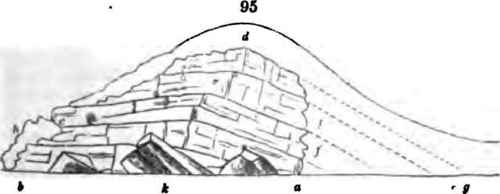
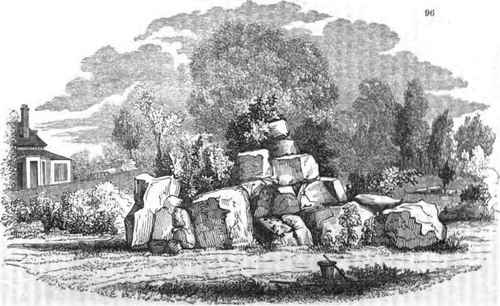
Fig. 95. may be described as a mechanical representation of a piece of artificial rockwork, in the form of a scar, or precipice, rising from a flat surface, and consisting of the cropping out of strata that have a considerable dip, or inclination. In this figure, abcd show the face of the rock on two sides, in which the lines of the strata, viewed in front, appear nearly horizontal, in different beds; each bed projecting somewhat beyond the one which is over it, in order to form ledges (e) far pleats. The dotted lines f f show the supposed continuation and dip of the strata under the turf. The space dig is covered with earth sad turf as is the rock on the opposite side at h; i shows the tolas si the back of the sear or cliff, where the soil is always deepest and best; and k, preparatory fragment! in the foreground. It will be recollected that this sketch is made purposely plain and formal, for the sake of illustration; but fig. 96., a view of part of the rockwork at Redleaf, may be referred to, as combining illustration with effect
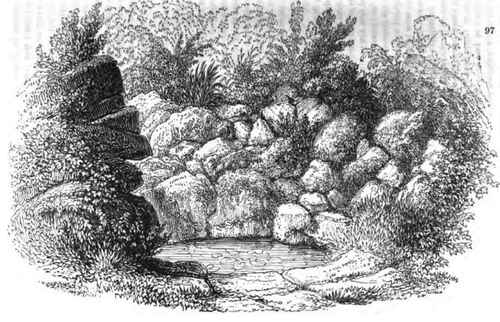
282. An excavation may be made in a fiat surface, and in the bottom of it water may be introduced; from one or more of the sides of this small pond, stratified rockwork may be carried up to the surface, mod considerably above it, to at to give some distant resemblance to an old stone quarry, which may be supposed to have existed there before the spot was turned into pleasure-grounds. An example of rockwork of this kind is given in fig. 97., and it is an idea which every gardener of taste will know how to improve and carry into execution.
283. A walk, or a glade of turf, may be sunk in a level surface, or carried through a knoll or raised surface; and the sides of the glade or walk may display scars or precipices of rockwork, more or less stratified, according to circumstances. On the surface above such rockwork trees may be planted, which would give the whole an air of troth, stability, and durability; the very reverse of the effect produced by heaping up fragments of stone about the roots of trees. An example of this is shown in fig. 98. In general no rockwork of any kind whatever can be put together in a manner satisfactory to the man of taste, except by a workman who has the eye of an artist, who can conceive beforehand the effect which he wishes to produce, who has some idea of connexion and grouping, and who knows the difference between peculiar and general nature. Those who attempt rockwork, without possessing one or more of these qualities of mind, can hardly fail to be unsuccessful; or, if they produce anything good, it must be by mere accident.
They may put together heaps of stones, larger or smaller, according to the abundance of the material, or the sum expended; the heaps may be curious, from the variety of stones, spars, etc, brought together; or ludicrous, from the fantastic shapes of some of them; or childish, from the position of others; but nothing to affect the imagination can ever be the result of such accumulations. After all that has been done, they will still be only heaps of stones. Hence it is, that all the tockworks in Britain, worth looking at, have been constructed by workmen who have had a natural genius for this kind of work; or under the immediate direction of artists. For example, those at Pain's Hill, Wimbledon House, and Oatlands, were put up by a stonemason, who devoted himself entirely to this kind of production, and who was eagerly sought for in every part of the country; that at Hoole, as we have seen, was designed and executed under the eye of the proprietor, Lady Broughton; that at Redleaf was also executed under the direction of the late Mr. Wells himself; and the interesting grottoes and cascades at Wardour Castle, by a mason who was much employed in that way throughout the country, and who, though he received nearly a pound a day, when employed, died some years ago, as we were informed in 1833, in the parish workhouse.
Continue to:


My Books

