


Pyrus Spectabilis, Parkmani, And Chinese Weeping Lilac
Description
This section is from the book "The Gardener's Monthly And Horticulturist V29", by Thomas Meehan. See also: Four-Season Harvest: Organic Vegetables from Your Home Garden All Year Long.
Pyrus Spectabilis, Parkmani, And Chinese Weeping Lilac
It is a pleasure to talk with the readers of the Monthly - when you have something to say. Two new trees have come to us, which prove to be such valuable additions to our list of choice ornamentals, that I take great pleasure in presenting them to our horticulturists.
I will first state that they are both perfectly hardy at Boston. "Pyrus Malus Parkmanii" is, probably, a variety of P. M. spectabilis, which originated in Japan, and was brought to this country by the late Piesident Clark of Amherst Ag. College. Two plants only were received, and one died, while the other had a lingering existence for some years, when it rallied and shone forth with the most beautiful blossoms and buds ever seen on a flowering apple, and its value has been fully acknowledged here for several years past.
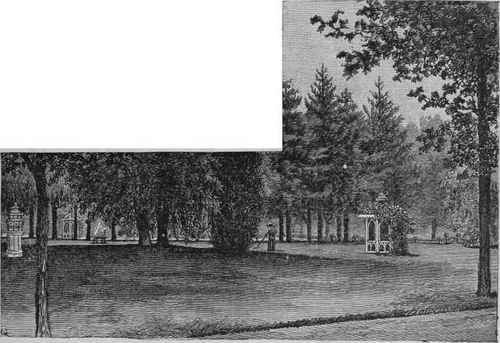
Lawn at J. M. Tilford's Residence. (See page 34).
It is a small-sized, slender-branched tree, with a thick top, and its leaves are remarkably firm, coriaceous, and glossy, cuneate in shape, and so distinct in appearance from any other trees of this family that it can be recognized at a distance as easily as a Rhododendron, while the autumn colors of the foliage are equal to those of the Liquidambar or any other tree we have.
The beauty of its foliage alone would entitle it to a place of honor on any lawn, but when its buds appear in May its surpassing loveliness is enthusiastically acknowledged by all who see it. The stems of the blossoms are three inches long, and so slender that the weight of its carmine buds, an inch in length, bends them down into a graceful curve, which adds greatly to the whole effect. The open flowers are a lighter shade of carmine, and are as double as an average tea rose.
Those who have seen the tea rose "Pere Gontier" may be told that its buds are fac-similes of those of that fine new rose, both in shape and color, though, of course, not so large. Any person seeing these long and elegant buds of carmine would suppose they were tea rose buds, and nothing else. I showed them last May to many amateurs, and all were so warm in their admiration that I felt I could not over-praise it myself.
The second new one is "Syringa ligustrina Pekinensis," variety Pendula. It is a lilac having foliage, in shape, like that of the laurel willow, and, probably, white flowers, although it has not yet flowered in this country. Its habit is almost precisely like that of Forsythiasuspensa; while, grafted high on a standard, it forms a more graceful tree than the Kilmarnock Willow. It is the first "Weeping" lilac ever seen, I think, and will be the parent of a new type of this family, no doubt.
Somerville, Mass.
Continue to:


My Books

