


Application Of Wind As A Power For Raising Water
Description
This section is from "The Horticulturist, And Journal Of Rural Art And Rural Taste", by P. Barry, A. J. Downing, J. Jay Smith, Peter B. Mead, F. W. Woodward, Henry T. Williams. Also available from Amazon: Horticulturist and Journal of Rural Art and Rural Taste.
Application Of Wind As A Power For Raising Water
A garden engine, manufactured by Downs & Co., Seneca Falls, State of Now York, enabled me to preserve many valuable plants, shrubs, and trees, during the severe drouth of last season. It was equally important as an implement of warfare in a contest I waged with the cherry and pear slugs, and some other depredating insects. The force with which it throws tobacco water, and other medicated washes, is sure to reach those enemies, however securely they are concealed. Its principles are simple, and the workmanship excellent. No gardener can well dispense with its use.
To pump from a well the requisite supplies of water was a work of no small labor. It led to the investigation of a method of working a pump by means of the wind. The practicability of the plan I am about to suggest, does not remain to be tested by experiment During former years, a small wind-mill was in successful operation upon the farm of Mr. Anderson, five miles west of Ashland, Ohio, on the road leading to Mansfield. It worked a pump that amply furnished a large stock of cattle, which otherwise could obtain no water. Two days only had it ceased to perform its duties during more than two years, and that interruption was occasioned by the meddling of mischievous boys. It is still in operation for ought I know. The cost of this simple machine, including pump, did not exceed fifteen dollars.
By reference to Plate I, the principles on which it was constructed will be at once comprehended. The direct application of the power, without the intervention of any geering or machinery, obviates much friction, hence a email amount only of power is required. The diameter of the wheel should not exceed four feet, a few inches less is preferable. It is firmly fixed by its hub on an iron axle formed of a square inch bar. The sails or buckets are secured, at their outward ends, to a wooden rim, like that of a large spinning wheel. An inch and a half crank is raised on the axle at B, which, at that point, is cylindrical, and upon which is adjusted the upper end of the piston-rod of the pump G. This, when in motion, of course commands a play of three inches.
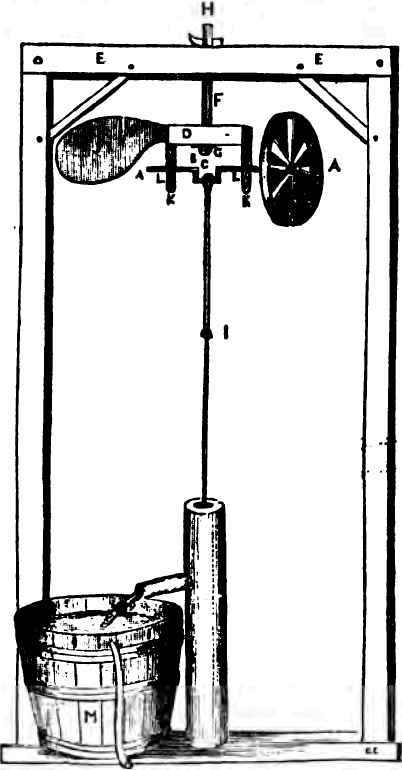
PLATE L.
Continue to:


My Books

