


Landscape Adornment - No. XX. "Entrances"
Description
This section is from "The Horticulturist, And Journal Of Rural Art And Rural Taste", by P. Barry, A. J. Downing, J. Jay Smith, Peter B. Mead, F. W. Woodward, Henry T. Williams. Also available from Amazon: Horticulturist and Journal of Rural Art and Rural Taste.
Landscape Adornment - No. XX. "Entrances"
By Geo. B. Woodward, Civil Engineer And Architect, No. 29 Broadway, New York.
"Evert place," says Mr. Loudon, "may be considered as producing three leading impressions on the mind of a stranger, viz.: that called forth by the entrance lodge, gates, and the portion of the approach which is seen through the latter; that which is produced by the first good view of the house obtained from the approach-road; and that which is obtained from the drawing-room windows, after entering the house".
These remarks were not considered strictly applicable to all places, as natural conditions and situations would very materially alter the manner of treatment. It would be desirable, in the management of large country estates, not to see the house immediately on entering the grounds, but have it come in sight after driving a moderate distance from the entrance. It is better to treat the view of the entrance and the view of the house apart from each other, and so manage the former that it becomes an index to the more important features within. We can call to mind a number of very fine places, not above fifteen acres in extent, in which these three leading impressions have been successfully carried out; or, rather, the attention is not drawn from the first to the second by having both coming into view at once.
The entrance gate, lodge, and accessories, are in many cases the only indications of a finished country seat; and but for something striking of this description, one might drive along almost unmindful of its existence, it being a frequent occurrence to plant out the highway in such a manner that no view of the grounds can be obtained from it.
An entrance should be spacious and attractive, and so planned as to admit of a display in planting both outside and inside the inclosure. If properly executed it forms one of the most agreeable attractions that arrest the eye of the passing traveller or the visitor who enters the premises. A spacious foreground indicates importance, and is an embellishment that may be adopted to good advantage where the wish is to convey an impression of magnitude or extent; care should be taken, however, to keep all improvements within the bounds of a reasonable proportion, and to make use of none but what would be appropriate to all other surroundings.
A very common defect, not always to be avoided, is having an ascending grade from the highway; it is far better to fix upon a level space, and let it extend at least thirty feet each side of the gate; it is easier for horses to stand while the gate is being opened, and they have less difficulty in starting than they would have on an up grade.
The position of the gate should be at least thirty feet from the customary travelled track of the public road, so that a carriage may turn out and admit other vehicles to pass while the gate is being opened.
As a general suggestion, it is best that the approach road should leave the public road at right angles, and take its direction at the most suitable point beyond forty feet from the gate; but as no general rule is applicable to all cases, we find it necessary to depart from this in many instances, and particularly so when the ground rises rapidly. We have repeatedly found it advisable, in practice, to enter obliquely, and to run the approach road nearly parallel with the highway for a considerable distance, and by so doing attain the elevation on which the house was situated by an easy and regular gradient. This, we know, is breaking down a rule that every novice believes has no exception; but experience will teach that it is the principles of landscape gardening, and not rules, that are applicable in all situations. Cases frequently occur in which impracticable obstacles between the best position for the entrance and the house render it absolutely necessary to override all so-called rules. We have had occasion to disregard many of them in practice.
A bend in the public road, an oblique junction of two roads, or a corner, are quite frequently found to be very suitable places for an entrance.
The accompanying plans are among the best that we have seen, and may be altered to suit almost every taste. A gate set in the straight line of the fence, without any foreground, would be the most simple. Plan No. 1 gives a foreground without using any more land than is necessary for the road, but does not admit of any exterior planting. No. 2 has both the convex and concave curve, and admits of more variety in embellishment. No. 3 is the most common and the least contracted of the three symmetrical designs, and is preferable to Nos. 1 and 2. An opportunity is here afforded for a display in planting.
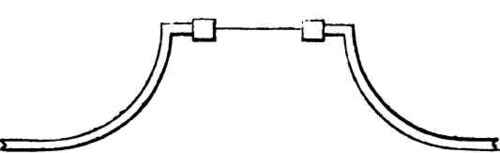
No. l.
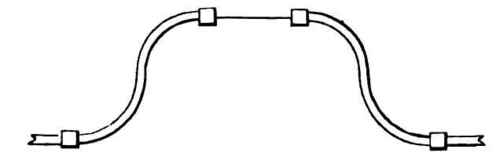
No. 2.
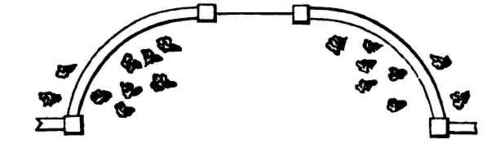
No. 3.
In either of these three, changes can be made by increasing the width and depth of foreground, or by making the curves flatter or sharper. If a small gate is wanted, it can be introduced without altering the general plan.
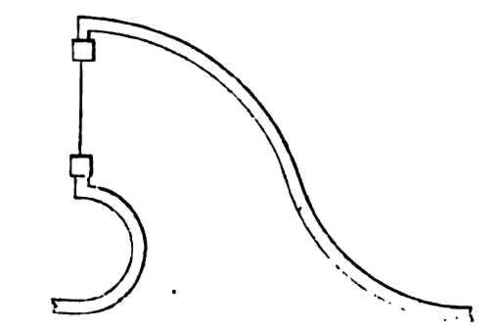
No. 4
No. 4 is sometimes used when the situation of the ground compels an abrupt turn; it also prevents an inspection of the premises from passers-by.
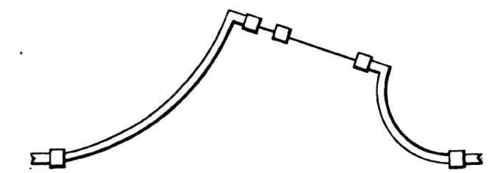
No. 5.
No. 5 is a modification of No. 1, more spacious, and applicable where the travel is mostly in one direction, as towards a village or depot.
All the accessories of an entrance, as the lodge, the foreground, the road, etc., should be treated as an independent feature; it should, in fact, be a little landscape of its own, with its embowered cottage, its lawn, its shrubbery, and its wood, which last, as Sir Henry Steuart says, "surmounts all obstacles and cures all deformities. Wood is so beautiful in itself that it throws its own delightful character over every thing which it touches. If your ground be high, it will give it shelter; if tame and flat, variety and elevation; and if it be irregular and deformed, it will oftentimes convert those seeming obstructions in to playful intricacy and unexpected beauty".
Continue to:


My Books

