


The May-Apple
Description
This section is from "The Horticulturist, And Journal Of Rural Art And Rural Taste", by P. Barry, A. J. Downing, J. Jay Smith, Peter B. Mead, F. W. Woodward, Henry T. Williams. Also available from Amazon: Horticulturist and Journal of Rural Art and Rural Taste.
The May-Apple
The May-Apple, so extensively diffused throughout the United States, is a well-known jndigenous herbaceous plant, growing luxuriantly in almost every moist and shady woods, often in dense patches, propagated by its creeping root.
This form of root is called a rhizoma, considered rather as a stem under ground, and is the part used medicinally - most active after the leaves have withered in the fall; the leaves are not eaten by cattle, and are reputed as being poisoncms. Though called May-Apple, the fruit never ripens before July, and is found also until late in September. It has a sweetish taste, much like the fruit of Passiflora edulus; according to Dr. Griffith, it also resembles it in outline: to some palates, its peculiar taste is quite agreeable, and it may be eaten freely with impunity.
Its dried and powdered root is extensively used, and enters into various recipes, under the name of "Mandrake." It has, besides, other local names, such as Raccoon-berry, Yellow-berry, Wild and ground Lemon, Pecan, etc. Our Pennsylvania Germans call it Bush-Apfel (wood-apple), while the European Germans call it Enten fuss (duck,s-foot),from the fancied resemblance of. the leave's to the webbed feet of a duck; the stem of the leaf being centrally attached, is called a peltate leaf Thus we have the significant scientific name compounded from the Greek, for foot and leaf, for its generic term, and the character of its attachment for the specific name, viz: Podophyllum peltatum.
These hard names are frequently objected to, yet it is much better to have a proper name, recognized in every language by men of ordinary education, than the arbitrary and numerous local terms so perplexing. For instance: in "Dr. Beach's American Practice," of 1848, p. 667, he calls it "Mandrake," and figures a reproduced cut of the Podophyllum Montana, a questionable species described by Rafinesque, and also figured in " Griffith's Medical Botany," p. 117; thus giving an erroneous figure and an objectionable name, since the "Mandrake " is a name appropriated for ages past to the ".Mandragora," a species of Atropa, about which the most marvellous stories are told by some of the older authors, (See Loudon's Encyclopaedia of Plants, p. 154-5).
In the "American Cattle Doctor," by G. H. Dadd, M. D., published by A. 0. Moore, 1858, p. 112, is the following remedy for the cure of Pleuro-Pneumofiia, or when cows are attacked with a slight cough.
℞ Powdered Golden Seal, (tonic,) 1 table-spoonful.
" "Mandrake," (relaxant.) 2 teaspoonfuls.
" Lobelia (anli-spaemodic.) 1 teaspoonful.
" Slippery Elm. or Mallow. (uhrtculing.) 1 table-spoonful.
" Hyssop tea, (liaphoretic.) 1 gallon.
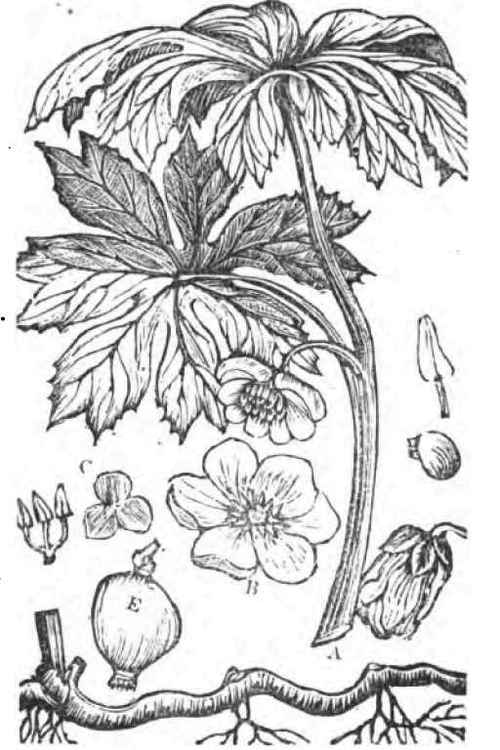
PODOPHYLLUM PALTATUM.
Strain the tea, mix the ingredients, and give a quart every two hours. In the meantime, inject half a table-spoonful of powdered lobelia and ginger each, mixed in a gallon of boiling water. The remedy is a good one.
It is not my intention to enter into an extended recapitulation of the numerous recipes into which the May-Apple root is introduced. I give the foregoing as an example of the necessity of making use of proper names, when dabbling in curatives. True, what is there in a name? "a rose by any other name would smell as sweet" - or something like it, was said by Shakspeare. Yet, to give a dose of corrosive sublimate instead of calomel, because both are compounded of mercury and chlorine, would not answer; and hence a correct knowledge of names and properties is of vast importance.
Dr. Jno. B. Newman recommends the following for a good and efficient purgative:
Take of powdered May-Apple (root) one ounce. " " Cream of Tartar " "
" " Spearmint, half an ounce.
Mix thoroughly; dose, a teaspoonful. This is to be given when purging is required in fevers. Some authors say that from five to ten grains of the powdered root is a dose. The late United States Dispensatory recommends twenty grains for an active purge.
This discrepancy arises from a difference in collecting the root, since they are difficult to find after the decay of the leaves, (unless the spot is marked;) collectors take them up while still in flower or fruit, and supply the shops, being then conspicuous and readily seen.
"An extract is also made, which is a good substitute for the extract of Jalap - dose from five to fifteen grains." - United States Dispensatory.
According to Dr. Smith, the resin, when pure, is white, and purges actively in the dose of two or three grains; this is the podophyllum, with which a country quack, a few years ago, came nigh unto purging one of his patients "beyond Jordan".
I cannot avoid adverting to the great difficulty systematic botanists have met with, in assigning to our May-Apple its true position. Dr. Asa Gray appends it to his Berberals, because its affinity is close to that of Jeffer-sonia Diphilla, also a single species, dedicated by Prof. Barton to Thomas Jefferson; this is the celebrated rheumatism root of Ohio, the anthers of which are valvular, a distinctive feature in the Berberry family. However, it also resembles in its habits our Blood root plant, quite as much, or rather more, than it does the May-Apple.
Dr. Lindley says its affinity is more nearly with the Crowfoot tribe, and maintains that "the main distinction between the Berberries and Crowfoots consists in the recurved anther valves of the former; and as Podophyllum has not such valves, it must go to Crowfoots".
Dr. Lindley again says: "that the Crowfoots differ from Dilleniads in the want of an aril, a deciduous calyx, etc." But it happens that our May-Apples have arilled seeds, as first shown by Prof. Torry, in his "Flora of New York, (State)," Vol. I, p. 35, and a deciduous calyx; also, Prof. Alphonse de Can-dolle attaches great generic value to the arillus; all things considered, it comes as near to our custard apple, commonly called papaw, in its pulpi-arilled seeds, deciduous calyx, two-ranked petals, extrorse anthers, numerous ovules, etc. I have even traced faint outlines of the rumination on thoroughly ripened seeds, approximating still more closely to the papaw. Yet, I will not enter the list with men of the known ability of Prof. A. Gray and the celebrated Dr. Lindley, by giving a contrary opinion.
Though one species only is recognized generally, yet, according to Dr. Gray, there is one found in the Nepaul Mountains, which has but six stamens, - the Podophyllum hexandria; this, and because the "nandina," to which latter the same objection in not having valvular anthers would obtain with equal force, and not objected to by Lindley, who, notwithstanding, retains nandina among his Berberals, also, has no doubt decided Dr. Gray in his opinion, which is certainly less objectionable than that of Dr. Lindley.
To close harmoniously, allow me to quote from Stillingfleet:
"Would you both please and be instructed too, Watch well the rage of shining, to subdue; Hear every man upon his favorite theme, And ever be more knowing than yon seem, The lowest genius will afford some light, Or give a hint that had escaped your sight".
Continue to:


My Books

