
![previous page: Propagating Plants By Grafting. [Continued From January Number.] By A. 8. Fuller](../../images/nav/page_prev.gif)


Propagating Plants By Layers
Description
This section is from "The Horticulturist, And Journal Of Rural Art And Rural Taste", by P. Barry, A. J. Downing, J. Jay Smith, Peter B. Mead, F. W. Woodward, Henry T. Williams. Also available from Amazon: Horticulturist and Journal of Rural Art and Rural Taste.
Propagating Plants By Layers
The same principles given for propagating plants by cuttings are also applicable to layers. In fact, a layer is only a cutting that is allowed to remain attached to the parent plant until it has produced roots through which it may collect sustenance for self-support.
Various methods are employed to produce this result, such as wringing, twisting, tonguing, or partially dividing that portion of the stem on which it is desired that roots shall be formed.
All these distortions of the stem or branches of the plant layered are for one object, that is, to check the downward flow of sap. Roots then become necessary for supplying sustenance to the cutting or layer, and are formed.
The most common method of preparing layers is that of making a tongue on the underside of the branch. The operation is performed thus: make an incision in the branch to be layered, just below a bud, cutting through the bark and into the wood to the depth of one quarter to one half its diameter, then pass the knife upward for an inch or more, splitting the stem lengthways, forming the tongue, as shown in fig. 124. The branch is then bent down and fastened in its place with a hooked peg, and that portion on which the incision is made is covered with soil or other material which shall exclude it from light and air, while at the same time keeping it moist, thus aiding the development of roots.
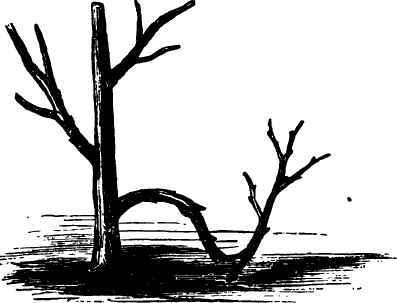
Fig. 124.
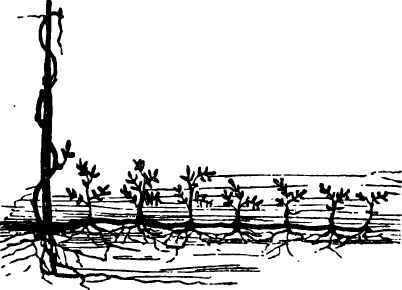
Fig. 125.
Twisting, coiling, or notching the branch, so as to partially separate the fibers, will often answer the purpose equally well as tonguing. Sometimes a ring of bark is taken off, partially if not entirely cutting off the downward flow of sap. Bending the branch at a very acute angle will often answer the same purpose, as the main object in all these distortions is to check, but not wholly prevent, the downward flow of sap, the layer receiving only a partial supply of nutriment from the parent plant.
Several branches may be layered from one plant, and it matters not whether it be herbaceous or woody, the general principles to be followed are the same. There is certainly a great difference in plants relative to the facility with which they produce roots; but it is equally as great in the herbaceous as in the woody. Some woody plants will produce roots in a few days by merely placing the branches on the surface of the soil and covering with any material that will keep them moist; while others with the most careful manipulation will not produce roots in less than two or three years.
In preparing layers of those plants which produce very slowly, it is best to distort that portion which is buried as much as possible with safety, but with many kinds no disturbance of the natural condition is necessary. With nearly all species of trailing plants, such as wistarias, tecomas, clematis, etc., it is only necessary to lay the stems in a shallow trench and when the buds push into growth, draw the soil back into place, each shoot producing a plant.
Roots will usually be produced in abundance the entire length of the old stem, as shown in fig. 125.
When roots are not produced as rapidly as desired, then the layered branch may be bent, as shown in fig. 126, which is a method usually practiced with the wistarias. Should the bending of the stem not prove to be a sufficient check to the flow of sap, a notch or tongue may be made on that portion which is covered with soil.
In preparing shrubs and trees for the purpose of producing layers therefrom, it is often necessary to head them back quite severely the year previous, so that a large number of shoots shall start from near the ground. Plants thus prepared are technically called stools; and if all the shoots are layered in any one season, then none should be layered the next, but all allowed to grow unchecked, so that the parent plant may regain that strength of which it has been deprived by excessive layering.
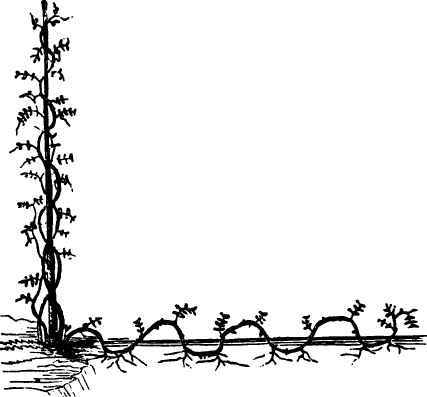
Fig. 126.
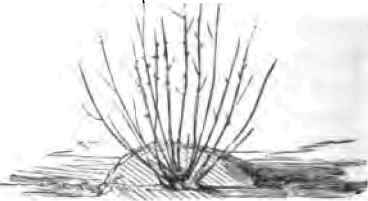
Fig. 127.
Sometimes the shoots are not bent down, but the stool is banked with earth, as shown in fig. 127; and when the shoots have emitted roots from their base, they are slipped off from the main stock and planted out separately. The quince, hibiscus, paradise apple, and many other kinds of plants that produce roots readily, are extensively propagated in this manner.
It is more convenient for the purpose of layering if the branch is near the ground, yet it is not positively necessary, because soil or other material which will answer the same purpose may be elevated to the branch to be layered. A platform may be made upon which to place the soil, or boxes or pots filled with it may be hung among the branches of a tree and the shoots layered therein. But when this is done, it will require more care to keep the soil moist around the layer than if the operation is performed in the usual manner.
The proper time for making layers is as variable as that of cuttings. With some plants it is best to layer the young growing wood, while with others they may be put down at almost any time. But, as a rule, layers should be made while the plant is growing the most rapidly, because roots are produced at that time more readily than at any other. It is not always advisable to wait until growth has commenced before making them, but the branch should be in position to produce roots when the proper time arrives.
With some plants it is better to make the layers in the autumn, for the same reason given for making cuttings at that time; but with others it would result in certain failure, consequently each Species or family may require different treatment to insure success.
The particular advantages to be gained in propagating plants by layers are:
First. That it is a very simple process of multiplying plants, by which the merest tyro may propagate those species and varieties which require great skill by other methods.
Second. It is a certain method, as the parent plant sustains the layer until it has produced roots through which it may derive sustenances for self-support. Thus particular varieties of the oak, hickory, tulip, and similar trees which are usually called difficult to propagate, may be multiplied by those who are but slightly skilled in these matters.
Third. With many kinds of plants, much larger specimens can be obtained in less time than it is possible to produce them from cuttings.
Continue to:


My Books

