


Propagating Plants By Grafting. [Continued From January Number.] By A. 8. Fuller
Description
This section is from "The Horticulturist, And Journal Of Rural Art And Rural Taste", by P. Barry, A. J. Downing, J. Jay Smith, Peter B. Mead, F. W. Woodward, Henry T. Williams. Also available from Amazon: Horticulturist and Journal of Rural Art and Rural Taste.
Propagating Plants By Grafting. [Continued From January Number.] By A. 8. Fuller
Roots are often used for stocks instead of the stems of plants. Cions may be fitted to a root, or a section of one, in precisely the same manner as they are upon stems or branches. The mechanical part of the operation is very similar in both cases.
Sometimes it is desirable to graft below the surface of the soil, that the cion may eventually take root and become capable of furnishing itself with sustenance from the earth instead of relying upon the original stock. In all cases where it is expected that the cions will emit roots, the junction should be made below the surface of the soil, at least so low that only the uppermost one on the cion shall be above the surface. Fig. 25 shows a common method of crown grafting below ground. The cion B is then severed in about two thirds of its diameter, and this portion removed, forming what is called a shoulder, at C; the remaining portion is then pared smooth and thin at the lowermost point. The stock is then cut off at D, and the bark at C removed with a thin slice of wood to correspond with the lip of the cion, which is then fitted to it, the shoulder of the cion resting upon the top of the stock. The cion and stock are then tied together with strings or waxed cloth, as in splice grafting. A, the surface of the ground.
All the other methods, such as the splice, cleft, crown, side, and saddle grafting, may be applied to roots as well as the stems of woody plants, and it must be apparent that a large root or stock will supply a cion with materials for making a vigorous growth than those of an opposite character. But while this is true to a certain extent, it should also be remembered that no cion can use any more plant-food than can be assimilated by its leaves; consequently, if the roots of the stock upon which it set gather more materials than can be used, there will be stagnation or entire inaction in some portion of the plant. When a large plant is severely cut back for grafting or other purposes, and thus deprived of its usual amount of foliage, it will often expend the greater portion of its vitality in producing suckers; but with some species few or no suckers are produced ; and as the vitality of the plants can find no outlet except through the one or more cions, it is thus rendered very feeble, simply for the want of an opportunity to perform its natural functions. No root will remain dormant and still healthy for any considerable time, under circumstances which are naturally suited to promote growth.
Knowing this, the propagator of plants should avoid cutting off all of the branches of a large stock unless he can substitute a sufficient number of cions to supply their place, or at least enough to allow all of the roots to act, although it it is but very little. To avoid the too severe checking of the stock when of large size, the branches of trees only are grafted, many cions being inserted upon one stock. The same principle is sometimes followed upon the roots; one or more of these are severed, and the end nearest the stem is raised to the surface and a graft inserted, as shown in fig. 26. The cion is allowed to grow one or two seasons, then dug up and transplanted.
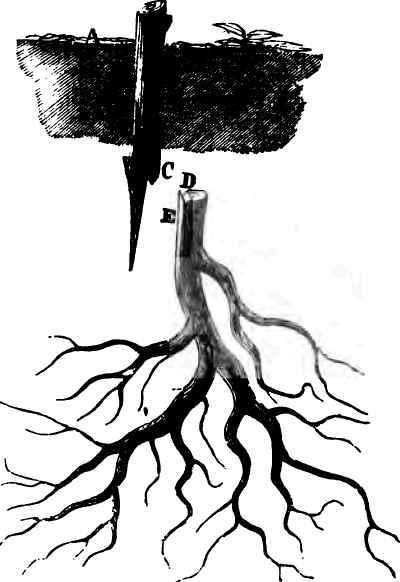
Fig. 25.
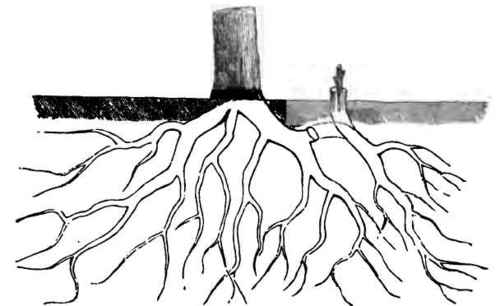
Fig. 26.
Grafting upon large roots is seldom practiced except in rare instances, and where small stocks can not be obtained.
The different methods of grafting are very numerous, over fifty being described in the various horticultural works extant, but they all produce nearly the same results; many of them are so nearly alike that it would be difficult to point any material difference. The French works, in particular, give many different ways of doing the same thing, the slightest variation being deemed sufficient reason for bestowing upon the process a distinct name. For instance, instead of dividing the cion, as shown in one of our modes of saddle grafting, the French gardeners will divide the stock and insert the cion in the center, as shown in fig. 27. This method is called by Dubreuil the double V graft. Another method, which is applicable only to small stocks, is shown in fig. 28. The cion is made wedge-shape at both ends, a bud being left on the bark about midway between the two points. The stock is divided as shown, but no wood is removed the cion being fitted into the incision; afterward the whole, except the bud, is inclosed with waxed cloth, if above ground; but if below, bass strings will usually answer the purpose.
This is an excellent method for grafting on pieces of roots of many kinds of ligneous as well as tuberous-rooted species.

Fig. 27.
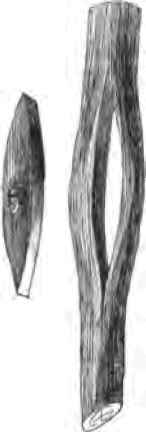
Fig. 28.
The one great object in the simple act of grafting is to join a portion of one plant to that of another, and in such a manner that they shall unite ana become as one, therefore the more simple the process, the more readily and successfully will it be performed.
Continue to:


My Books

