


![next page: Propagating Plants By Grafting. [Continued From January Number.] By A. 8. Fuller](../../images/nav/page_next.gif)
Propagating Plants By Grafting
Description
This section is from "The Horticulturist, And Journal Of Rural Art And Rural Taste", by P. Barry, A. J. Downing, J. Jay Smith, Peter B. Mead, F. W. Woodward, Henry T. Williams. Also available from Amazon: Horticulturist and Journal of Rural Art and Rural Taste.
Propagating Plants By Grafting
Grafting is governed by the same physiological principles as budding.
There must exist an affinity between the stock and cion; if not, a permanent union is impossible.
With some of the modes in use, the operation of grafting is very similar to that of budding, but with this important difference - that in grafting, a larger section of the plant to be propagated is used than in budding; besides, it can be performed upon a great variety of plants while they are dormant.
The art of grafting is one of the most ancient methods known of multiplying individual species and varieties of plants; still there is scarcely one person in a hundred who sufficiently understands the process to put it into successful practice. The same thing may be said of all the most common methods of propagating plants, oft-repeated but seldom learned by any considerable number of people of any one generation.
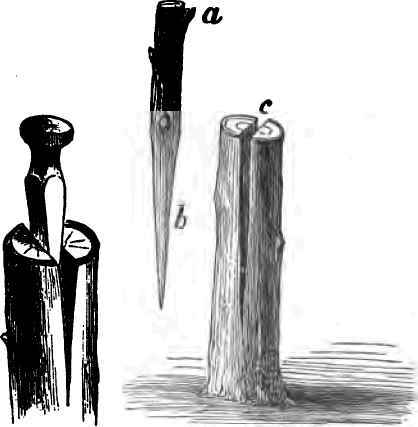
Fig. 5.
Fig. 6.
The implements used for grafting are: a small saw, for cutting off the heads of large stocks or branches of trees; a good, strong knife, with a thick back, to make clefts in the stock; a small knife, to prepare the cions with; a wedge, grafting chisel, and a small mallet. The above-named implements are often made of peculiar patterns, to suit the fancy of the operator; but the chief aim is to have the work well done. Other kinds of implements are used for performing particular modes of grafting, of which I shall have occasion to mention as the different methods are described.

Fig. 7.
In addition to these, bass strings, such as used in budding, for tying in the grafts, and grafting-wax, to cover the wounds and protect them from the air and water, are necessary.
There are many kinds of grafting-wax in use, as well as other compositions, which answer the same purpose. A composition made of clay, fresh cow manure, and cut straw was the principal material used in grafting until the present century. It was prepared as follows: Take a quantity of good strong clay and some fresh cow manure, add sufficient water to make it the consistency of thick paste, add a little fine cut hay or straw; if a little salt - say one. pint to the bushel - is added, it will assist it in retaining moisture. This composition should be made several weeks before it is wanted for use, and be thoroughly worked oyer as often as twice a week, until used, for the more it is manipulated the better. This composition is but little used at the present time; but there are a few nurserymen who prefer it for some kinds of plants to the more modern grafting-wax. There are many different kinds of grafting compositions recommended in the various works on gardening, which proves conclusively that the exact proportions of materials, or, in fact, the materials themselves, if of like nature, are not very essential to success.
About a hundred years ago, a composition made of the following materials was considered most excellent, if not the yery best: 1 lb. pitch, 1 lb. rosin, ½ lb. beeswax, J lb. hog's lard, ½ lb. turpentine - melted and well mixed together. While in a liquid state it was spread upon thick tough paper or thin muslin; after it had become cool, the paper or muslin was cut into narrow strips of any required size, and then answered the double purpose of strings to hold the graft and for excluding the air and water from the wounds. These waxed strips are in common use at the present day in grafting small stocks of fruit trees and other kinds of woody plants. For grafting in the open air, the following compound is probably in more general use in this country than any other: rosin, four parts ; beeswax, two parts; tallow, one part - melted together; and after it has become cool it is applied by hand, or when in a liquid state it may be applied to paper or muslin. If it is to be used in very cool weather, then add a little more tallow. Linseed oil is sometimes used instead of tallow, in the following proportions: rosin, six pounds; beeswax, two pounds; linseed oil, one pint.
Judging from my own experience, I consider tallow much preferable to oil, and I would warn the rovice agrmsti using indiscriminately the different kinds of oils, as an occasional inexperienced person has done to his loss. Gum shellac, dissolved in spirits of ammonia or alcohol, collodion, etc., are sometimes used, but not so generally as the compositions already named.
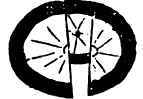
Fig. 8.
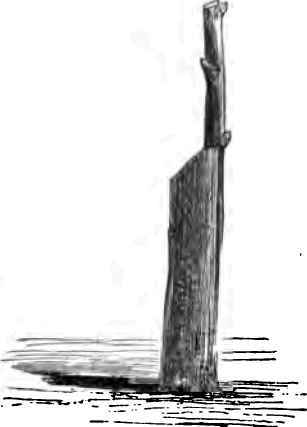
Fig. 9.
In all the different modes of grafting, great care should be observed in having the external surface of the wood of the stock and cion to be exactly even - no matter whether the external surface of the bark is even or not. This allows the new cells, which form between the bark and wood of both stock and cion, to unite and form a channel, through which the sap can readily pass. The sap ascends through the wood of the stock into that of the cion (graft), causing the leaves to expand, which, in their turn, assimilate it, preparatory to its return, as stated in a previous chapter.
The time for grafting most kinds of woody plants in the open air is in the spring, just before or at the time the sap begins to liquefy, varying the time to suit the different species, for experience has demonstrated that there are some which may be operated upon much earlier than others. It has also been discovered that the small branches of even the most hardy trees are often injured by severe cold weather ; therefore, when these are wanted for cions, it is best to take them from the parent stock in autumn, soon after the leaves have fallen, and preserve them in earth, charcoal, saw-dust, moss, or some similar material, where they will be cool - not frozen - and just sufficiently moist to prevent shriveling.
Cions of ripe wood may also be cut at the time they are used, but their vitality is often weakened by the severity of the weather, and the delicate tissue injured to such an extent that it will not form what is termed in grafting granulation (although it is precisely the same as the callus on cuttings), which fills up any small interstices that may exist between the stock and cion, allowing a communication between. Wood of one season's growth is preferable for cions to older (except in rare instances), and it should always be firm and fully matured, and selected from the most healthy and vigorous branches. The following are some of the most common methods of grafting:
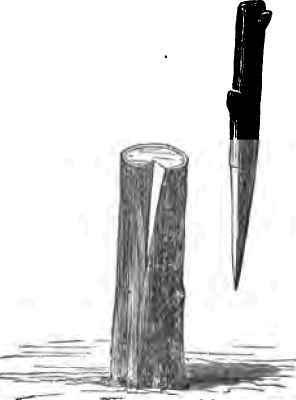
Fig. 10.
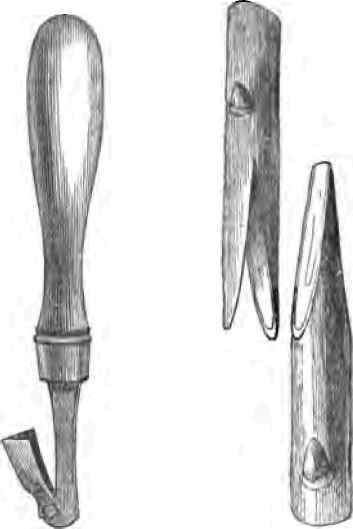
Fig. 11.
Fig. 12.
Continue to:


My Books

