


Propagating Plants By Suckers And Division of The Roots
Description
This section is from "The Horticulturist, And Journal Of Rural Art And Rural Taste", by P. Barry, A. J. Downing, J. Jay Smith, Peter B. Mead, F. W. Woodward, Henry T. Williams. Also available from Amazon: Horticulturist and Journal of Rural Art and Rural Taste.
Propagating Plants By Suckers And Division of The Roots
Dr. Asa Gray, in his "Structural Botany," page 102, defines a sucker as "a branch of subterranean origin, which, after running horizontally and emitting roots in its course, at length, following its natural tendency, rises out of the ground and forms an erect stem.
"The rose, the raspberry, and mint afford familiar illustrations, as well as many other species which shoot up 'from the root,' as is generally thought, but really from subterranean branches. Cutting off the connection with the original root, the gardener propagates such plants by divisions"
The above is a brief statement of the theory generally advanced by vegetable physiologists in relation to the origin of suckers - i. e., that they are produced from subterranean branches, and not from true roots.
Now, while it is not my purpose to occupy any considerable space in this treatise in endeavoring to explain any theory relative to the propagation of plants, nor to provoke a discussion upon the origin of buds or roots, still there are some mystifying statements made by our best authorities on the subject that call for a passing notice. According to Dr. Gray's theory, the raspberry can scarcely be said to have any roots; at least it would be difficult to fix. the point where branches end and roots begin, because one of these so-called subterranean branches, which is not more than one-fiftieth of an inch in diameter, will often produce buds and stems as readily as those which are larger. Other vegetable physiologists make the same or very similar assertions. Schleiden, in his "Principles of Scientific Botany," page 220, says that "no root is capable of producing buds." If this is true, then thousands of plants which we cultivate have no roots, inasmuch as there is not a portion of that which is commonly called root, however minute, that can not under proper circumstances be made to produce buds and leayes. Professor Lindley, in his "Theory of Horticulture," chap.
X., while referring to this subject, says: "A cutting is only capable of multiplying a plant when it bears buds upon its surface; and as the stem is the only part upon which buds certainly exist, so the stem is the only part from which cuttings should be prepared."
According to this theory, cuttings made from the leaves are not only ignored, but should not be used, although we have every reason to believe that at the very time that the above paragraph was written there was scarcely a garden in England in which plants were not being propagated from cuttings of the leaves and from true roots, on neither of which could buds be discovered when taken from the parent stock.
To show how readily some writers promulgate theories founded upon what they may have supposed to be general principles, I will make another extract from the same page as the last: "And again, as the internode or space of the stem which intervenes between leaf and leaf has no buds, their station being confined to the axil of the leaves, a cutting prepared from an internode only is as improper as from the root."
It certainly may be very improper to make cuttings from the internode or from roots, still every gardener knows that with such plants as the willow, quince, poplar, etc., that not only will roots be produced from such portions of the stems, but buds as well. It is quite evident that the learned author (Professor Lindley) had some fears that this theory would not stand the test among the practical men, for he adds: "It will occasionally happen that, owing to unknown causes, morsels of the true roots will generate what are called adventitious buds, and hence we do occasionally see the root employed for propagation, as in the Cydonia Japonica; but these are rare exceptional cases, and by no means affect the general rule."
But he has previously said that "a cutting is only capable of multiplying a plant when it bears a bud upon its surface.* Do we really ever look for buds on the surface of the roots when making cuttings of the blackberry, raspberry, paulownia, catalpa, and hundreds of other plants which are being constantly propagated from pieces of the roots? It certainly makes but little difference with the results whether buds are to be seen or not so long as they are produced at the proper time. The assertion that there are only exceptional cases, consequently do not affect the general principle, has really no foundation, because we are not confined to any particular family or species of plants to find those which may be propagated from the roots. The tender geranium is as readily multiplied from roots as the paulownia, pear, or plum.
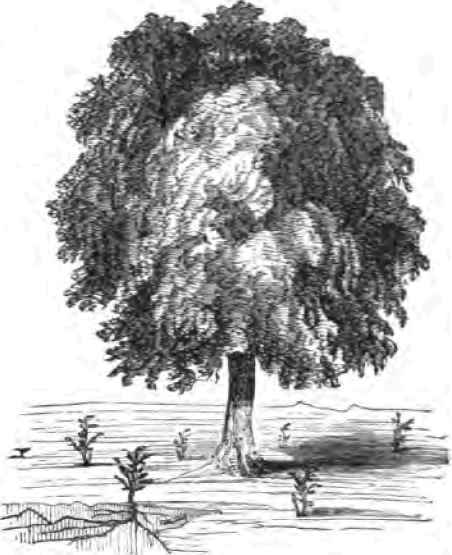
Fig. 153. - Roots Exposed.
It is true that there are many plants which the most scientific propagator has not as yet been able to multiply from root divisions; but because all such attempts have heretofore been unsuccessful, is no proof that it can not be done, or will not at some future time. Why one plant possesses so much vitality that almost every portion, from the leaves to the most minute point of root, can readily be made to produce a separate plant, while with another every attempt at such a division is unsuccessful, can not be scientifically explained. The fact is apparent - the cause unknown. There are many kinds of plants that produce suckers in such abundance that no artificial aid is required, except in separating them from the main plant at the proper time. But there are others which require assistance, such as heading down the parent plant, or severing the roots, leaving them in the ground until suckers are produced.
This last method of propagation was practiced two hundred years ago more than at the present time. In an old work written by Moses Cook, in 1675, we find this method described as follows: "In the latter end of February or beginning of March dig round the trees you intend to increase from till you find such roots as before mentioned, and taking your knife, cut them three or four inches from the great roots, smooth at the place you cut off; then raise up that end, putting in the earth to keep it up, that when your ground is leveled again, the end of the root so cut may be two or three inches above ground." A tree thus prepared would appear somewhat as shown in fig. 153. New shoots will spring from the ends of the roots exposed. The next season the entire root, or only a portion of it, may be taken up with the plant attached. Mr. Cook evidently had not heard of the modern theory of buds not being produced or found on tree roots, as he gives this plan as a sure one for propagating most of the forest trees then in cultivation.
Continue to:


My Books

