


Propagating Plants By Suckers And Division of The Roots. Continued
Description
This section is from "The Horticulturist, And Journal Of Rural Art And Rural Taste", by P. Barry, A. J. Downing, J. Jay Smith, Peter B. Mead, F. W. Woodward, Henry T. Williams. Also available from Amazon: Horticulturist and Journal of Rural Art and Rural Taste.
Propagating Plants By Suckers And Division of The Roots. Continued
When trees have been subjected to this mode of propagation for several successive generations, it increases their natural tendency to produce suckers, until with some kinds the habit will become a very troublesome, if not a decided nuisance; therefore, in such cases, it should never be resorted to if it can be avoided.
Plants that produce suckers can usually be grown from pieces of the roots, and this mode is practiced more generally at present than that of waiting for the roots to produce them without artificial aid. Plants grown in this manner are generally better supplied with fibrous roots, and assume more of the character of those grown from seed, therefore are better suited for transplanting. Root cuttings of hardy plants are usually made in the autumn, for the same reasons given for making cuttings of the ripe wood at that time.
The size of the cutting will vary according to the species operated upon, and the manner of keeping through the winter will also vary considerably; owing to the different structure of the roots, some will require more warmth and moisture to develop buds and roots than others, therefore each family or species will need a particular treatment peculiar to itself, which it would be difficult to explain under any general rule.
Propagating Plants By Suckers And Division of The Roots #1
The variableness in the structure and form of roots demands a corresponding variation in the mode of propagation. Some kinds are hard and woody, and such as these often require a particular treatment to cause the development of buds and new roots, while others will produce them in abundance under the most ordinary care. Among herbaceous plants there are an immense number of species which are readily multiplied by root divisions. The paeonia and dahlia are types of a class of plants that produce tubers with the buds clustered at the apex or crown, and not distributed over the entire surface, as seen in the common potato and artichoke. In multiplying the plants of either class we have only to separate the buds, leaving a tuber, or a small portion of one, attached to the bud, for the purpose of furnishing it with sustenance until it shall emit new roots and tubers. Many of the fibrous-rooted plants, which grow in tufts or stools, as seen in some species of grass, garden pinks, and other familiar plants, are commonly propagated by division of the roots. All plants which naturally produce buds, bulbs, or tubers on their roots or subterranean branches, are, as a rule, more readily propagated by root divisions than those which do not show such a development.
But, as I have previously stated, with many species the existence of buds is of no importance whatever, because there is an inherent power in the plant sufficient to produce them whenever they are required.
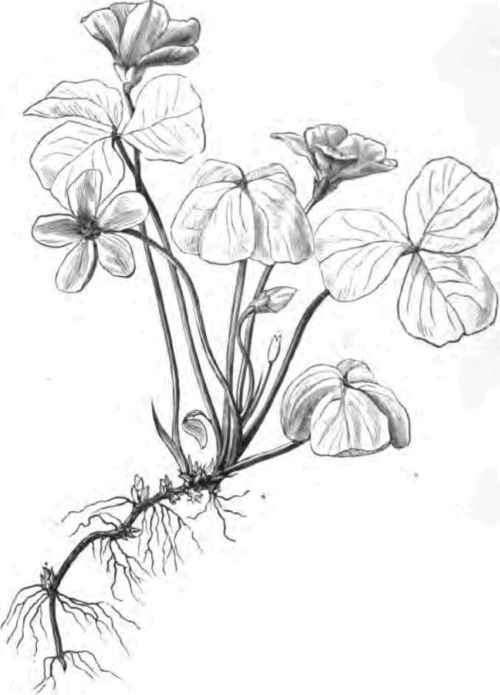
Fig. 162. - Oxalis Acetosella.
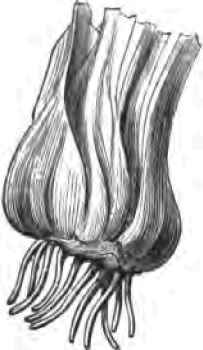
Fig. 163.
It is, however, only by experiment that we can determine what kinds of plants possess the power of producing adventitious buds; consequently it is always best to preserve all the buds that may be observed upon roots that are being used for propagation. For instance, in dividing the large root-stocks of the yucca, yuccania, canna, and arundo, the buds are situated at what are called the joints, consequently the roots should be cut through the internode, so that the buds will not be injured.
The oxalis acetosella has interspersed along its root-stock a number of small bulbs, as shown in fig. 162; at the base of each there is a small bundle of fibrous roots through which the plant mainly draws its sustenance. With such an example before him, the merest novice could readily determine how many divisions to make; but if no such bulbs nor buds were apparent, as is usually the case with the roots of the paper mulberry, paulownia, and similar trees, then he would have no guide, but must determine how large or small the pieces should be to produce the best results by experimenting with the different sizes.
We are now supposing that those propagators who have discovered the best methods of propagating the different species of plants had kept the method to themselves, which, fortunately for the present and future generations, is not the case, to any considerable extent.
Although it may be quite a difficult matter in some cases to decide what particular portion of a plant is the true root, and perform their functions only, i. e.y gather sustenance for the support of the plant, still there are many instances where the point of separation is distinctly marked, and no change of position ever takes place. In many of the bulbs the point of junction between the true roots and the bulb is very distinct, although in common practice we often speak of dividing the roots, which in reality is only a division of leaves, or a fleshy deposit made by them at their ease, as in the common garden lily. The Tigridia is a familiar example of a bulb which rapidly multiplies by divisions. Fig. 163 shows a cluster of these bulbs which has been produced from one in a single season. The, true roots are large and fleshy, and contain nutriment which is absorbed by the bulb, even after they have been separated from the soil. The roots of plants are mainly buried in the soil, consequently their peculiarities, habits, and structure are studied far less than the stems, branches, leaves, and flowers, which are continually in view.
But they possess many beauties, which when once seen will never be forgotten; and their wonderful structure, along with the important place they occupy in the vegetable kingdom, demands our best efforts to discover all the secrets of their growth and development, much of which is at present unknown.
Continue to:


My Books

