


Quinn Pear
Description
This section is from "The Horticulturist, And Journal Of Rural Art And Rural Taste", by P. Barry, A. J. Downing, J. Jay Smith, Peter B. Mead, F. W. Woodward, Henry T. Williams. Also available from Amazon: Horticulturist and Journal of Rural Art and Rural Taste.
Quinn Pear
Several specimens of this pear were handed to us by P. T. Quinn, of Newark, N. J., on Jan. 2d, who stated that the fruit had been kept in an ordinary cellar, without any particular care having been taken to preserve them beyond the ordinary time of their maturity. Some specimens were still hard, while others were in fine eating condition. The fruit is small and not particularly attractive to the eye, but the quality is unsurpassed among our winter pears, and will compare most favorably with the best of our autumn varieties.
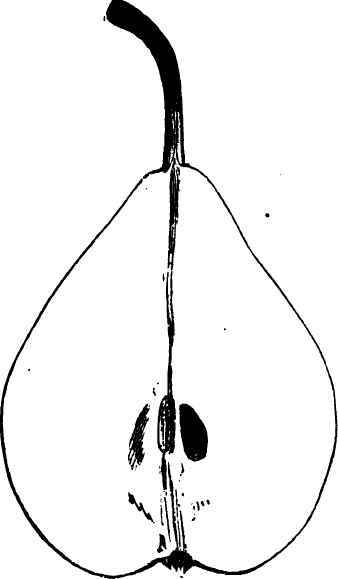
Fig. 25. - Quinn Pear.
A committee of the Farmer's Club of the American Institute, consisting of Dr. E. Ware Sylvester, Wm. S. Carpenter, and John Crane, made the following report upon this pear, which was read by the chairman, Dr. Sylvester, at their meeting, held Jan. 2d.
"The Committee on the Quinn Knight Pear (which had received its name by a vote of the Farmer's Club at a previous meeting) respectfully report:
"That they have examined the pears, and the trees upon which they grew. The tree was imported by the late Prof. Mapes about sixteen years since, without a name, being labeled as one of Knight's Seedlings. It was placed in the front yard, among the evergreens, and has not received the care usually bestowed upon fruit-trees, yet it has made a fair growth.
"'The fruit is below medium size, the larger specimens measuring six inches in circumference; shape, pyriform, tapering rapidly toward the stem end; calyx, shallow, inserted in a regular basin; skin, thick, inclined to golden russet. The pears are in good perfection now (Christmas), and Mr. Quinn thinks its season is from the 1st of November to the middle of January, with ordinary care. They are rich and juicy, free from grit, and in flavor and aroma occupy the first rank. It is, in fact, a Winter Seckel; and if on trial it shall prove adapted to our climate, it will be a very valuable acquisition to our winter pears.'
"Mr. Quinn objected to the motion to rescind a part of the name, inasmuch as he was not the originator of the pear, but only the cultivator of the tree. He desired to retain the original name - Knight's Seedling.
"N. C. Meeker said he was decidedly in favor of short names for pears. A great many people dare not sometimes pronounce the long names of pears, because they are so hard.
"It was then voted that the pear be called the Quinn Pear.
" Solon Robinson said he thought it the best winter pear that has ever been exhibited at this Club. A few specimens were distributed, which were really delicious."
Quinn Pear #1
It may be a superior pear, but its size is a great objection, and unless better in some respect than Dana's, Hovey, or Lycurgus, it will take a good many years to get it extensively grown. Somehow I have myself, and, I know, so have many others, very little confidence in the committee reports of the American Institute Farmers' Club. The rose-growers abroad, when a new rose is introduced, first learn the name of the introducer, and from their knowledge of that introducer's previous plants, form at once an impression of its value. If the growers' list-shows varieties that for years have proved good, and that are retained and grown by cultivators generally, then they eagerly buy; but if, on the contrary, the varieties so introduced have only existed a season or two, and then become superseded by better sorts, or thrown out because when proved they were not found equal to sorts already known, then the buyer hesitates in purchasing. So with this Farmers' Club; and I have yet to learn of any new fruit or flower, grain or vegetable, which it has commended, that has stood the test of years.
Continue to:


My Books

