


Gathering And Preservation Of Fruits. Part 2
Description
This section is from "The Horticulturist, And Journal Of Rural Art And Rural Taste", by P. Barry, A. J. Downing, J. Jay Smith, Peter B. Mead, F. W. Woodward, Henry T. Williams. Also available from Amazon: Horticulturist and Journal of Rural Art and Rural Taste.
Gathering And Preservation Of Fruits. Part 2
"In gathering fruits, a dry time and a cloudless sky should be chosen; and the middle of the day, from noon to four o'clock, is the best time to operate, as the fruits are charged with less humidity, the flavor is more concentrated, and those destined to be preserved keep better. This rule applies to all fruits.
2d. Mode Of Gathering
The best method of gathering fruits consists in detaching them one by one with the hand. All pressure should be avoided as far as possible, as every bruise is followed by a brown spot which gives place to and brings on the rapid decay of the entire fruit.
II. Preservation
"•The preservation of fruits can only be applied to those which ripen during the winter, and which, detached from the tree before the first frosts, are placed under shelter from the cold to complete their maturity. The grape only is an exception to this. Summer and autumn fruits are also preserved, but only by the aid of certain proceedings such as drying, and cooking more or less perfect, added to the exclusion of air or the addition of sugar - proceedings which result in discoloring the fruit and altering their flavor more or less sensibly. We can not here describe the different methods.
" To preserve the fruits of winter, it is necessary, first, to prevent the action of frost, which disorganizes them completely; second, to retard the progress of their maturity in such a manner that a certain number of them will not ripen till towards the month of May in the following year. Experience has demonstrated that decomposition succeeds quite rapidly to complete maturity, and that it is impossible to prolong their preservation beyond this point.
" To obtain more or less perfectly the two-fold condition which we come to describe, depends upon the construction of the place in which the fruits are deposited, the fruit-room, and to the care which they receive.
1st Of The Fruit-Room
The fruit-room will give the more satisfactory results in proportion as it fills the six following conditions:
" 1. That its temperature be uniformly equal. It is by changes of temperature, which expand or rarify the liquids contained in the fruits, that fermentation is excited and the interior organization destroyed, phenomena from which result maturity or ripeness.
"2. That this temperature should be eight to ten degrees above freezing. A higher temperature favors fermentation too much. If, on the contrary, it is lowered to two or three degrees, this fermentation ceases and maturation becomes stationary. Thus we see fruits preserved five or six months in an ice-house. In this case the end aimed at has been exceeded; for we are obliged, in taking them from the ice-house, to expose the fruits for a certain length of time to a higher temperature, in order to ripen them. The fruits thus preserved ripen afterwards with difficulty, and their quality is often found altered.
"3. That the Fruit-Room he deprived of the action of the light This agent also accelerates maturation in facilitating the chemical reactions which produce this phenomenon.
"4. That all the carbonic acid disengaged from the fruits be retained in its atmosphere. This gas, it appears from experiments of Couverchel, contributes powerfully to the preservation of fruits.
"5. That the atmosphere be more dry than humid. Humidity is also a condition necessary to fermentation; ft diminishes the resistence of tissue in the fruits, and favors the effusion of its juices. It is, then, proper to avoid its accumulation in the fruit-room ; but it must never be completely dry, for the fruits losing then, by evaporation, a considerable quantity of the aqueous fluids, wither, dry up, and do not ripen.
"6. That the fruits are so placed as to diminish as far as possible the pressure which they exercise upon each other. This continued pressure determines the rupture of the vessels and cells toward the point of pressure, the different fluids are mingled, and this mixture promotes the chemical combinations which result in maturity*
"Wo propose to construct a fruit-room to fulfil these conditions, in the following manner:
"We would choose a very dry soil, somewhat elevated, facing the north, and completely shaded from the sun by high plantations of evergreen trees. The dimensions are to be determined by the quantity of fruit to be preserved. That of which we give the plan (fig. 2) is 15 feet long in the inside, 12 feet wide, and 9 feet high. This will give place to 8,000 fruits, allowing each one to occupy 4 inches square. It is sunk 2 1/2 feet in the ground; and if the soil is very dry, it may be 3 feet. This enables us the more easily to guard the atmosphere against the external temperature. To prevent surface water from accumulating in the surrounding soil and filtering into the fruit-room, the surface of the ground should descend from the walls, and these should be constructed of cement a foot above the soil.
"This fruit-room is inclosed by two walls, (A and B,) leaving between them an open space (G) about 10 inches wide. This stratum of air interposed between the two walls is the surest means of protecting the interior from the exterior temperature. The two walls are each 12 inches thick, constructed with a sort of mortar, or mud, made of clay and straw. This material is cheap, and on the whole a bad conductor of heat, and on this account preferable to common masonry. The walls are pierced with six openings - throe in the inside and three in the outside walls - the first similar and exactly opposite to the last, The openings fcr the outside wall are -
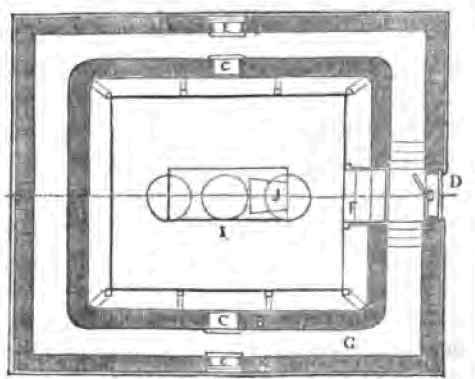
Fig. 2.
"1. A double door (D): the outside door opens out; that of the interior inward, and it opens in two parts like a shutter. When the frosts are severe, the space between the two doors should be filled with straw.
Continue to:


My Books

