


Ornamental Planting Of Trees And Shrubs. Part 5
Description
This section is from the book "Practical Landscape Gardening", by Robert B. Cridland. Also available from Amazon: Practical Landscape Gardening.
Ornamental Planting Of Trees And Shrubs. Part 5
Specimen Lawn Trees
Specimen trees planted on the lawn should be low branched unless it is desirable to maintain a view under the overhanging limbs. Surface rooting trees, such as the soft or Silver Maple, should not be used, as it is difficult to maintain a lawn under them. The Oaks (Fig. 89) are deep rooted and almost unsurpassed as lawn specimens. The Sugar Maple, the large growing Magnolias, Kentucky Coffee, American Ash (Fig. 90) and English Ash, Sweet Gum and the Elms, are among the best deciduous trees. Specimen evergreens are greatly desirable and add to the Winter aspect. Such splendid trees as Nordmann's Fir, Cedar of Lebanon and Deodora Cedar (Fig. 91), Hemlock Spruce, Silver Fir, Blue Spruce (Fig. 92) and White Pine are among the most important. If one has a love of trees, it is in the individual lawn specimens that a great variety may be had and, if care be used in the placing, the unity will still be preserved. As advised for specimen planting along drives, avoid straight lines. Keep the larger trees toward the back and do not crowd along the property line; place the smaller varieties toward the point of view.

Fig. 87. - Groupings of trees and shrubs along curved driveways are artistic and pleasing..
Lines of trees should be avoided. - See page 93.
Lawn Groupings
The lawn plantations or groups, those which are planted in the middle distance, should be pleasing in outline and so placed as to accentuate the view to some pleasing object beyond. The plants should be so arranged in the group that the outline is flowing and not stiff and regular. For the general arrangement and varieties best suited to such groupings we may take some suggestions from Nature, as there are certain trees and shrubs which we frequently find standing apart from woodlands.
The Balsam Fir and the White Birch (Fig. 93) make a pleasing combination planted together, also either the Austrian or White Pine and the Beech. The Oriental Spruce, Nordmann's Fir and Roster's Blue Spruce (Fig. 92) may be used together in groups with very gratifying results. The Japanese conifers, such as the Retinis-poras, should always be grouped together or with the Arborvitaes. They do not harmonize well with the coarser leaved conifers.
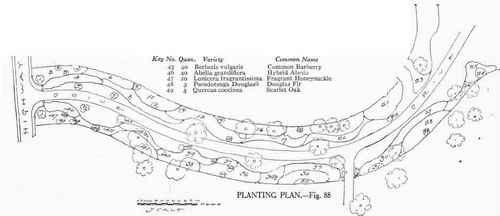
Key To Planting Plan. - Fig. 88 - A Naturalistic Planting Along A Curved Driveway
Key | ||||
No | Quan. | Variety | Common Name | |
I | 2. | Quercus rubra | Red Oak | |
2. | 6o | Rhodotypos kerrioides | White Kerria | |
3. | 3. | Pinus sylvestris | Scotch Pine | |
4. | 6o | Abelia grandiflora | Hybrid Abelia | |
5. | 2. | Ulmus americana | American Elm | |
6. | 25. | Viburnum tomentosum | Japanese Snowball | |
7. | I | Acer saccharum | Sugar Maple | |
8. | 70. | Lonicera Morrowi | Bush Honeysuckle | |
9. | I | Pyrus floribunda | Flowering Crab | |
IO | 20. | Crataegus Oxycantha | English Hawthorn | |
ii | I | Juniperus Schottii | Schott's Cedar | |
12. | I | Tsuga canadensis | Hemlock | |
13. | 70. | Hydrangea quercifolia | Oak-leaved Hydrangea | |
14. | I | Cerasus japonica rosea | Pink Japanese Cherries | |
I5. | I | Cedrela sinensis | Chinese Cedrela | |
16. | 40. | Cercis canadensis | Red Bud | |
17. | 40. | Buddleia Veitchii | Butterfly Plant | |
18. | I | Thuya occi. pyramidalis | Pyramidal Arborvitae | |
19. | 60. | Viburnum dilatatum | Japanese Bush Cranberry | |
20. | SO | Pyrus meianocarpa | Dwarf Pyrus | |
21. | 40. | Cornus florida | White Dogwood | |
22. | I | Betula lutea | Sweet Birch | |
23. | 30. | Spiraea Thunbergii | Snow Garland | |
Key | ||||
No | Quan. | Variety | Common Name | |
24. | 3. | Pterostyrax hispidum | Wistaria Tree | |
25. | 75. | Jasminum nudiflorum | Yellow Jasmine | |
26. | 20. | Cornus alternifolia | Blue Dogwood | |
27. | 135. | Berberis Thumbergii | Japanese Barberry | |
28. | 40. | Cornus mas. | Cornelian Cherry | |
29. | 1. | Thuya occidentalis | Arborvitae | |
30. | 60. | Viburnum acerifolium | Maple-leaved Viburnum | |
31. | 5. | Crataegus Oxycantha | English Hawthorn | |
32. | 2. | Pyrus Ionensis, Bechtel's Double-flowering | Bechtel's Crab | |
33. | 150. | Hypericum Moserianum | St. John's Wort | |
34. | 60. | Cotoneaster Simonsii | Shining Rose Box | |
34½ | 15. | caragana arborescens | Siberian Pea | |
35. | 3. | Pinus Strobus | White Pine | |
36. | 70. | Exochorda grandiflora | Pearl Bush | |
37. | 35. | Xanthorrhiza apiifolia | Yellow Root | |
38. | 5. | Pinus austriaca | Austrian Pine | |
39. | 75. | Cercis japonica | Japanese Judas | |
40. | 1. | Cedrela sinensis | Chinese Cedrela | |
41. | 30. | Cornus florida | White Dogwood | |
42. | 75. | Rosa humilis | Native Rose | |
43. | 1. | Acer saccharum | Sugar Maple | |
44. | 1. | Tsuga canadensis | Hemlock | |

ONE OF THE BEST TREES FOR THE LAWN.
Fig. 89. - Pin Oak (Quercus palustris). Among other requirements, specimen lawn trees should be low branched. The Pin Oak fulfills every requirement. - See page 93.

THE AMERICAN ASH MAKES A DESIRABLE SPECIMEN.
Fig. 90. - American Ash (Fraxinus americana). A quick growing type of desirable lawn tree. - See page 93.

A SUITABLE SPECIMEN TREE FOR SMALL LAWNS..
Fig. 91. - Deodar Cedar (Cedrus Deodara). Recommended as a specimen lawn tree. Of beautiful form and foliage; closely related to the Cedar of Lebanon. - See page 93.
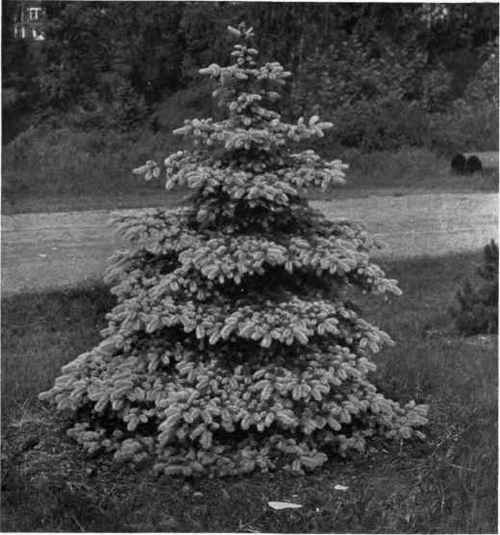
ALWAYS REMARKABLE AND ALWAYS DESIRABLE.
Fig. 92. - Koster's Blue Spruce (Picea pungens Kosteriana). Well known as a desirable evergreen; tips of foliage of a beautiful blue sheen. - See pages 93 and 94.
Groups on small areas should not be overcrowded. If immediate effect is desired first arrange for the permanent trees and then others may be added and removed as the desired trees develop. Individuals in group plantings should have ample space to show their true characteristics, otherwise they assume a stiff, unnatural habit, and mar the scene they are intended to embellish. It is a question often as to just how much space some trees and shrubs require, so great is the diversity in habit of growth. For the tall growing shrubs, such as the Weigela, Mock Orange, Snowball and Lilac, six feet apart is a good average; three feet will suffice for medium-sized plants; two feet for the dwarf growing kinds. If these distances are followed it is advisable to set the plants in the turf and leave a space around each plant spaded up; when the grass dies out between the plants, the area may be made into a dug bed. This system is much better than having a dug bed from the first with large, bare spaces between plants. Should conditions favor the dug bed, a ground cover, such as Pachysandra, creeping Phlox, Candytuft, Rock Cress or Hypericum may be used to advantage.
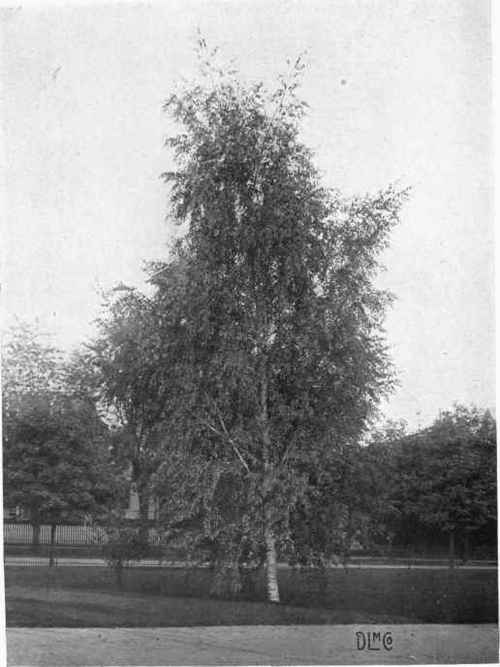
THE BARK OF THE WHITE BIRCH OFFERS A PLEASING CONTRAST.
Fig. 93. - The cut-leaved, pendulous White Birch (Betula alba laciniata pendula) is a good tree for lawn groupings. With its white bark and graceful habit it lends itself to many pleasing combinations. - See page 94.
Continue to:


My Books

