


Ornamental Planting Of Trees And Shrubs. Part 7
Description
This section is from the book "Practical Landscape Gardening", by Robert B. Cridland. Also available from Amazon: Practical Landscape Gardening.
Ornamental Planting Of Trees And Shrubs. Part 7
Evergreens In Border Plantings
If evergreens are used for a border planting set them in masses rather than as scattered specimens. Plant them in positions where it is desirable to have a Winter screen or where they will help plantings in front of them. If used as a background select only kinds that have green foliage. Plants, such as Judas, Golden Bell and Pyrus, together with shrubs having showy fruit, are very handsome against a background of evergreens (Fig. 99). The pyramidal type of evergreen, such as Arborvitae, Cypress and Juniper, are highly recommended for border planting, as they give an accentuated note to the scene and add to the picturesqueness more than any other type of plant.

BOUNDARY PLANTINGS - Fig. 94. - "Belt plantations are always appropriate where it is necessary to create the scene within the grounds or where privacy is desired." Such plantations should always be more or less sinuous. Even on the smallest properties, the irregular curved line is more pleasing than a straight one. The combination of Spiraea Anthony Waterer and Yucca in this illustration is particularly good. - See page 101.
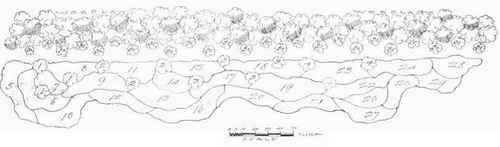
Planting Plan. Fig. 95.
Key To Planting Plan (Fig. 95). BOUNDARY OR CELT PLANTATION A belt planting along a woodland to make a break between the natural woodland and the lawn less abrupt. - See page 101.
Key No. | |||
Quan. | Variety | Common Name | |
1. | 3. | Tsuga canadensis | Hemlock |
2. | 3. | Pinus austriaca | Austrian Pine |
3. | 4. | Pinus Strobus | White Pine |
4. | 3. | Tsuga canadensis | Hemlock |
S. | 100. | Berberis Thunbergii | Japanese Barberry |
6. | 40. | Viburnum dentatum | Arrow Wood |
7. | IO | Euonymus alatus | Cork-barked Spindle Tree |
8. | 25. | Cercis canadensis | American Judas |
9. | 25. | Rhodotypos kerrioides | White Kerria |
IO | 25. | Ligustrum Regelianum | Regel's Privet |
11. | 15. | Cornus florida | White Dogwood |
12. | 15. | Symphoricarpos vulgaris | Coral Berry |
I5. | Symphoricarpos racemosus | Snowberry | |
13. | 35. | Hydrangea arborescens | Native Hydrangea |
14. | I5. | Lonicera tatarica | Bush Honeysuckle |
I5. | IO | Koelreuteria paniculata | Varnish Tree |
16. | 50. | Aronia melanocarpa | Black Choke Berry |
Key, No. | |||
Quan. | . Variety | Common Name | |
17. | IO | Lonicera fragrantissima | Early Honeysuckle |
18. | I5. | Crataegus cordata | Washington Thorn |
19. | 30. | Rubus odoratus | Flowering Bramble |
20. | 30. | Hydrangea arborescens grand, alba | |
Hills of Snow | |||
21. | 30. | Stephanandra flexuo3a | Stephanandra |
22. | IO | Cornus sericea | Silky Dogwood |
23. | IO | Viburnum lentago | Sheepberry |
24. | IO | Styrax japonica | Japanese Styrax |
25. | 15. | Vaccinium corymbosum | Cranberry |
26. | 20. | Rhodotypos kerrioides | White Kerria |
27. | 30. | Rhus copallina | Shining Sumach |
28. | 15. | Viburnum Opulus | High Bush Cranberry |
29. | 25. | Symphoricarpos vulgaris | Coral Berry |
30. | 13. | Cornus florida | White Dogwood |
31. | 12. | Cercis canadensis | Judas Tree |
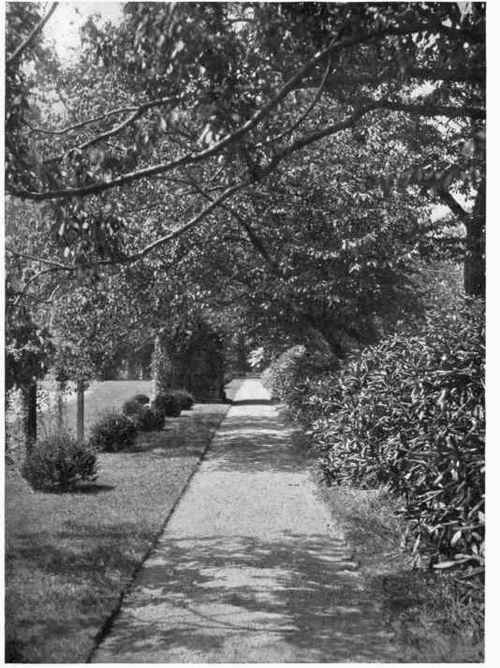
BORDER PLANTING ALONG A PROPERTY LINE.
Fig. 96. - Instance of an attractive boundary planting along a property line, affording privacy and adding picturesqueness to the scene. - See page 102.
Continue to:


My Books

