


Exercise XL. The Study Of Lime-Sulphur
Description
This section is from the book "Laboratory Manual Of Horticulture", by George W. Hood. Also available from Amazon: Laboratory Manual Of Horticulture.
Exercise XL. The Study Of Lime-Sulphur
Material. Stone lime, flowers of sulphur, commercial lime-sulphur.
Apparatus. One-gallon granite kettle, hydrometer, large glass cylinders, cooking burner.
It has been learned that lime-sulphur can be used as a fungicide and in some cases is superior to Bordeaux mixture for the spraying of certain plants and the controlling of certain diseases. The point of difference between lime-sulphur as a fungicide and as an insecticide is the degree of dilution, or the strength of the solution. The strength can best be determined by the use of a hydrometer (Fig. 37), which tests the density of the solution.
There are several formulas from which the lime-sulphur is made. A good commercial formula to follow is
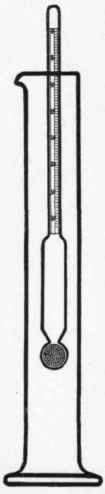
Fig. 37. Cylinder, showing hydrometer for testing the density of lime-sulphur solution.
Stone Lime........... | .....40 lb. |
Flowers of sulphur | .....80 lb. |
Water.............. | .....50 gal. |
Laboratory formula. Weigh out four ounces of stone lime and eight ounces of flowers of sulphur. Place the lime in the granite vessel and slake with water, adding the water gradually and being careful not to smother the lime with too much water. Stir until the lime is thoroughly slaked and forms a uniform paste. Now add enough water to make a half gallon, after which place over the fire and boil. Now mix the flowers of sulphur to a thin paste, and add gradually to the lime when boiling, and stir constantly. Allow the mixture to boil for about an hour, stirring at frequent intervals. Keep the water in the vessel at a constant level by adding hot water from time to time. This level can be determined by measuring the depth of the liquid with a stick that has previously been notched.
As soon as this solution is cool enough, allow it to settle, pour off the liquid into a cylinder, and test with the hydrometer. Note the reading, and tabulate. Now dilute a portion of the solution with water according to the following scale, until it is the proper strength for a summer spray, and dilute another portion until it is the proper strength for a dormant spray.
Degree, Baume | Specific Gravity | Dilution for Dormant Spray | Dilution for Summer Spray |
35 | 1.318 | 1 to 9 | 1 to 45 |
34 | 1.306 | 1 to 8 3/4 | 1 to 43 |
33 | 1.294 | 1 to 8 | 1 to 41 |
32 | 1.283 | 1 to 7 3/4 | 1 to 40 |
31 | 1.271 | 1 to 7 1/2 | 1 to 38 |
30 | 1.260 | 1 to 7 | 1 to 36 |
29 | 1.250 | 1 to 6 3/4 | 1 to 34 |
28 | 1.239 | 1 to 61/2 | 1 to 32 |
27 | 1.228 | 1 to 6 | 1 to 31 |
26 | 1.218 | 1 to 5 3/4 | 1 to 29 |
25 | 1.208 | 1 to 5 1/2 | 1 to 28 |
24 | 1.198 | 1 to 5 1/4 | 1 to 26 |
23 | 1.188 | 1 to 4 3/4 | 1 to 24 |
22 | 1.178 | 1 to 4 1/2 | 1 to 23 |
21 | 1.169 | 1 to 4 1/4 | 1 to 21 |
20 | 1.160 | 1 to 4 | 1 to 20 |
19 | 1.150 | 1 to 3 1/2 | 1 to 18 |
18 | 1.141 | 1 to 3 1/4 | 1 to 17 |
17 | 1.132 | 1 to 3 | 1 to 16 |
16 | 1.124 | 1 to 2 3/4 | 1 to 15 |
15 | 1.115 | 1 to 2 1/2 | 1 to 14 |
The above table is for diluting the concentrated lime-and-sul-phur solution for the dormant as well as for the summer sprays. The dilution for the summer sprays is usually from thirty-five to forty-five gallons of water when the Baume test is 32° or 33°. Now figure out from this table the degree of the dilution of your sample made in the laboratory.
Example 1. The concentrated lime-sulphur solution, test 35° Baume, by the table has a specific gravity of 1.318. If it is desired to spray trees with lime-sulphur at 20° Baume, which has a specific gravity of 1.160, calculate the number of dilutions required as follows: the decimal of concentration of the
Baume 35° is .318; this, divided by the decimal for Baume 20°, which is .160, will give 19.8, or the number of dilutions required, this result being obtained by adding 19.8 volumes of water to 1 volume of the concentrated lime and sulphur. This rule is based upon the general fact that the density of a solution heavier than water varies inversely with the number of dilutions.
When the density of the lime-sulphur solution or the homemade wash has been first determined by the use of a hydrometer, sprays of any desired density may be calculated by using the table. The rule for determining the number of dilutions is as follows: divide the decimal of the concentrate by the decimal of the spray desired; the quotient will be the number of dilutions.
Decimal of the concentrate/ Decimal of the spray desired
= the number of dilutions
.318/
.160
19.8
Example 2. Assuming that the decimal of the concentrate is known and that this concentrate is diluted by a certain number of volumes of water, what is the decimal of the spray? Taking the same example as in Ex. 1, we have the decimal of the concentrate, .318, and the number of dilutions, 19.8. Dividing .318 by 19.8 equals .160, which is the decimal of the spray and corresponds to 20° Baume. Now figure out the degree of dilution for each sample you make in the laboratory.
Decimal of the concentrate/ Number of dilutions
= decimal of the spray
.318
19.8 =
.160
Secure some concentrated lime-sulphur solution. How does this differ in color and looks from the home-made lime-sulphur solution? Test each of the solutions with the hydrometer. Note the reading in each case. What amount of water was necessary to bring both of the solutions to the same reading? How do you account for the difference, if any? Discuss fully.
References
Bulletin No. 288, Cornell Agricultural Experiment Station. Bulletin No. 289, Cornell Agricultural Experiment Station. Circular No. 10, Michigan Agricultural Experiment Station. Bulletin No. 830, New York Agricultural Experiment Station.
Continue to:


My Books

