


Exercise XXXIV. The Study Of Splice, Whip, And Double-Whip Grafting
Description
This section is from the book "Laboratory Manual Of Horticulture", by George W. Hood. Also available from Amazon: Laboratory Manual Of Horticulture.
Exercise XXXIV. The Study Of Splice, Whip, And Double-Whip Grafting
Material. One-year-old apple-seedling roots, scions from apple trees.
Apparatus. Sharp budding-knife, raffia or grafting-cord.
Grafting is the operation of inserting into a stock a scion or twig comprising one or more buds. It is classified in various ways, chiefly with reference to the method in which the scion and the stock are joined.
The union of the scion with the stock depends upon the growing together of the cambium tissue of the two plants. This tissue is the living active cells found between the bark and the wood. It is composed of cells which are actively dividing. The layer of cambium tissue is very narrow, being only four or five cells in thickness. It is very essential that careful and painstaking work be done and that the student be thoroughly familiar with the position the cambium layer occupies in both the stock and the scion.
The scions are cut in the late fall, in winter, or at any time before the buds swell in the spring. It is thought, however, that the later the scions are taken from the tree before the buds swell, the greater will be the success in grafting, other things being equal. Each scion should contain from three to five well-developed buds, and it should be cut about one-half inch above and below a bud. Only the previous year's growth is used in all ordinary cases, but an exception to this is found in the maples and several of the ornamentals in which the older wood may be used.
The scions should be stored in moss, sand, or sawdust and kept in a cool place until they are used to prevent drying out or swelling of the buds. This is very important for successful grafting. Only well-formed branch buds should be used.
Splice Grafting
Splice grafting represents the simplest form of grafting. In this form the scion and the stock should be as nearly the same size as it is possible to get. In splice grafting it is well to use one-year-old apple seedlings, and scions taken from apple trees. The two parts, namely, the stock and the scion (Fig. 26), are simply cut diagonally across and the two firmly tied together.
The cut should be one inch to one and one-half inches across. This form of grafting is frequently employed upon plants with soft or tender wood which will not admit of splitting.
Make a drawing, natural size, and three inches in length, of both the stock and the scion, showing the parts in position ready for tying. How long did you make the diagonal cut? Place the dimensions on your drawings. To what kind of stock is this method of grafting best adapted? Practice by making a number of these grafts. Care must be taken that the cambium layers are in apposition. Why is this important? Discuss.

Fig. 26. Splice grafting, showing the relative size of the stock and the scion.
Whip, Or Tongue Grafting
This form of grafting is employed only on small stocks, one or two years old. The stocks are usually seedling roots, and the grafting is usually performed in the winter. Both the scion and the stock (Fig. 27) are cut diagonally across, as in splice grafting, and the cut should be at least one to one and one-half inches across, according to the size of the stock. A vertical cleft is then made in both the stock and the scion, and the two are joined by shoving the tongue of the scion into the cleft of the stock. The two parts are held together by tying with raffia or grafting-cord. If the wound stands above the ground, it must be protected by applying grafting-wax over the bandage.
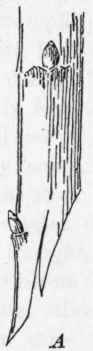

Fig. 27. Whip grafting.
A, scion, showing the diagonal cut and the split; B, scion inserted into the stock
1. Make a natural-size drawing of the root, showing the diagonal cut and the cleft. How long should this cut be? Place the dimensions on the drawing, and describe how the cut, which should be clean and even, is best made. Discuss.
2. Make a natural-size drawing of the scion, showing the cut and the cleft. The scion should contain three or four well-developed and plump buds. How long is the scion? Label all parts, and place the dimensions on your drawings.
3. Show by a natural-size drawing the stock and the scion tied in position. What size of stocks is best suited to this form of grafting? What commercial operation depends upon this method of propagation? What superiority, if any, does a tree produced by this method have over a tree produced by budding? When is the best time of the year to do root grafting, and why? Why is it essential to have at least one side of the stock and the scion flush with each other? Where do you find the cambium layer on the stock and the scion? Indicate on your drawing by an arrow the location of the cambium tissue.
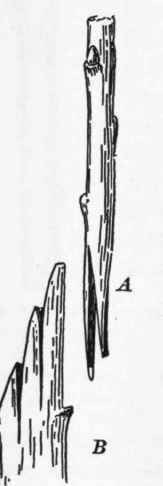
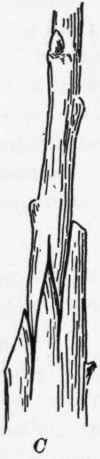
Fig. 28. Double-whip grafting.
A, scion; B, stock, showing the double split; C, scion inserted into the stock
Double-Whip Grafting
This is a modified form of whip grafting in which two clefts are made instead of one (Fig. 28). The scion, having two supports in the stock, forms a more intimate contact with it. This method is usually too slow for general practice, but is good in special cases, particularly with some plants that are a little hard to graft. Make a natural-size drawing of the stock and the scion. Make a drawing of the stock with scion in position. Describe.
References
Bailey, "The Nursery Book," chap. v.
Goff, "Principles of Plant Culture," pp. 219-230.
Continue to:


My Books

