


Chapter 9. On Beautiful Flower Beds
Description
This section is from the book "Beautiful Gardens - How To Make Them And Maintain Them", by Walter P. Wright. Also available from Amazon: Beautiful Gardens: How To Make And Maintain Them.
Chapter 9. On Beautiful Flower Beds
Although there has been a great development in garden borders during the past few years, there are very few gardens in which flower beds are not found. In some of these, unfortunately, very elementary principles are applied. The design is commonplace, and the effect is tawdry. A great many gardeners still look on a breadth of "Geraniums" as the highest form of bedding out. However, things are not so bad as they were, and as time passes we may reasonably expect to see more originality displayed.
For practical purposes a bed may be distinguished from a border by the fact that it occupies a position in the interior of the garden, whereas the latter is on the outskirts. The one is seen on all sides, the other usually presents only one frontage. It is scarcely necessary to point out the importance of the distinction. Where economy has to be considered we can fill up the back of a large border with cheap shrubs, but Aucubas are not admissible in flower beds.
In the chapter on the adornment of lawns it was suggested that we might associate turf and flowers in one of two ways - to have flower beds with grass walks between, or to have a lawn with beds on the outskirts. It is a mistake to attempt a blend of the two. Groups of beds might be formed on very large lawns, although even in such cases they are easily overdone, and the author is familiar with more than one noble establishment wherein what should be a fine extent of lawn is patchworked up with beds in a way that robs it of all dignity and repose. In the case of small places it is a disastrous error to cut severely into a lawn. The beds, it is true, look better for their foil of cool turf than they would do on gravel, but the lawn, as a lawn, is spoiled.
The garden lover who has made up his mind that he wants a real lawn, however small, should exercise restraint in respect to flower beds. He should teach himself that two or three good beds on the margin will look a great deal better than a number of poor ones peppered about all over it.
In considering the size and form of beds, due regard must be had to certain practical considerations. In the first place, beds on the outskirts of a circular lawn should be curvilinear, and not rectangular. In the second place, the plainer the outline the less work there will be in maintaining the edges. A "star" shaped bed may be pretty enough in its way, but clipping the edges in the various rays (and undipped edges soon give a very untidy appearance to a bed) will be a somewhat tedious business. In the third place, the outer edge of the bed should not be carried close to the walk or border, so as to leave a very narrow verge, which is bad to mow, and liable to crumble down. Two feet at least should be allowed. In the fourth place, the beds should not be large in proportion to the size of the lawn. They are not intended to dominate it.
What is known as "the bedding system" has come to have a certain specific meaning. It is associated in most people's minds with tender plants, such as "Geraniums," Heliotropes, and Lobelias, which have to be wintered under glass. There is no reason, however, why bedding out should not be practised (1) entirely with hardy plants, or (2) with plants treated as annuals and not preserved through the winter. As an example, we might have a bed beautiful in spring with Pyrethrums, and, as these plants lift safely when in full growth, they could be moved away when they went out of bloom, and their places occupied by Salpiglossises, Antirrhinums, or some other plant raised from seed in gentle heat early in the year. Or, as another example, a good strain of coloured Primroses and Polyanthuses might be planted, with a sprinkling of Tulips, in autumn, and lifted in June to make way for a mixture of Comet Asters and the beautiful Tobacco, Nicotiana Sanderae, which lasts far on into autumn, and is especially beautiful towards evening.
Every flower-lover should strive for two main things in his beds - grace and freshness. The first is best secured by a simple combination. The effect of mingling a great many different kinds of plants in one bed is frequently as unfortunate as mingling a great many different flowers in a bouquet. There is apt to be a jumble of inharmonious elements. The second is a question of reflection and observation. It is not difficult to find happy combinations, and there is sufficient variety of material to afford scope for many different plans.
As instances of success are often helpful, the author gives a few which he has himself enjoyed. In every example it will be seen that the materials are simple and inexpensive:
(a) A bed cleared of bulbs was planted with dwarf Bouquet Asters and Salpiglossises in mixture. The Asters, which grew about nine inches high, formed the groundwork. They were full of bloom, and remarkably pretty, but a little formal in themselves. The graceful, arching stems of the Salpiglossises, laden with their beautiful urns and drooping over the Asters, entirely relieved the stiffness. Both plants were raised from seed in spring and planted in June.
(b) A large bed of Wallflowers was cleared in early June, and planted with Nicotiana Sanderae, Comet Asters, and bush Sweet Peas. This formed a remarkably effective combination, yet it only cost a few pence, as all the plants were seedlings. Bush Sweet Peas may be introduced to fairly large beds with excellent effect. They are compact, but brilliant and long lasting. The looser growth of the Tobacco takes off any stiffness.
(c) A bed was planted in autumn with the single white Pyrethrum Dawn, mixed with the graceful rosy Heuchera sanguinea. Blooming early in a warm spot, the Heuchera was in flower with its neighbour.
(d) A harmony in blue and mauve was secured by planting the beautiful Iris pallida with the lilac Pyrethrum Roland and the blue Flax, Linum perenne.
(e) An extremely graceful combination was that of the white Bridal Wreath plant, Francoa ramosa, with the pretty double rose annual Clarkia elegans flore pleno. Had the Clarkia been spoiled by overcrowding it would have been over long before the Bridal Wreath was at its best, but being severely thinned it lasted far into the summer.
The idea of spring as well as summer beauty should always be in the mind of the planter, and he must never be afraid of two plantings. With one alone it is practically impossible to avoid bare beds for a considerable part of the year. Bulbs are, of course, very useful in the spring, but it is a mistake to rely on them alone, as is generally done in the public parks, because the soil is bare from autumn to spring. Here comes in the value of useful things like Arabises, double and single, Aubrietias, and Forget-me-Nots as carpeters. They are all easily raised in thousands out of doors from twopenny packets of seed in late spring, and are ready for planting in autumn. Tulips associate well with all of them. Primroses and Polyanthuses are also carpeters, and lovely beyond praise when in full bloom, They are not available for many town gardeners, as they do not thrive in an impure atmosphere. Wallflowers carry their foliage through the winter, but they are not suitable for associating with bulbs, as they grow very strongly in spring. They must stand on their own bottom, which they are quite good enough to do.
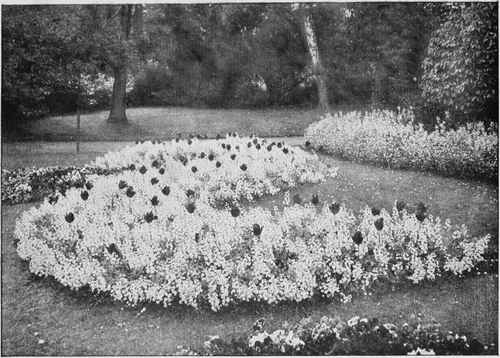
Fig. A bed of double white arabis and tulips.
A bed of Canterbury Bells makes a nice, green, winter covering, and bulbs may be dotted among the plants, to bloom before the latter get into active growth. The fact that Canterbury Bells are slow growers in their early stages might be more taken advantage of than it is for interpolating other things.
Bold, distinctive flowers of pronounced individual merit like May flowering Tulips, Carna tions, and tuberous Begonias may well have a bed to themselves. The author has heard old-fashioned bedders object to a bed of these Tulips because, being late bloomers, they "get in the way of the bedding plants." This is a flagrant case of trying to merge the greater into the less. The Tulips can be lifted towards the end of June, laid in somewhere to ripen, and their places filled with Sander's Tobacco, Comet Asters, and other things vastly more graceful and beautiful than a noisy flaunt of "Geraniums." The author has had a very pretty effect before now by planting Heddewig's Indian Pink, Dianthus Heddewigii, raised from seed sown in February, in a bed in June, and dotting a few Salpiglossises among the plants to break the uniformity. A basket bed of Ivy-leaved Geraniums looks well on a large lawn.
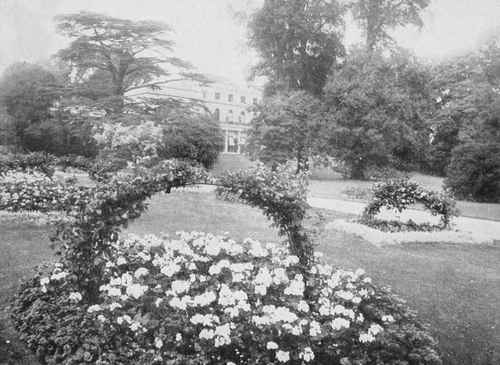
Fig. The basket garden at Messrs. de Rothschild's Gunnersbury Park.
It would probably do away with a great deal of hesitation if flower-lovers realised how well all bulbs lift before or after blooming. Daffodils are perhaps the most complaisant of all. It might really be imagined, from the desolating array of empty flower beds one sees in many gardens up to June, that there were no such things as cheap, easily grown, easily shifted, spring-flowering hardy plants. If nothing more interesting could be provided to keep beds alive, the hardy annuals, of which penny or twopenny packets are always available, could be drawn upon. Pretty little things like the pink Soap-wort (Saponaria), Silene pendula compacta, Limnanthes Douglasii, and Nemophila insignis, flower charmingly in spring if sown early the previous September.
The value of Violas, Thrift, and Pinks as edgings must not be overlooked. The selection of Violas is now considerable, and the flowers are almost good enough to stand on their own merits as bedders. This they might easily do if it were not for the flatness, as the flowers are extremely beautiful, and produced in great profusion over a long period. They may be used for carpeting - Liliums, for example - and also for edgings in broad bands.
The well-known white Pinks, Mrs. Sinkins and Her Majesty, are both capital edging plants.
Bold autumn effects can be secured with Michaelmas Daisies and early Chrysanthemums, and both these splendid plants may be drawn upon for large beds.
Something will be found about stumps and forks in the chapter on Roses. These may be introduced into large flower beds with splendid effect. They are often beautiful objects in themselves, as well as valuable for breaking stiff outlines.
Remember that a bold, solitary clump of Pampas Grass, or Red Hot Poker (Kniphofia), is often very effective among flower beds.
Continue to:


My Books

