


Chapter 10. On Some Beautiful Bulbous Flowers
Description
This section is from the book "Beautiful Gardens - How To Make Them And Maintain Them", by Walter P. Wright. Also available from Amazon: Beautiful Gardens: How To Make And Maintain Them.
Chapter 10. On Some Beautiful Bulbous Flowers
A class of plants which includes Daffodils, Lilies, Tulips, and many Irises will be accepted at once as of the first importance in the flower garden. Were it limited to these alone we should look, upon it as thoroughly worthy of study, but so far is this from being the case, that we have amongst the bulbs a long array of beautiful and valuable plants.
Volumes might be - volumes have been - written about various bulbs. Specialists have dealt individually with Daffodils, Irises, and Lilies. Even the Crocus - which, if not a bulb botanically considered, is so from a garden point of view - has its monograph. This is evidence enough of the interest taken in bulbs by flower-lovers, and if more were wanted it is supplied in an equally convincing, if less literary, form in the rapidly multiplying lists of trade dealers.
Bulbs are being more and more used beyond the confines of the flower garden proper. They are being naturalised in the semi-wild garden outskirts, in meadows, and in woodlands. There is nothing much more delightful than a nodding colony of Poet's Narcissus in the tangled grass of a shady bank beyond the dressed grounds, or of Grape Hyacinths on a groundwork of Ivy in a dell.
The stiff beds of Hyacinths in the large beds of the city parks give only the most meagre idea of the uses to which bulbous flowers can be put in spring. Municipal gardeners do praiseworthy work with the means at their command, and in the circumstances which surround them, but country flower-lovers need not copy them. As a matter of fact, a bed of Hyacinths is a very unsatisfactory object, about on the same plane as the bed of "Geraniums" which obtrudes its aggressive presence so frequently in summer. The cheaper bulbs may - indeed, should - be utilised for spring bedding, but they look much better grouped with a good carpeter than as mere masses of unrelieved colour.
Circular and oval lawn beds look very well in spring planted with groups of Tulips carpeted with white Arabis or Forget-me-Not. The early Dutch varieties appeal to people of moderate means on account of their cheapness and cheerful colours, but the tall May bloomers are bolder, finer, and more lasting. Clumps, with or without carpets, will also enliven the mixed borders at a period when the herbaceous plants are only just starting growth.
Narcissi should be used in beds and borders, as well as in the grass. Such fine, free things as Horsefieldi, Sir Watkin, Barri conspicuus, Henry Irving (early), Duchess of Westminster, Empress, Emperor, and Stella Superba, are worthy of being planted freely. (See special chapter.)
Calochorti are lovely summer flowering bulbs for warm, sunny borders. Little colonies of them are delightful. The colouring of the flowers is very delicate and pleasing.
Chionodoxas (Glory of the Snow) are dwarf plants in the way of the Scillas (Squills), mostly blue of different shades, and amongst the earliest of flowers. Luciliae, grandiflora and Sardensis are three charming sorts. Colchicums (Meadow Saffrons) are worthy of attention. The autumn bloomer (autumnale) is useful and cheap.
The early Dutch Crocuses, such as Mont Blanc, Sir Walter Scott, and Golden Yellow are pretty and very cheap. There are, too, a number of rarer species, both autumn and spring blooming, such as biflorus, chrysanthus, Imperati, vernus, sativus, speciosus, and Sieberi, which are really exquisite little flowers.
The hardy Cyclamens may be included, like the Crocuses, amongst bulbous plants by courtesy. They look very dainty when grown in a little colony on a raised border, or on the rockery.
The Erythroniums (Dog's-tooth Violets) have marbled foliage and distinct flowers.
Another quaint plant is the Fritillaria, or Snake's Head Lily, with drooping, tessellated flowers. The best known one (excluding the noble F. Imperialis, or Crown Imperial - a really splendid plant for border clumps) is F. Meleagris. F. armena and F. recur va are both equally worth growing.
Gladioli are worth specialising, and many people will grow them under names in beds, as they do Carnations and Roses; but it must not be forgotten that they are capable, when grown in clumps, of greatly enhancing the beauty of a herbaceous border in summer and early autumn. For this purpose the cheaper species may be chosen, such as Brenchleyensis, Colvillei, floribundus, and psittacinus. Most of these flower much earlier than the beautiful Gandavensis hybrids. (See special chapter.)
The true bulbous Irises, as distinguished from the Flags and Cushions, include some of the most exquisite of hardy flowers. Not only are the popular English and Spanish Irises included in the bulbous section, but such delightful little flowers as alata, Bakeriana, Histrio, Persica, and its variety Heldreichii, and reticulata and its several varieties, belong to it. (See special chapter.)
Leucojums (Snowflakes) are early bloomers, as chaste as, but larger than, the Snowdrops.
The Liliums give us some of the most glorious of garden flowers. L. auratum, and its superb varieties platyphyllum, rubro-vittatum and Wittei, are magnificent in the deep peat and loam of Rhododendron beds and elsewhere. L. giganteum lifts its stems with their crown of lovely white flowers ten and twelve feet high. Brownii and Humboldtii are also grand sorts. Such popular Lilies as candidum (the Madonna Lily), Chalcedonicum, croceum, longiflorum (which is charming when mixed with Tuberoses), Mart agon (Turk's Cap), speciosum (lancifolium), tigrinum (Tiger Lily), and umbellatum are as easily grown as any border plant. Canadense and pardalinum (Panther Lily) enjoy a peaty compost. (See special chapter.)
The Muscaris (Grape and Feather Hyacinths) are pretty flowers. Botryoides, comosum, monstrosum, and conicum Heavenly Blue are very popular; the Musk Hyacinth, moschatum, also enjoys favour.
Ranunculuses, included by courtesy, are old florists' flowers; they are a little too correct for many flower-lovers, but the colours are brilliant.
Scillas and Snowdrops give us two of our prettiest early bulbs. The common blue Squill, Scilla Sibirica, is a very cheerful little flower; and so is bifolia, in its many charming varieties. S. festalis or nutans is frequently naturalised. The ordinary single Snowdrops make charming colonies in grass, and the better sorts, such as
Galanthus Elwesi, G. plicatus, and G. uivalis Imperati, are worthy of special places.
Tigridias (Tiger Flowers) are extremely showy plants, though the individual flowers are fleeting.
Trillium grandiflorum is a beautiful white flower, delicious in a colony in a shady spot. And Watsonias also are beautiful in sheltered spots.
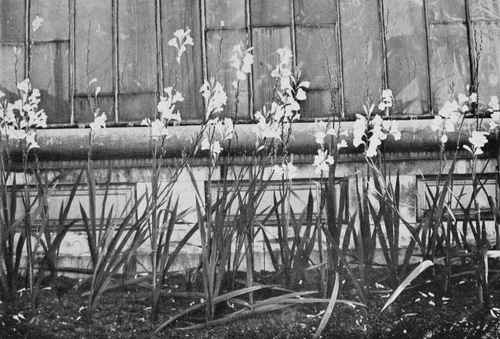
Fig. Watsonias in a sheltered outside border at Kew.
This is but a glance at a few of the better known bulbous flowers, but it may suffice to show the flower-lover how much he would miss if he did not give some study to the bulbs. When his attention is fairly turned to them it is quite likely to extend to the less familiar members of this great class, such as Alliums, Anomatheca, Babianas, Bravoas, Brodiaeas, Ixiolirions, and Puschkinias, amongst which will be found many uncommon and yet beautiful flowers.
He may even try his luck with such magnificent plants as the Belladonna Lily, Crinums, and Nerines, which are not hardy, but may sometimes be grown successfully out of doors in warm and sheltered spots.
Most bulbous flowers thrive best in sandy, gritty loam, and as a class do not care for clay. But happily for clay-holders, two great bulbs - Daffodils and Tulips (see special chapters) - thrive on strong land if it is thoroughly worked. The author finds that the magnificent May-flowering Tulips never give more robust stems, larger flowers, or richer colours than on clay; and what is more, their lasting powers are greater than on sand. The truth is that they love moisture, as Hyacinths and Daffodils also do, and very few growers give them half enough of it.
Continue to:


My Books

